



“My favourite book” is one of the most common essay topics in school, appearing in tests, homework and exams from Class 5 to Class 10. It looks easy — you only have to write about a book you like. Yet many students struggle with it. They repeat the same few sentences, retell the whole story instead of giving their own opinion, or copy a paragraph from the internet and end up with an essay that sounds like everyone else’s. This guide explains how to write my favourite book essay in your own words: a clear structure, useful vocabulary, and three simple ways to make the essay yours.
What a My Favourite Book Essay Really Asks For
The title is not “retell your favourite book”. Your teacher already knows the story. What they want is your thinking: which book you chose, why it matters to you, and what you noticed that someone else might have missed.
A good my favourite book essay does three things. It names the book and its author clearly. It gives a short taste of the story — just enough for the reader to understand why the book is interesting. Most importantly, it explains your own response: what you liked, what surprised you, what you learned, and how the book changed the way you think. That third part earns the marks, and it is what makes your essay different from every other student’s.
My Favourite Book Essay Outline: A Simple Structure That Works
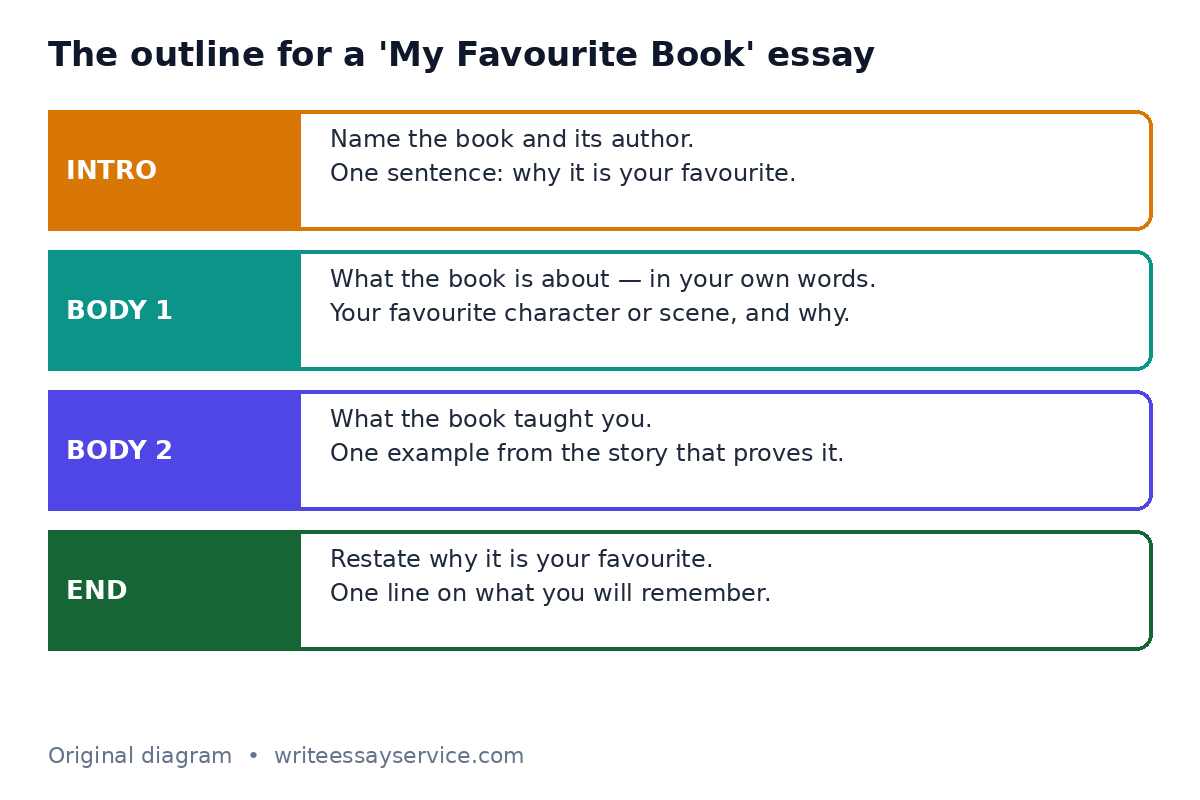
Every strong school essay follows a simple shape: a beginning, a middle and an end. Here is a my favourite book essay outline you can use for almost any book and any class level.
- Introduction. Name the book and its author, say what kind of book it is, and finish with one honest sentence about why you like it. That sentence is your main idea.
- A short summary. Give only the main character, the setting, and the central problem. Two or three sentences are enough.
- Why it is your favourite. The longest part. Give two or three reasons, each in its own paragraph, with a small example from the book.
- What you learned. A short paragraph about what the book taught you or how it changed your thinking.
- Conclusion. Two or three sentences summing up your opinion — who you would recommend it to, or what you will remember. No new ideas here.
For longer pieces, plan before you write. Our guide to how to plan a 500-word essay shows a ten-minute method, and the five-paragraph essay structure explains the same shape in five paragraphs.
Vocabulary Bank: Words and Phrases for Your Essay
Good vocabulary means choosing words that say exactly what you mean. Pick a few phrases that fit your ideas.
Introducing the book: “My favourite book is… written by…”; “It is a (novel / storybook / biography / adventure story) about…”; “The story is set in…”; “The main character is…”
Describing what happens: “The story begins when…”; “The main character faces a difficult choice…”; “The most exciting part is when…”; “The story builds up to…”
Giving your opinion: “What I like most about this book is…”; “In my opinion, the best part is…”; “I found the character of… inspiring because…”; “This book stands out because…”
Explaining what you learned: “This book taught me that…”; “After reading it, I realised…”; “The lesson I took from this story is…”; “It changed the way I think about…”
Useful describing words: inspiring, memorable, thoughtful, humorous, exciting, moving, honest, brave, curious, determined, kind, clever, imaginative.
Avoid vague praise such as “very good” or “very nice”. Instead of “It is a very good book”, try “It is an inspiring book because it shows how an ordinary person can do something brave.”
How to Adapt the Essay for Your Class Level
The same topic is set for different ages, but the expectations change. Here is how to shape your essay at each level.
Class 5–6: Short and Simple
A my favourite book essay for class 5 is usually 100 to 150 words in three short paragraphs, and a my favourite book essay for class 6 follows the same pattern. Keep sentences short: one paragraph to introduce the book, one to say what happens and why you like it, and one for your final thought. Choose one clear reason and explain it well. Simple, correct English with your own honest opinion scores far better than copied sentences you do not understand.
Class 7–8: More Detail and More Reasons
In Class 7 and 8, your essay is usually 200 to 300 words and your teacher expects more detail. Give two reasons, each in its own paragraph, supported by a small example from the story. Describe one character in more detail — what they are like and why you admire them. Use connecting words such as “however”, “for example” and “as a result”, and write about what the book taught you, not only what happened in it.
Class 9–10: Longer, More Thoughtful, More Personal
In Class 9 and 10, the essay is often 300 to 500 words, and marking rewards original thinking. Discuss the theme — courage, friendship, honesty or growing up — and explain how the author develops it through the story. Compare two characters, or explain how one scene changed your view of something. Your conclusion should feel like a judgement you reached yourself. At this level, your own voice matters more than perfect vocabulary.
Three Ways to Make the Essay Your Own
These three habits separate an essay that sounds copied from one that sounds like you.
1. Use Your Own Example
Do not just say “the book is interesting”. Choose one moment that stayed in your mind — a funny scene, a brave decision, a sad moment — describe it in your own words, and explain why it mattered to you. Nobody else will choose the same moment, so your writing naturally becomes more detailed and honest.
2. Give Your Own Reason
“I like this book because it is interesting” tells the reader nothing. Ask a better question: why this book, and not another? Perhaps it reminded you of something in your own life, or a character reminded you of a family member. A reason that connects the book to your own life is always stronger than a general one, and it cannot be copied because it comes from your experience.
3. Write Your Own Ending
Most copied essays end the same way: “I like this book very much and I will read it again.” Write a different ending. Say who you would recommend the book to and why — a younger sibling, a friend who likes adventure stories, or someone who needs encouragement. An ending that looks forward, or passes the book on to someone else, feels thoughtful and finished.
Common Mistakes to Avoid
- Retelling the whole story. A long summary with no opinion is the most common mistake. Keep the summary short and spend most of your words on your own reasons.
- Copying from the internet. A copied paragraph may look impressive, but it is not your work, and teachers can usually tell. Your own simple sentences are worth more than someone else’s polished ones.
- Writing only general praise. “It is a very nice book” says nothing. Always follow an opinion with a reason and an example.
- Forgetting the author and the details. Always name the author, and check the spelling of names and titles before you hand your work in.
- Skipping the final check. Read your essay aloud when you finish. If a sentence sounds strange, rewrite it in simpler words.
Frequently Asked Questions
How long should a my favourite book essay be?
A my favourite book essay for class 5 is usually 100 to 150 words, Class 7–8 essays are around 200 to 300 words, and Class 9–10 essays are often 300 to 500 words. Check your teacher’s word limit first, then plan your paragraphs to fit it.
How do I write a my favourite book essay in my own words?
Choose a book you genuinely like, then note three things: what happens in it, why you like it, and what you learned from it. Write those points in simple sentences of your own, without looking at anyone else’s essay.
What is the best outline for a my favourite book essay?
A simple outline works best: introduction, short summary, two or three reasons with examples, what you learned, and a conclusion. It works for Class 5 through to Class 10 — you only change the length and detail.
Can I write a my favourite book essay in 150 words?
Yes. A my favourite book essay 150 words long is a common task in Class 5 and 6. Use three short paragraphs: introduce the book and its author, give a sentence or two of story and your main reason for liking it, then finish with what you learned.
Which book should I choose for this essay?
Choose a book you have actually read and enjoyed, even if it is a simple storybook. It is much easier to write honestly about a book you remember well than about a famous one you never finished. If you can describe one scene from memory, you have chosen well.
What should I avoid in a my favourite book essay?
Avoid copying text from the internet, retelling the whole story, and writing only vague praise such as “it is very nice”. Your own words, your own example and your own reason are what make the essay strong.
Writing a my favourite book essay is an exercise in honest thinking: choosing a book you care about and explaining why it matters in your own words. Use the outline, borrow a few phrases from the vocabulary bank, adapt the length to your class, and make the essay yours with your own example, your own reason and your own ending. The result will sound like you — and that is exactly what your teacher is looking for.