



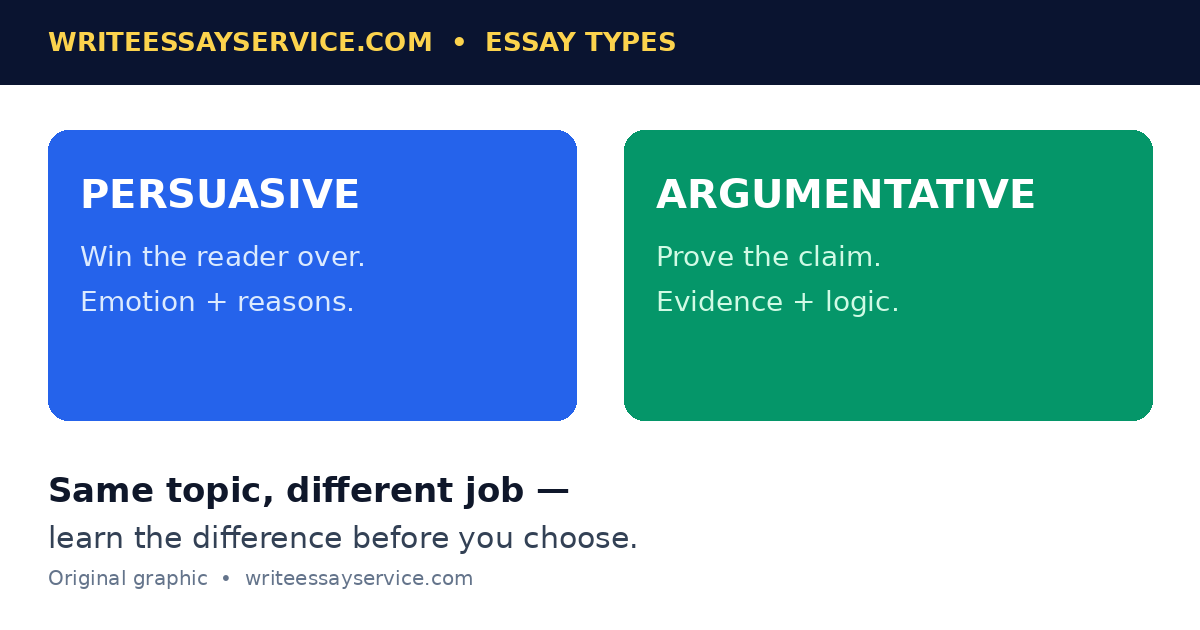
If your teacher has asked for an argumentative essay and you have written something that reads like a passionate speech, you may have discovered — too late — that the two forms are not interchangeable. The persuasive vs argumentative essay difference is one of the most common points of confusion in academic writing. A persuasive essay wants to move its reader; an argumentative essay wants to convince them with a reasoned case. Both use evidence, both take a position, and both follow a recognisable essay structure — but they differ in purpose, audience, tone, and the kind of proof they rely on. This guide explains the distinction in plain terms, compares the two forms side by side, and then gives you two original topic lists — one for each form — with a suggested angle for every topic.
What Is a Persuasive Essay?
A persuasive essay is written to convince the reader to agree with a viewpoint, adopt a belief, or take a particular action. Its central tool is persuasion, and that means it draws on more than logic alone. A persuasive writer appeals to the reader's values, emotions, and sense of identity as well as to facts. The language tends to be direct and engaging: rhetorical questions, vivid examples, and carefully chosen words that carry emotional weight are all common. The writer is not pretending to be neutral. Instead, they are openly advocating for a position and inviting the reader to join them.
Persuasive writing appears in speeches, advertisements, and opinion columns, which is one reason students often find it the more natural form. The goal is not simply to show that a claim is reasonable; it is to make the reader care enough to change their mind or act. That is why persuasive essays often end with a call to action, whether that is a change of habit, a vote, or a new way of seeing an issue.
What Is an Argumentative Essay?
An argumentative essay is written to prove that a claim is valid by building a logical case and defending it against objections. Its central tool is reasoning, supported by evidence. The writer takes a clear position, presents reasons and supporting material — such as research findings, statistics, expert opinion, and documented examples — and then addresses counterarguments honestly before refuting them. The tone is measured and academic, even when the subject is controversial.
An argumentative essay does not ask the reader to feel a certain way; it asks them to accept that the conclusion follows from the evidence. That is why it is the default form in many university assignments: it demonstrates critical thinking, research skills, and the ability to weigh competing claims.
Persuasive vs Argumentative Essay: A Side-by-Side Comparison
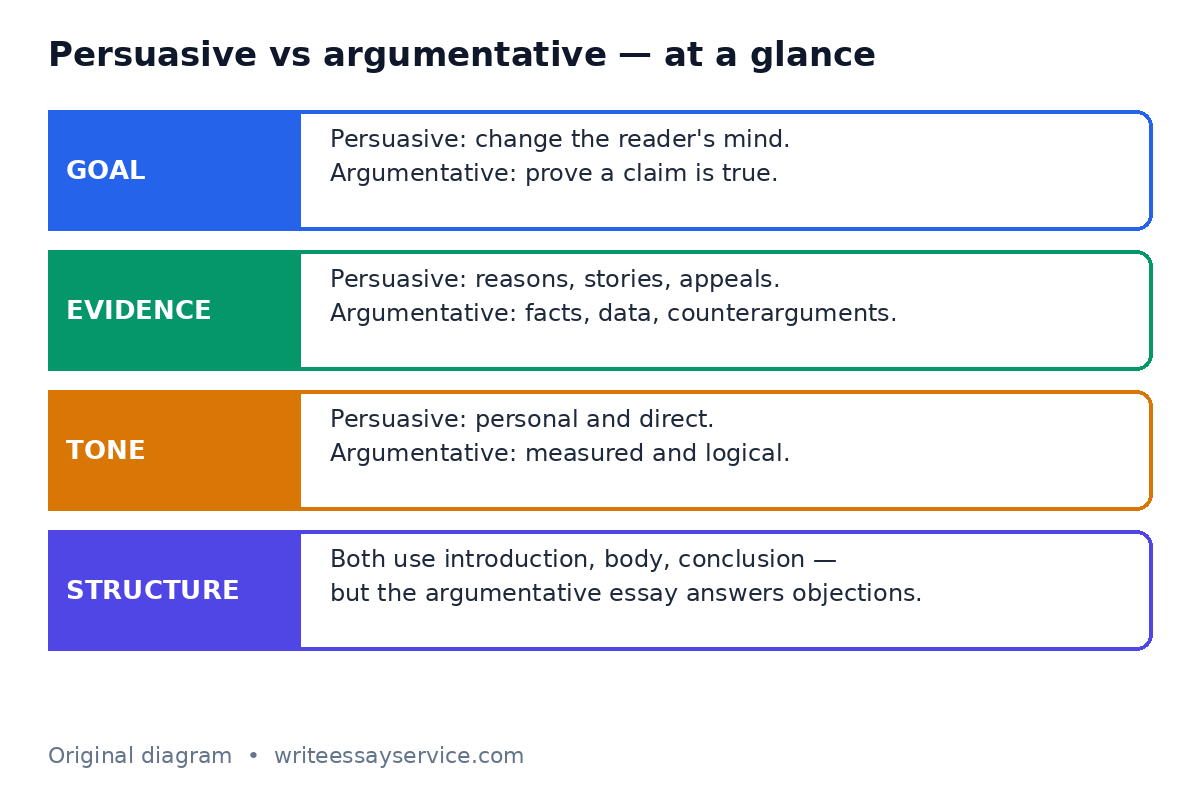
The table below summarises the main differences between the two forms. Keep it in mind when you are deciding which approach an assignment requires.
| Feature | Persuasive essay | Argumentative essay |
|---|---|---|
| Primary purpose | Convince the reader to agree or act | Prove a claim is valid through reasoned argument |
| Audience | A general or specific reader whose mind you want to change | An academic reader who expects a logical, evidence-based case |
| Main appeal | Emotion, values, and logic combined | Logic and evidence, with emotion kept in the background |
| Use of evidence | Examples, anecdotes, and facts chosen for impact | Research, data, and expert sources, cited and weighed |
| Counterarguments | May be mentioned briefly or set aside | Must be acknowledged and refuted fairly |
| Tone | Passionate, direct, and engaging | Measured, objective, and academic |
| Typical structure | Introduction, emotional hook, supporting points, call to action | Introduction, thesis, body paragraphs with evidence, rebuttal, conclusion |
| Success looks like | The reader feels moved to agree or act | The reader accepts the claim as well supported |
The Key Differences in Depth
Purpose: Changing Minds vs Proving a Point
The purpose of a persuasive essay is to change the reader's attitude or behaviour — does the reader now support the idea, or intend to do something about it? The purpose of an argumentative essay is narrower and more formal: to demonstrate that a thesis is true, or at least the best-supported conclusion available. Success is measured by the strength of the reasoning, not by whether the reader feels inspired.
Evidence: Stories and Examples vs Data and Sources
Both forms use evidence, but they use different kinds. A persuasive essay might open with a personal story or a striking example because a vivid case can move a reader quickly. An argumentative essay still benefits from examples, but its backbone is verifiable evidence: studies, statistics, historical records, and expert opinion. Sources should be credible and acknowledged even when they complicate the writer's case.
Audience: Who You Are Writing For
Persuasive writing usually addresses readers who can be swayed — members of the public, voters, or a community group — and speaks to what they care about. Argumentative writing addresses readers who will test the argument: a tutor, an examiner, or an academic audience, who care less about how the writer feels and more about whether each step of the reasoning holds up.
Tone and Language
Persuasive essays use vivid, emotive language, rhetorical questions, and direct address ("Imagine if…", "We cannot afford to ignore…"). Argumentative essays use cautious, precise language, with qualifying words such as "suggests", "indicates", and "on balance", because the writer is weighing evidence rather than rallying support.
Structure: Where Each Form Puts Its Weight
Both forms follow a clear essay structure, and the five-paragraph essay structure is a useful starting point for either. In a persuasive essay, the introduction often opens with a hook designed to create an emotional connection, and the conclusion typically includes a call to action. In an argumentative essay, the introduction presents the issue and a precise thesis, the body paragraphs each develop one reason with evidence, one section answers the strongest counterargument, and the conclusion restates the thesis in light of the evidence.
12 Argumentative Essay Topics (With an Angle for Each)
These argumentative essay topics are designed for a reasoned, evidence-based approach. Each one comes with a suggested angle — a particular claim you could defend — so the topic is a starting point for an argument rather than a finished thesis.
- Should universities replace traditional exams with continuous assessment? — Argue from evidence about stress, learning retention, and fairness to different kinds of learners.
- Is a four-day working week good for the economy? — Weigh productivity studies and trial results against the costs for employers and public services.
- Should social media platforms be legally responsible for misinformation on their sites? — Consider free speech principles alongside the documented harms of false information.
- Does homework improve learning, or does it widen the gap between pupils? — Use research on outcomes, time use, and unequal home support.
- Should cities ban cars from their centres? — Balance air quality and public space gains against access for disabled residents and small businesses.
- Is artificial intelligence in schools a help or a hindrance to learning? — Examine evidence on cheating, personalised learning, and critical thinking skills.
- Should voting be compulsory in national elections? — Compare turnout and legitimacy in countries with and without compulsory voting.
- Do video games improve problem-solving skills? — Draw on cognitive research while addressing concerns about screen time and addiction.
- Should the school leaving age be raised to eighteen everywhere? — Argue from employment data, educational outcomes, and young people's autonomy.
- Is remote working better for the environment than office working? — Compare commuting emissions with home energy use and the effects on city centres.
- Should governments fund the arts at the same level as science? — Weigh cultural, educational, and economic returns against competing budget priorities.
- Does tourism do more harm than good to historic cities? — Use case studies of overcrowded destinations to assess economic benefits against damage to heritage and housing.
If you want a much longer set of ideas in this form, our list of 120 argumentative essay topics for 2026 covers a wide range of subjects, from education and technology to health and the environment.
12 Persuasive Essay Topics (With an Angle for Each)
These persuasive essay topics are designed for writing that moves the reader. Each suggested angle points to the values or emotions the topic can appeal to, which is where persuasive writing does its work.
- Every school should have a garden where pupils grow their own food. — Appeal to health, connection with nature, and pride in something pupils built themselves.
- Local shops deserve our support before online giants. — Appeal to community identity, personal service, and the character of a high street.
- Reading for pleasure should be protected in the school timetable. — Appeal to the joy of stories and the quiet confidence reading gives young people.
- We should all learn basic first aid. — Appeal to the reader's sense of responsibility for the people around them.
- Public libraries are worth funding, even in a digital age. — Appeal to equal access, free learning, and libraries as a refuge for everyone.
- Say no to fast fashion: choose clothes that last. — Appeal to fairness for garment workers and respect for the planet.
- Every town needs more safe cycling routes. — Appeal to freedom, health, and the pleasure of getting around under your own power.
- Volunteering should be part of every young person's education. — Appeal to empathy, belonging, and the satisfaction of helping others.
- Plastic packaging should carry a warning, like cigarettes do. — Appeal to the shock of seeing the true cost of something ordinary.
- Older people have knowledge our communities cannot afford to lose. — Appeal to respect, memory, and the value of listening across generations.
- School start times should be later for teenagers. — Appeal to fairness: young people are asked to learn while their bodies are still half asleep.
- We should repair things instead of replacing them. — Appeal to pride in craftsmanship and a refusal to treat good objects as disposable.
How to Choose Between the Two Forms for Your Assignment
Choosing the right form starts with the assignment itself, not with your preference. Read the question carefully and look for the verbs it uses. Words such as "argue", "evaluate", "assess", "to what extent", and "discuss" usually signal an argumentative essay: the marker wants a reasoned case with evidence and counterarguments. Words such as "convince", "persuade", "make the case for", and "write a speech" point towards a persuasive essay, where moving the reader matters as much as the logic.
Next, consider the audience and the marking criteria. If the work will be marked on the quality of research, use of sources, and handling of counterarguments, an argumentative approach is almost certainly expected. If it will be marked on the power of the language, the strength of the appeal, and whether the reader is moved, persuasive writing fits better. When in doubt, ask your teacher which form they expect — a short question at the start saves a rewrite at the end.
It also helps to think about the topic. Subjects with clear research evidence and genuine disagreement lend themselves to argumentative writing, while subjects where values and feelings are central often work better as persuasive writing. Either way, a single essay should commit to one form and follow its conventions consistently.
Common Mistakes to Avoid
- Writing a persuasive essay when an argumentative one was asked for. Relying on emotion and ignoring counterarguments will cost marks, however passionately the essay is written.
- Writing an argumentative essay that never takes a position. Presenting both sides without a clear thesis is a discussion, not an argument.
- Ignoring the counterargument. In argumentative vs persuasive writing alike, the strongest essays anticipate objections. In an argumentative essay, an unanswered counterargument is a serious weakness.
- Using weak or uncited evidence. Claims such as "studies show" without a source, or statistics without context, undermine an argumentative essay and weaken a persuasive one.
- Letting emotion replace reasoning in an argumentative essay. Vivid language has its place, but it cannot substitute for evidence.
- Overstating the case. Absolute claims ("everyone agrees", "there is no doubt") invite the reader to find the exception that breaks them. Qualified, precise language is more convincing in both forms.
- Forgetting the audience. An essay aimed at teenagers and an essay aimed at policymakers need different examples, vocabulary, and appeals, even on the same topic.
Frequently Asked Questions
What is the persuasive vs argumentative essay difference?
The difference between persuasive and argumentative essay writing is the goal. A persuasive essay aims to convince the reader to agree with a viewpoint or take action, using emotion, values, and logic. An argumentative essay aims to prove that a claim is valid through reasoned argument and evidence, and it must address counterarguments fairly.
Can a persuasive essay use evidence?
Yes. Good persuasive writing uses facts, examples, and statistics — but it chooses them for impact and pairs them with emotional and value-based appeals. The difference from argumentative writing is emphasis: evidence supports the persuasion rather than carrying the whole case on its own.
Does an argumentative essay have to address counterarguments?
Yes, and this is one of the clearest markers of the form. A strong argumentative essay identifies the strongest objection to its thesis, considers it honestly, and explains why the thesis still stands. Skipping this step leaves the argument open to an obvious challenge.
Which is easier to write, a persuasive or an argumentative essay?
Most students find persuasive essays easier to start, because they can draw on personal feeling and vivid language. Argumentative essays usually take more research and planning. Match the form to the task rather than to your comfort.
Can the same topic work as both a persuasive and an argumentative essay?
Yes. A topic such as school start times can be argued with research on adolescent sleep and academic performance, or it can be presented as a persuasive appeal to fairness and wellbeing. The topic stays the same; the purpose, evidence, tone, and structure change. The topic lists above show how the two forms treat similar subjects differently.
How do I choose between persuasive and argumentative writing for my assignment?
Look at the wording of the question, the audience, and the marking criteria. If the question asks you to evaluate evidence and weigh competing claims, choose the argumentative form. If it asks you to convince a reader or inspire action, choose the persuasive form. If you are still unsure, ask your teacher before you begin writing.