



The 5 paragraph essay structure is the first essay structure most students learn. It is simple: an introduction, three body paragraphs and a conclusion. Five paragraphs, five jobs. Once you understand what each paragraph must do, you can use the same shape for almost any school essay.
This guide does not hand you a finished essay to copy. A ready-made essay teaches you nothing. Instead, it takes the structure apart, paragraph by paragraph, and shows you the job each one has to do, with a worked essay outline and one short model paragraph to learn from.
If you are new to planning, start with our guide to how to write an outline for an essay. And if you are working to a tight deadline, our guide on how to plan a 500-word essay in 10 minutes shows how a short plan saves time.
What the 5-Paragraph Essay Structure Is — and Why Teachers Use It
The 5 paragraph essay structure organises an argument into five paragraphs: one introduction, three body paragraphs and one conclusion. Each body paragraph makes one point, supports it with evidence, and connects it back to the main argument.
Teachers use this essay structure for students because it makes thinking visible. In only five paragraphs, a teacher can see whether you have a clear thesis, whether each paragraph has one idea, and whether your conclusion follows.
Longer essays are built from the same parts, so learning this version well means longer essays only need more body paragraphs, not a new skill.
A five paragraph essay example is often shown as a complete essay, and that can be misleading. The interesting part is the thinking underneath it: the choice of a thesis, and keeping each paragraph to a single idea.
The Structure at a Glance: Introduction, Body, Conclusion
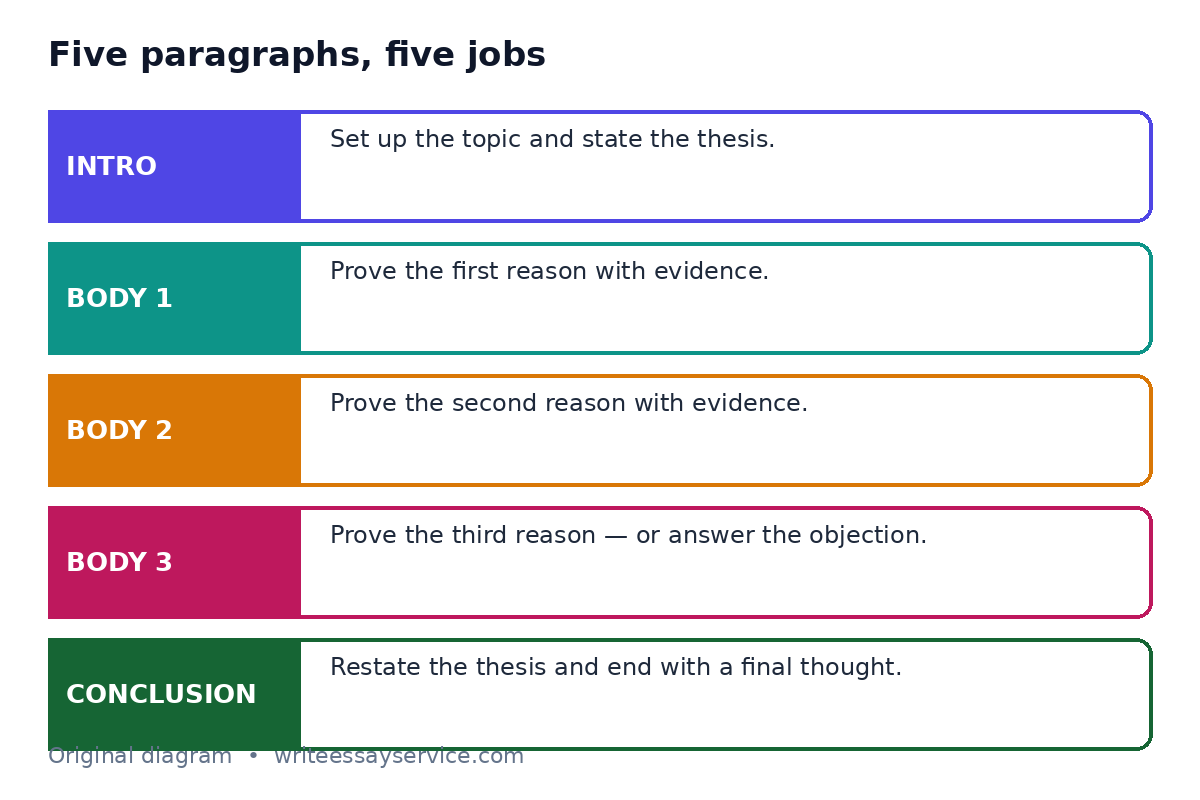
Paragraph 1 — Introduction. Introduce the topic, give just enough background, and end with a thesis statement: the one sentence that states your position.
Paragraph 2 — Body paragraph 1. Your first main point. Start with a topic sentence, support it with evidence, explain what the evidence shows, and link back to your thesis.
Paragraph 3 — Body paragraph 2. Your second main point, handled the same way. It should be a different point, not the same point said twice.
Paragraph 4 — Body paragraph 3. Your third main point — or a counter-argument you answer. Same pattern: one point, evidence, explanation, link.
Paragraph 5 — Conclusion. Restate your thesis in fresh words, sum up your three points, and finish with a final thought. Do not introduce new evidence here.
Paragraph 1: The Introduction — Hook, Background, Thesis
The introduction has three jobs, in order. First, show what the topic is and catch the reader's attention. Second, give enough background to follow the argument. Third, end with a thesis statement.
The opening need not be dramatic. A surprising fact, a short question, or a plain statement all work, as long as they are relevant. "Every morning, thousands of students put on the same uniform before school" opens a topic clearly. "School uniforms are bad" does not; it is a conclusion pretending to be an introduction. Background should be brief: one or two sentences explaining why the topic matters.
The thesis statement is the most important sentence in the essay. It states your position clearly enough that a reader could disagree with it. "School uniforms should be kept because they reduce peer pressure, save families money and help students focus on learning" is a thesis: it takes a position and previews three points. "School uniforms are a topic that many people discuss" is not, because nobody could disagree with it. Could someone reasonably hold the opposite view? If not, your thesis is probably too vague.
Paragraphs 2–4: The Body — One Point, One Paragraph
The three body paragraphs are where your argument is actually made. Each one has the same shape, and the same rule governs all three: one paragraph, one point. That rule is the heart of the 5 paragraph essay structure.
Each body paragraph should follow this pattern. Topic sentence: the first sentence states the paragraph's one point and connects it to the thesis — for example, "First, uniforms reduce the pressure to wear expensive clothes." Evidence: support the point with something concrete, such as a fact you have checked or an example from your own school. Evidence separates an argument from an opinion. Explanation: the step students skip most often — explain what the evidence shows. Linking sentence: end by linking back to your thesis, such as "Reducing this pressure is one reason uniforms are worth keeping."
Notice what the paragraph jobs are: the topic sentence promises, the evidence proves, the explanation connects, and the link closes. If a paragraph contains two points, it cannot do these jobs properly. Split it, or choose the stronger point.
Put your strongest point first or last, and your second-strongest point in the middle. Make sure the three points are genuinely different. "Uniforms save money", "uniforms reduce shopping costs" and "uniforms are cheaper than other clothes" are one point said three ways.
Paragraph 5: The Conclusion — Close, Don't Repeat
The conclusion has one job: to close the argument. First, restate your thesis in fresh words. Second, sum up your three points very briefly. Third, finish with a final thought: what follows from your argument, or why the question matters.
A conclusion must not introduce new evidence or a new point. If you find yourself writing "Another reason is…" in your final paragraph, that reason belongs in the body. It should not simply repeat the introduction either.
A good conclusion is often quieter than the introduction. "Uniforms will not solve every problem in schools, but on cost, pressure and focus, the case for keeping them is strong" is a better ending than a sweeping claim you cannot support.
An Annotated Plan: A Worked Essay Outline on School Uniforms
Here is a complete essay outline on one sample topic — "Should school uniforms be kept?" — with notes explaining why each part is there. This is a plan to write from, not an essay to submit.
Thesis: School uniforms should be kept because they reduce peer pressure over clothes, save families money, and help students focus on learning.
Why this thesis works: it takes a clear position, it can be disagreed with, and it previews exactly three points — pressure, cost and focus — one for each body paragraph.
Introduction: Opening — the morning routine of putting on a uniform. Background — uniforms are debated in many schools. Thesis — as above, at the end. Why: the opening is concrete, the background is one sentence, and the thesis comes last, where the reader expects it.
Body paragraph 1 — Peer pressure: Topic sentence — uniforms take away the daily comparison over brands. Evidence — comments on clothes, the cost of keeping up, feeling left out. Explanation — when everyone dresses alike, clothes stop being a way of judging each other. Link — this is the first reason uniforms are worth keeping. Why first: it is the most human point, and the easiest to recognise from school life.
Body paragraph 2 — Cost: Topic sentence — one set of uniform costs less over a school year than a wardrobe of fashionable clothes. Evidence — uniform cost compared with regular clothes; uniforms can be passed on or bought second-hand. Explanation — for families on a tight budget, that saving matters every term. Why separate: cost and peer pressure are different kinds of argument.
Body paragraph 3 — Focus: Topic sentence — with less attention on appearance, more attention goes to lessons. Evidence — teachers' observations, or your own experience. Explanation — removing one distraction helps. Why last: it is the broadest point, drawing the other two together.
Conclusion: Restated thesis — keeping uniforms is justified on pressure, cost and focus. Brief summary — one line recalling the three points. Final thought — uniforms will not fix every school problem, but on these three grounds the case for keeping them stands. Why short: it adds nothing new; it reminds the reader of the argument and leaves one clear thought behind.
This plan contains no full sentences to copy and no conclusion written for you. A plan should tell you what to argue and in what order. The writing is yours to do. Reuse this shape for any topic: change the thesis, choose three genuinely different points, and keep the same paragraph jobs.
A Short Model Paragraph to Learn From
The paragraph below is a learning example, not a full essay and not something to submit. It is one body paragraph only, from the uniforms plan above.
First, uniforms reduce the pressure to wear expensive clothes. In our school, several students have said they worry each morning about whether their clothes look new enough, and some feel embarrassed when they cannot afford the brands their classmates wear. When everyone wears the same uniform, that daily comparison disappears. Clothes stop being a way of judging each other, and students can worry less about how they look and more about the day ahead. Reducing this pressure is one reason uniforms are worth keeping.
It works because it has one clear idea, opens with a topic sentence stating it, proves it with concrete evidence, explains what the evidence means, and links back to the thesis. Aim for the same discipline — one idea, one piece of evidence, one explanation, one link.
Common Mistakes in 5-Paragraph Essays
More than one idea in a paragraph. If you cannot summarise a paragraph in one short sentence, it probably contains two ideas. Split it, or cut the weaker one.
A weak thesis. A thesis nobody could disagree with gives your essay nothing to argue. It should take a position and preview your points.
Points without evidence. "Uniforms save money. Uniforms reduce pressure. Uniforms help focus." Three claims with no evidence is a list, not an argument.
The same point, repeated. Three paragraphs that all say "uniforms are cheaper" give the reader one reason, not three. Are your three points genuinely different?
A conclusion that just repeats the introduction. Restate your thesis in fresh words, sum up briefly, and finish with a final thought.
Skipping the plan. Without an outline, introductions run too long, body paragraphs wander, and conclusions arrive suddenly. Ten minutes on a plan makes the writing faster and the essay clearer.
Frequently Asked Questions
How long should a 5-paragraph essay be?
A common length is 500 to 800 words: roughly 100 words for the introduction, 120 to 150 words for each body paragraph, and 80 to 100 words for the conclusion. The body should be the longest part, because that is where the argument happens.
Can I use the 5-paragraph essay structure for any topic?
Yes, for most school essays — argumentative, discursive and explanatory topics all fit the shape. It works less well for stories and personal reflections. If your topic has four or five main points, add a body paragraph rather than squeezing two points into one.
What makes a good topic sentence?
A good topic sentence states the paragraph's one point clearly and connects it to the thesis. It should be specific — "Uniforms save families money" — rather than vague — "There are many advantages to uniforms."
How do I choose my three body paragraph points?
Start from your thesis. Ask what three different reasons support it, and write each one as a single sentence. Then check that they are genuinely different. If you can only find two strong points, narrow your thesis so a third paragraph can answer a counter-argument instead.
Should the conclusion introduce new ideas?
No. The conclusion restates the thesis, sums up the points already made, and offers a final thought. New evidence or a new point belongs in the body.