


The first sentence of an essay does more work than any other. It has to earn the reader’s attention, set the tone, and point towards the argument that follows. That is a lot to ask of one line, which is why so many openings fall flat: they either promise something the essay never delivers, or they try so hard to be clever that they say nothing at all.
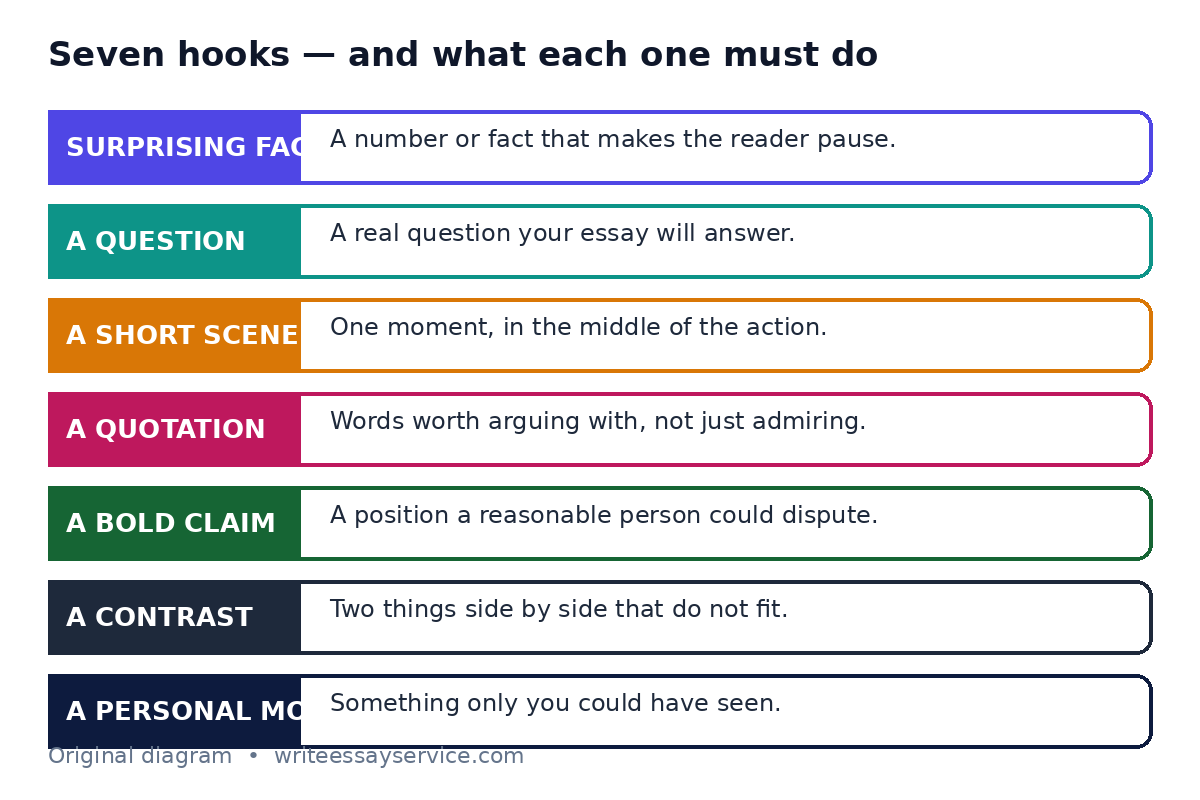
Learning how to start an essay well is not about finding a magic formula. It is about understanding what each kind of opening can and cannot do, then choosing the one that fits your topic, your audience, and your thesis. The best essay hooks are not the most dramatic ones; they are the ones that lead naturally into the argument. This guide covers seven proven hook types, each with an original example and advice on when it works and when it fails, plus a section on matching your hook to your thesis and a short checklist.
For more on planning and structuring the whole essay, see our essay writing guide. And if you are still choosing a topic, our list of 120 argumentative essay topics for 2026 is a useful place to start.
1. The Surprising Fact
A surprising fact opens with information the reader did not expect, creating a small puzzle the reader wants solved. This is one of the most reliable essay introduction hook options, especially for argumentative and informative writing.
“A honeybee can recognise a human face, yet its brain is smaller than a grain of rice.”
When it works: the fact is genuinely surprising, accurate, and connected to your thesis. If your essay argues that intelligence takes many forms, the bee’s tiny brain is a strong opening move. Choose facts your reader is unlikely to know already.
When it fails: the fact has nothing to do with the argument. “Sharks existed before trees” might raise an eyebrow, but if your essay is about libraries, the reader will feel tricked. Never invent a statistic to make an opening punchier.
2. The Question
A well-placed question turns the reader from a passive observer into a participant. Instead of being told something, they are asked to think about it — and people find it hard to ignore a question aimed at them. Question hooks suit reflective, persuasive, and exploratory topics.
“If every school day began an hour later, would students actually learn more — or would they simply stay up an hour later the night before?”
When it works: the question is specific, genuinely open, and connected to the essay’s argument. It should not have an obvious one-word answer, and your essay should actually explore it.
When it fails: the question is too broad or too easy. “Have you ever wondered about the importance of education?” is not a hook; it is a cliché your reader has seen a hundred times. Ask one strong question, then answer it with your argument.
3. The Short Scene
A short scene drops the reader into a moment — a place, a sound, a small event — before any argument appears. It is the most vivid of the hook examples for essays, because readers remember scenes far better than statements. This attention grabber suits narrative, descriptive, and reflective writing.
“The hall smelled of floor polish and nervous sweat. Outside the door, a queue of students whispered last-minute facts to one another, and every few minutes the invigilator’s voice called out another name.”
When it works: the scene is brief — two or three sentences at most — and clearly connects to the essay’s theme. Here, the scene introduces exam anxiety, which an essay on assessment could build on. A smell, a sound, or a small visual detail makes the moment feel real.
When it fails: the scene runs too long or never connects to the argument. A whole paragraph on a sunset before an essay about recycling wastes the reader’s time. It also fails when the scene is invented — never present a made-up anecdote as fact.
4. The Quotation
A quotation borrows someone else’s words to open the conversation. A well-chosen line can frame your argument in a single sentence and show you have done your reading. Quotation hooks work particularly well in literary analysis and essays on ideas.
“As the novelist George Orwell wrote, ‘If liberty means anything at all, it means the right to tell people what they do not want to hear.’”
When it works: the quotation is short, accurate, and genuinely relevant — and you engage with it rather than letting it sit there. The example above would suit an essay on free speech. Always check the wording and the source before you use a quotation.
When it fails: the quotation is used as decoration rather than as part of the argument. A line from Shakespeare at the top of an essay about climate change is not a hook; it is a distraction. If a quotation does not sharpen your argument, leave it out.
5. The Bold Claim
A bold claim states something strong, even slightly provocative. It works by creating disagreement — or at least curiosity — in the reader’s mind. They keep reading to find out whether you can defend what you have just said. This is one of the most powerful essay opening lines for argumentative writing.
“Most students do not fail exams because they know too little. They fail because they have never been taught how to revise.”
When it works: you can actually support the claim with evidence in the paragraphs that follow. A bold claim is a promise: your essay must deliver the reasoning and the examples that back it up. It also works when the claim is specific — the example names a clear cause, poor revision skills.
When it fails: the claim is too extreme to defend, or simply an opinion dressed up as fact. “Homework is completely useless” is not bold; it is lazy. A bold claim also fails if you soften it immediately. Make the claim, then prove it.
6. The Contrast
A contrast places two opposing ideas side by side and lets the tension between them pull the reader in. The gap between what was and what is, or between expectation and reality, is inherently interesting. Contrast hooks suit essays about change, comparison, and cause and effect.
“In 1990, a student writing an essay needed a library card and a free afternoon. Today, the same student needs a password and thirty seconds — and yet the essay is often harder to write, not easier.”
When it works: both sides of the contrast are concrete and the difference between them is real. The reader recognises both halves: the library trip and the instant search. The contrast then raises a genuine question — why has easier access not made writing easier?
When it fails: the contrast is forced or false. A striking comparison that tells the reader nothing about your topic is just a trick. It also fails when the two sides are not genuinely in tension — preferring summer to winter is a difference, not a contrast that drives an argument.
7. The Personal Moment
A personal moment opens with a brief, honest experience from your own life. It works because readers connect with real experience more readily than with abstract claims. This hook suits reflective essays, personal statements, and any topic where your own perspective matters.
“I was sixteen when I first read a poem I did not understand, and instead of feeling stupid, I felt curious. That feeling has shaped every essay I have written since.”
When it works: the moment is specific, brief, and clearly linked to the essay’s theme. The example introduces curiosity as a response to difficulty, a theme an essay on learning could develop. The moment should be genuine and modest; a small, true experience is far more persuasive than a grand, dramatic one.
When it fails: the personal story takes over the essay, or it is irrelevant to the argument. An opening about your holiday before an essay on renewable energy is a detour, not a hook. It also fails when the personal moment replaces the argument — “this is just my opinion” is not a thesis.
Matching Your Hook to Your Thesis
The most common mistake with essay hooks is choosing the opening first and the argument second. The hook should serve the thesis, not the other way round. A dramatic scene that has nothing to do with your argument is a false start, and readers notice the disconnect within a paragraph.
Start by writing your thesis in one plain sentence. Then ask what the reader needs to feel, know, or wonder before they can follow this argument. A thesis about technology and learning suits a contrast; one about free speech suits a quotation or a bold claim; one about your own experience suits a personal moment.
Try the “bridge” test: read your opening, then your thesis, and ask whether a reader could walk from one to the other without a leap. The strongest introductions do not just grab attention — they point. Every sentence between the hook and the thesis should narrow the gap to the claim your essay will defend.
A Checklist for Testing Your Opening
Before you commit to an opening, run it through these checks.
- Does it connect to your thesis? If you removed the hook and the essay still made sense, the hook is decoration. Rewrite it so it points at your argument.
- Would it make a stranger keep reading? Does the opening give someone who does not care about your topic yet a reason to read the next sentence?
- Is it honest? Every fact should be accurate, every quotation correctly attributed, and every personal moment true.
- Is it the right length? A hook should be one to three sentences — trim anything longer.
- Does it sound like you? An opening full of words you would never use will ring false.
- Could it open a different essay? If so, it is too generic. A good hook belongs to this essay alone.
Frequently Asked Questions
What is the best hook for an essay?
There is no single best hook — it depends on your topic, your audience, and your thesis. A surprising fact suits an argumentative essay, a short scene suits a reflective one, and a quotation suits a literary one. Choose the hook that leads most naturally into your argument.
How long should an essay hook be?
One to three sentences is usually enough. A hook should grab attention quickly and hand over to the thesis; anything longer has stopped being a hook and started being a detour.
Can I use a question as an essay hook?
Yes, provided the question is specific and your essay actually explores it. Avoid broad, clichéd questions, ask one strong question, and then answer it with your argument.
Should the hook match the thesis?
Yes — this is the most important rule in this guide. A hook that does not connect to the thesis feels like a trick. Every good essay introduction hook points towards the argument that follows.
What is the most common mistake when writing essay hooks?
Using a dramatic opening that has nothing to do with the argument. A shocking statistic, a vivid scene, or a famous quotation only works when it leads into the thesis. Stacking several hooks together is the second most common mistake — pick one hook and do it well.