
An opinion essay is a short piece of writing in which you state a clear view on a question and defend it with reasons and examples. Unlike a report, which mainly presents facts, an opinion essay asks you to take a side: should schools ban mobile phones, is social media doing more harm than good, or should the voting age be lowered? Your reader should finish knowing exactly what you think and why. That is why the topic matters so much — a good topic has a real debate at its heart, with sensible people on both sides and enough evidence to build a case.
The opinion essay topics for students in this list are chosen with that test in mind. Each one comes with an angle — the particular way into the subject — and the question your essay should answer, so you never face a bare title wondering where to begin. These are the best opinion essay topics 2026 has to offer, covering school, technology, the environment, health, work, culture, sport and the future. If you are still deciding between essay types, our 120 argumentative essay topics for 2026 show how an argumentative essay differs in structure, and our guide to persuasive vs argumentative essays explains when each form fits best. Before you choose, read a few opinion essay examples to see how a strong opening states a position in the first paragraph — learning how to write an opinion essay starts with the topic itself. The opinion essay ideas below give you all three: a topic, an angle, and the question to answer.
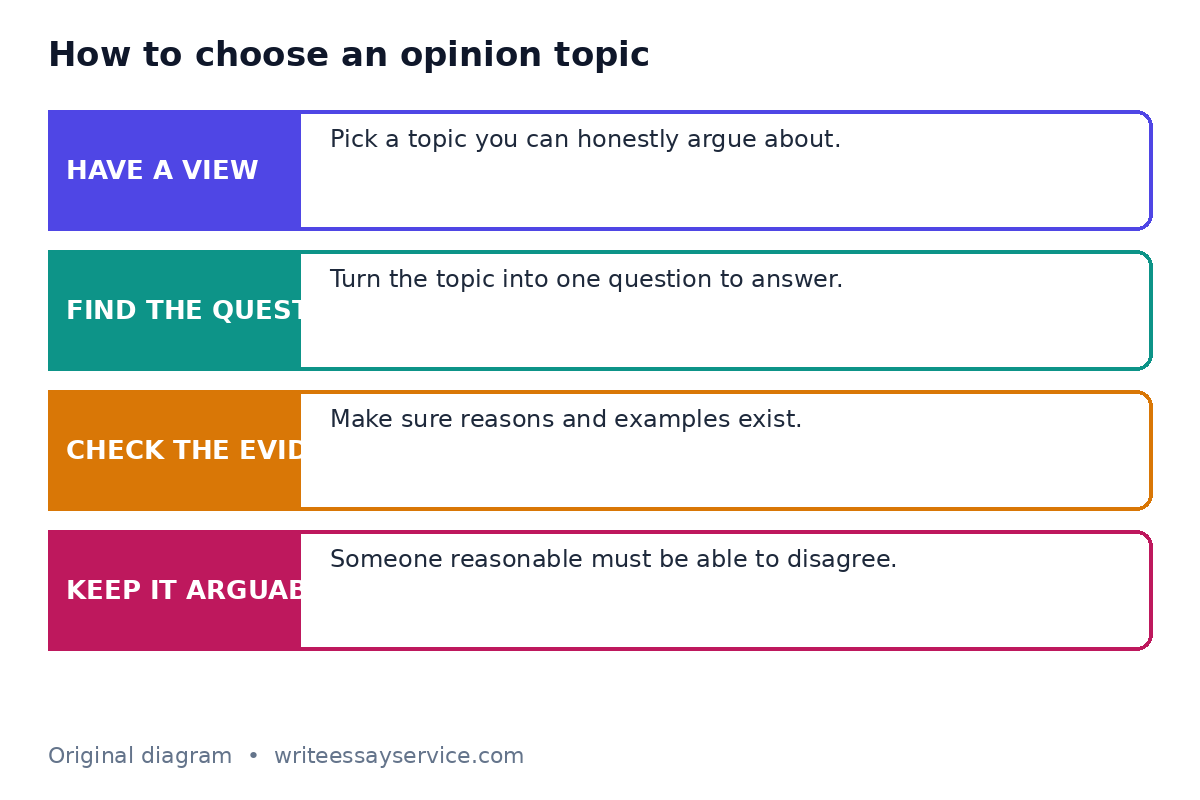
How to Choose an Opinion Essay Topic
A good topic passes four tests. First, it is genuinely debatable: reasonable people disagree about it. Second, you have a view on it, or one you can argue with conviction after some research. Third, there is evidence available — facts, examples or expert views to support your reasons. Fourth, it is narrow enough to argue in one essay. “Technology is bad” is too wide; “Schools should ban smartphones during lessons” is a question you can actually answer. Before you commit, state your position in one sentence, then ask what the strongest objection to it would be. If you can imagine a fair counter-argument, you have a real debate — and a stronger essay.
100 Opinion Essay Topics 2026 — School and Education
- Should schools ban mobile phones during lessons? — attention versus distraction. Question: do phones help students learn, or distract them too much?
- Should homework be abolished in primary school? — family time versus practice. Question: does homework at a young age improve learning, or mainly add stress?
- Should the school day start later for teenagers? — the case from sleep science. Question: would a later start improve students’ health and results?
- Should students wear school uniforms? — identity versus equality. Question: do uniforms reduce bullying, or suppress individuality for no real benefit?
- Should exams be replaced by continuous assessment? — one test versus ongoing work. Question: which method shows more fairly what a student has learned?
- Should every student learn a second language? — a global skill worth the time. Question: is compulsory language learning worth the classroom time it takes?
- Should schools teach financial literacy as a compulsory subject? — practical skills for real life. Question: would lessons on budgeting and debt prepare young people better?
- Should AI tools be allowed in school essays? — help versus cheating. Question: when does using AI become dishonest, and when is it a useful study tool?
- Should students choose their own subjects earlier? — freedom versus breadth. Question: does early specialisation help motivated students, or close doors too soon?
- Should school lunches be free for every student? — fairness and health. Question: would universal free lunches improve learning and equality enough to justify the cost?
Technology and AI
- Should AI-generated content be labelled by law? — transparency for readers. Question: do readers have a right to know when content was made by a machine?
- Is AI a threat to human creativity? — defending or challenging the fear. Question: does AI replace creative work, or change what creative work looks like?
- Should self-driving cars be allowed on public roads? — safety versus new risks. Question: are driverless cars safe enough today, or should they stay in testing?
- Should children under 13 be banned from using smartphones? — the case from child development. Question: does early smartphone use harm children more than it helps them?
- Will robots take more jobs than they create? — a side on automation. Question: should we welcome automation, or prepare for a future with fewer jobs?
- Should facial recognition be banned in public places? — security versus privacy. Question: does the safety gained justify the loss of privacy?
- Is the internet making us less able to think deeply? — attention and memory. Question: has constant online information improved our thinking, or weakened our concentration?
- Should governments control the development of powerful AI? — regulation versus freedom. Question: would strict AI rules protect society, or slow down helpful progress?
- Should people have the right to be forgotten online? — privacy versus history. Question: should anyone be able to demand old information about them be deleted?
- Is technology making education better or worse? — judging the overall effect. Question: have screens improved learning, or made classrooms more distracted and less personal?
Social Media and the Internet
- Does social media do more harm than good for teenagers? — a clear overall verdict. Question: does social media help young people connect, or damage their wellbeing?
- Should influencers disclose sponsored content clearly? — honest advertising. Question: are current disclosure rules enough to protect followers?
- Should anonymous accounts be banned on social media? — free speech versus abuse. Question: would removing anonymity reduce abuse enough to justify the loss of protection?
- Is cancel culture a fair way to hold people accountable? — judging a modern phenomenon. Question: does public shaming correct bad behaviour, or punish people without a fair hearing?
- Should parents monitor their children’s social media accounts? — safety versus trust. Question: does monitoring protect children, or damage the trust a family needs?
- Has social media made friendships weaker? — the quality of connection. Question: are online friendships as meaningful as face-to-face ones?
- Should social media companies be responsible for misinformation? — assigning responsibility. Question: should platforms be punished for false content, or only the people who post it?
- Is it right for employers to check a job applicant’s social media? — privacy at work. Question: should what someone posts online affect their chances of getting a job?
- Should there be a legal daily screen-time limit for children? — law versus family choice. Question: would a legal limit protect children’s health, or should screen time be a family decision?
- Does online activism actually change anything? — testing digital protest. Question: is sharing posts and signing petitions real change, or a substitute for action?
Environment and Climate
- Should single-use plastics be banned completely? — a total ban or a gradual approach. Question: would a full ban help the environment enough to justify the inconvenience?
- Should flying be taxed more to fight climate change? — travel costs versus emissions. Question: would higher flight taxes cut emissions fairly, or stop poorer people travelling?
- Is individual action on climate change pointless without government action? — where responsibility lies. Question: do personal choices matter, or is climate change only solvable by governments?
- Should countries pay poorer nations for climate damage? — fairness and history. Question: do wealthy countries that caused most emissions owe compensation to those suffering most?
- Should meat consumption be reduced by law? — regulation versus personal choice. Question: would limits on meat be a fair response to its environmental impact?
- Is nuclear power the best answer to climate change? — defending a contested solution. Question: does nuclear energy offer the cleanest reliable power, or do its risks outweigh the benefits?
- Should fast fashion be taxed or restricted? — targeting a wasteful industry. Question: would taxing cheap clothing reduce waste, or punish people who cannot afford expensive clothes?
- Should every new building have solar panels? — green building rules. Question: would compulsory solar panels cut emissions enough to justify the extra building cost?
- Are electric cars really better for the environment? — beyond the tailpipe. Question: once manufacturing and electricity are counted, are electric cars clearly greener?
- Should zoos be closed to protect animals? — conservation versus captivity. Question: do zoos help conservation enough to justify keeping wild animals in enclosures?
Health and Wellbeing
- Should junk food advertising aimed at children be banned? — protecting children. Question: would a ban reduce obesity, or should parents decide what their children eat?
- Should mental health days be allowed in schools and workplaces? — the case for rest. Question: would official mental health days improve wellbeing, or be misused?
- Should sugary drinks be taxed? — judging a public health policy. Question: does a sugar tax reduce obesity, or mainly punish poorer consumers?
- Is social media the main cause of rising anxiety in young people? — testing a popular claim. Question: can teenage anxiety be blamed mostly on social media, or are other pressures more important?
- Should the legal age for buying cigarettes be raised to 21 everywhere? — prevention. Question: would raising the smoking age save lives, or push young smokers towards illegal sales?
- Should gym classes be compulsory for all school students? — defending physical education. Question: does compulsory physical activity improve health and focus enough to justify the time?
- Should healthcare be free for everyone, paid for by taxes? — a basic right. Question: is universal free healthcare the fairest system, or too heavy a burden on taxpayers?
- Is it healthy to follow a strict diet in your teens? — warning or reassurance. Question: do strict diets help teenagers stay healthy, or risk eating disorders and poor growth?
- Should employers offer flexible working hours? — work-life balance. Question: would flexible hours improve health and productivity, or make teams harder to manage?
- Does eight hours of sleep matter more than studying late? — rest versus revision. Question: should students sacrifice sleep before an exam, or does rest improve results more?
Money, Work and the Future of Jobs
- Should the minimum wage be raised significantly? — workers versus businesses. Question: would a higher minimum wage lift people out of poverty, or cost jobs?
- Is a four-day working week a good idea? — judging the trade-off. Question: would a four-day week make workers happier and just as productive?
- Should unpaid internships be banned? — fairness at work. Question: do unpaid internships exploit young workers, or offer experience that justifies no pay?
- Is a university degree still worth the cost? — questioning an assumption. Question: does a degree still lead to better jobs, or have its costs made it a poor investment?
- Should billionaires be taxed much more heavily? — extreme wealth. Question: would a wealth tax reduce inequality fairly, or discourage enterprise that creates jobs?
- Is the gig economy good for workers? — flexible work. Question: does gig work offer freedom and opportunity, or insecure pay and no protection?
- Should everyone receive a universal basic income? — a radical idea. Question: would a guaranteed basic income free people to work and learn, or discourage work?
- Should teenagers work part-time during term time? — experience versus study. Question: does a part-time job teach useful skills, or damage school results?
- Is it better to save money or invest it? — practical advice with a clear position. Question: for a young person starting out, is saving safer, or does investing build wealth faster?
- Should cash be replaced entirely by digital payments? — a cashless society. Question: would going fully cashless be more convenient, or exclude people who depend on cash?
Culture, Society and Values
- Should museums return artefacts taken during colonial rule? — ownership and history. Question: do museums have a duty to return looted objects, or preserve them for the world?
- Is it wrong to wear clothing from another culture? — appreciation versus offence. Question: when does borrowing from another culture become disrespectful rather than a compliment?
- Should the voting age be lowered to 16? — the case for younger voters. Question: are 16-year-olds mature and informed enough to vote?
- Should celebrities use their fame to speak about politics? — the role of public figures. Question: do celebrities have a responsibility to use their platform, or should they stay out of politics?
- Is traditional media still more trustworthy than social media? — comparing news sources. Question: should we trust newspapers more than online sources, or has that trust been lost?
- Should cities preserve old buildings, even when new ones are needed? — heritage versus progress. Question: is protecting historic buildings worth the cost when housing is in short supply?
- Is it fair that women still earn less than men for the same work? — a persistent gap. Question: is the pay gap mainly caused by discrimination, and what should be done about it?
- Should public libraries still exist in a digital age? — defending a public institution. Question: do libraries still serve a purpose when almost everything is available online?
- Is graffiti art or vandalism? — judging a contested art form. Question: should street art be celebrated as public creativity, or punished as damage?
- Should children be taught religion in state schools? — faith and education. Question: does teaching religion promote understanding, or breach the separation of faith and public education?
Sport and Competition
- Should professional athletes be paid more than doctors and teachers? — what society values. Question: do athletes deserve huge salaries, or does the gap show society values entertainment over essential work?
- Should performance-enhancing drugs be legalised in sport? — a level field or free choice. Question: would legalising doping make sport fairer, or destroy fair competition?
- Is competitive sport good for children? — benefits versus pressure. Question: does competitive sport teach teamwork and resilience, or put unhealthy pressure on children?
- Should esports be treated as a real sport? — defending a new category. Question: do video game competitions deserve the same recognition as traditional sports?
- Should the Olympic Games be held in one permanent location? — arguing for reform. Question: would a permanent site save money, or take away the honour of hosting?
- Is it fair that men’s and women’s sports receive unequal funding? — equality. Question: should women’s sport receive the same funding and coverage as men’s?
- Should footballers be allowed to protest during matches? — athletes and politics. Question: do players have the right to protest injustice during matches, or should sport stay separate?
- Is winning the only thing that matters in sport? — challenging a famous idea. Question: should sport be judged by results alone, or by effort and sportsmanship too?
- Should contact sports like boxing be banned? — danger versus choice. Question: is boxing too dangerous to allow, or should adults be free to choose their risks?
- Should school sports be competitive, or focused on participation? — the purpose of school sport. Question: does competition motivate students, or discourage those who are less talented?
Politics, Law and Citizenship
- Should voting be compulsory for all citizens? — duty versus freedom. Question: would compulsory voting make democracy fairer, or force unwilling people to vote?
- Should the death penalty be abolished everywhere? — a clear moral position. Question: can capital punishment ever be justified, or is it always wrong?
- Should the government monitor citizens to prevent crime? — safety versus liberty. Question: does surveillance make society safer, or give governments too much power?
- Is democracy the best system of government? — defending or challenging a belief. Question: does democracy always produce the best decisions, or can it fail when voters are misinformed?
- Should 16-year-olds be allowed to drive? — maturity and risk. Question: are 16-year-olds responsible enough to drive safely, or would it increase accidents?
- Should freedom of speech include the right to offend? — the limits of a core right. Question: should speech that offends be protected, or should the law limit speech that causes harm?
- Should countries accept more refugees? — a moral duty. Question: do wealthy countries have an obligation to accept more refugees, or limit numbers to protect their citizens?
- Should the police use AI to predict crime? — prevention versus fairness. Question: would predictive policing prevent crime, or unfairly target innocent people?
- Should the legal drinking age be lowered to 18? — consistency or caution. Question: if 18-year-olds can vote and marry, should they also be allowed to drink legally?
- Is it right to fine people who do not vote? — a penalty for apathy. Question: would fines increase turnout and civic duty, or punish people unfairly?
The Future and Big Questions
- Should humans try to colonise Mars? — ambition versus fixing Earth first. Question: is settling Mars worth the enormous cost, or should that money solve problems here?
- Will AI ever be truly intelligent? — what intelligence means. Question: can machines ever think like humans, or will they always be clever imitations?
- Should people be allowed to choose their own death? — a sensitive question. Question: should assisted dying be legal for people who are suffering?
- Is the world becoming a better place? — judging progress overall. Question: have health and living standards improved enough to say the world is getting better?
- Should we bring back extinct animals through science? — playing with nature. Question: would reviving extinct species help the planet, or risk problems we cannot predict?
- Will remote work replace the office completely? — the future of work. Question: are offices becoming unnecessary, or will people always need a shared workplace?
- Should every child learn to code? — a new basic skill. Question: is coding as essential as reading and writing, or a specialist skill?
- Is space exploration a waste of money? — challenging or defending exploration. Question: does space research deliver enough benefits to justify its cost?
- Should people live forever if science made it possible? — a radical future. Question: would living forever be a gift, or damage society and the meaning of life?
- Is happiness more important than success? — what a good life means. Question: should people aim first for happiness, or does success bring happiness in the end?
How to Turn a Topic into a Thesis
Turn your topic into a thesis: one sentence that states your position clearly. Answer the question behind the topic directly. For topic 1, a thesis might be: “Schools should ban mobile phones during lessons, because the distraction they cause outweighs any benefit they offer in class.” The thesis answers the question, takes a side, and hints at the main reason, which the essay will then prove with evidence.
A strong thesis is specific, arguable and honest. Specific means it names the subject and the claim, not a vague feeling. Arguable means someone could reasonably disagree; if nobody could, there is no essay. Honest means it is a view you can defend with evidence. Write your thesis before you draft the body, then use it as a test: every paragraph should support it, and anything that does not should be cut.
Frequently Asked Questions
What is an opinion essay?
An opinion essay is a short piece of writing in which you state a clear view on a debatable question and support it with reasons and examples. It has an introduction that states your position, body paragraphs that each make one reasoned point, and a conclusion that restates your view.
How do I choose the best opinion essay topic?
Pick a topic that is genuinely debatable, that you care about, and that you can support with evidence. Use the question behind each topic in this list as a test: if you can answer it in one sentence and imagine a fair counter-argument, the topic will work.
How long should an opinion essay be?
For most school and college assignments, 500 to 1,000 words is typical, though your teacher’s instructions come first. That allows an introduction, three body paragraphs and a conclusion — enough to argue a position properly without repeating yourself.
What is the difference between an opinion essay and an argumentative essay?
An opinion essay is built mainly around your personal view, supported by reasons and examples. An argumentative essay goes further: it presents evidence, addresses counter-arguments in detail and aims to persuade through logic and research. Our guide to persuasive vs argumentative essays explains the difference in full.