



A descriptive essay does not list what something looks like. It makes the reader feel they are standing beside you, seeing, hearing, smelling and touching the same thing. The best descriptive essay topics 2026 has to offer are the ones with a clear angle — a reason to describe this place, person or moment now, and not just to catalogue it.
This list gives you one hundred topics, each with an angle and the sensory detail that will carry it. Pick one, find the detail only you would notice, and build your description around it.
How to Describe Anything Well: The Five-Sense Method
Before you choose a topic, learn the method. Good description is not about using more adjectives — it is about choosing the right details.
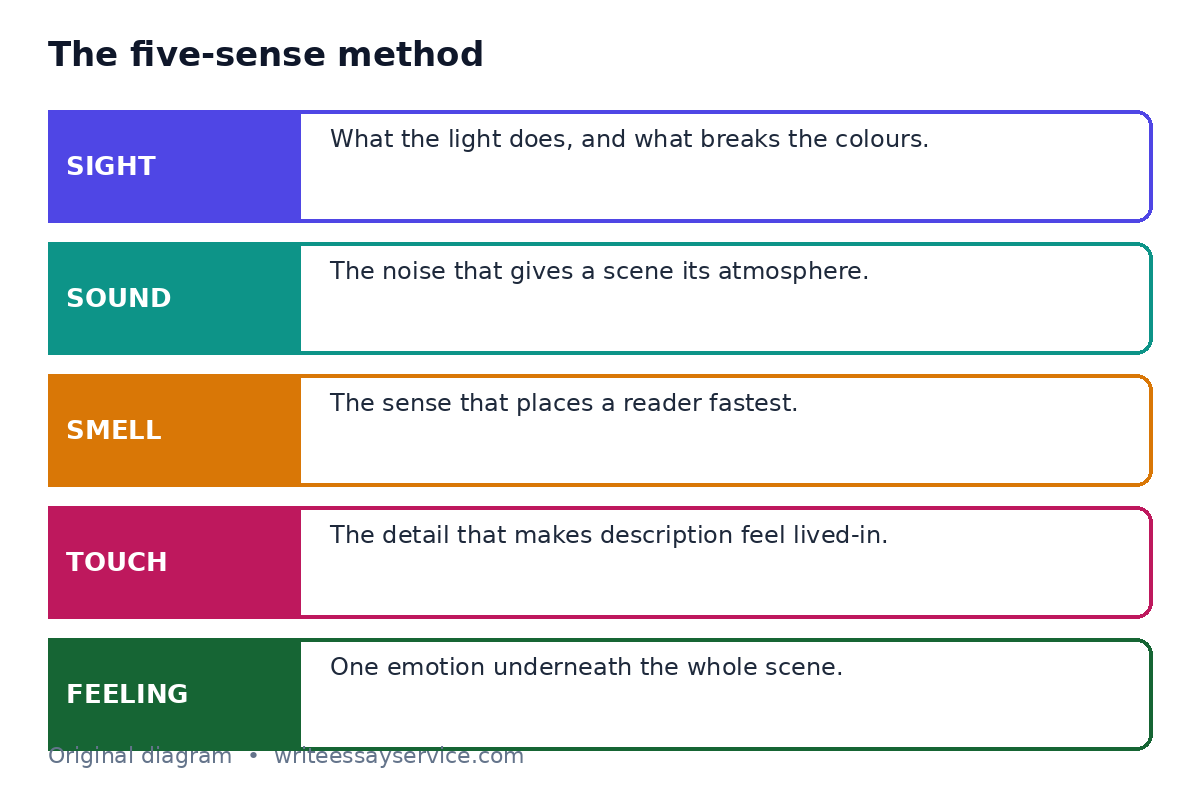
Sight first, but not only sight. What does the light do? What colours dominate, and what breaks them? One precise visual detail beats a paragraph of vague adjectives.
Add sound. A place is silent or noisy, and the kind of noise matters: the hum of a fan, the call of a street vendor, the creak of a door. Sound gives a scene its atmosphere.
Smell and taste are memory. A smell — rain on hot dust, fresh bread, old books — can place a reader in a scene faster than any view. Use it sparingly and precisely.
Touch makes it real. The rough bark, the cold metal, the weight of a bag. Touch is the sense most writers forget, and the one that makes description feel lived-in rather than observed.
Choose one feeling. Every strong description has an emotion underneath it: comfort, loneliness, excitement, fear. Decide what your reader should feel, then choose details that create it — and leave out the ones that do not.
If you are new to planning essays, our guide to planning a 500-word essay in 10 minutes shows how to turn a topic into a timed plan. For story-shaped topics, our list of 100 narrative essay topics for 2026 pairs well with this one.
Places
- The street where you grew up — the angle: how it has changed, and what has not. Sensory detail: the sound of the same gate, still creaking.
- A crowded bazaar at dusk — the angle: the moment the lights come on. Sensory detail: the smell of frying food mixing with dust.
- Your favourite corner of your home — the angle: why this small space feels safe. Sensory detail: the worn patch on the chair where you always sit.
- A railway station at night — the angle: waiting, and everyone waiting differently. Sensory detail: the cold bench, the echo of announcements.
- A beach after the crowds leave — the angle: what the place is like when nobody is watching. Sensory detail: wet sand, gulls, the smell of salt.
- A mountain viewpoint at sunrise — the angle: the slow arrival of light. Sensory detail: cold air, the valley filling with mist.
- The school corridor between lessons — the angle: five minutes of chaos. Sensory detail: slamming lockers, shoes on polished floor.
- A library’s oldest room — the angle: silence with a history. Sensory detail: the smell of old paper, dust in a shaft of light.
- A rooftop in your city — the angle: seeing a familiar place from above. Sensory detail: washing lines, water tanks, the hum of traffic below.
- A hospital waiting room — the angle: hope and fear in the same chairs. Sensory detail: the ticking clock, the smell of disinfectant.
People
- Your grandmother’s hands — the angle: a life told through one pair of hands. Sensory detail: the roughness, the rings, the way they move when she talks.
- A street vendor you see every day — the angle: a stranger you know better than some friends. Sensory detail: his call, the rhythm of his work.
- Your best friend laughing — the angle: the sound that tells you everything about them. Sensory detail: the way their whole face changes.
- A teacher who changed your mind — the angle: one lesson you still remember. Sensory detail: chalk dust, a voice that made the room quiet.
- A baby’s first steps — the angle: courage in miniature. Sensory detail: wobbling feet, outstretched arms, the gasp of the watchers.
- An old fisherman mending his nets — the angle: patience as a craft. Sensory detail: salt-stiff fingers, the smell of rope and sea.
- A child waiting for the school bus — the angle: the longest ten minutes of the day. Sensory detail: a heavy bag, kicking at stones.
- A nurse at the end of a long shift — the angle: kindness when tired. Sensory detail: tired eyes, steady hands.
- Your father at work — the angle: seeing a parent as a person, not a role. Sensory detail: the tools of the trade, the concentration.
- A stranger who helped you once — the angle: a face you cannot forget. Sensory detail: one gesture, one sentence, and the relief it brought.
Seasons and Weather
- The first rain after a long summer — the angle: a whole city breathing out. Sensory detail: the smell of wet dust, the sound on tin roofs.
- A winter morning in the mountains — the angle: the world made quiet. Sensory detail: breath in cold air, frost on window glass.
- A summer afternoon with no electricity — the angle: heat as a character. Sensory detail: still air, the hum of a hand fan, sweat on skin.
- Autumn leaves in a park — the angle: beauty in letting go. Sensory detail: the crunch underfoot, gold and rust colours.
- A thunderstorm over the sea — the angle: power you cannot argue with. Sensory detail: lightning, the smell of ozone, waves hitting rock.
- Spring in a village garden — the angle: the year starting again. Sensory detail: new green, the buzz of bees, damp earth.
- Fog on a winter road — the angle: a world reduced to ten metres. Sensory detail: headlights as pale circles, muffled sound.
- A hot wind before a storm — the angle: the air itself warning you. Sensory detail: dust in the eyes, trees bending, sudden stillness.
- Snow falling on a sleeping town — the angle: silence you can see. Sensory detail: soft light, footprints filling in behind you.
- The monsoon from a window — the angle: watching weather you cannot control. Sensory detail: rain on glass, gutters overflowing, grey light.
Food and Taste
- Your mother’s cooking on a festival day — the angle: a taste that means home. Sensory detail: steam, spices, the sound of the pressure cooker.
- Street food at midnight — the angle: a city that eats after dark. Sensory detail: smoke, sizzling oil, the crowd around one cart.
- The first mango of the season — the angle: waiting all year for one flavour. Sensory detail: juice on your hands, the sweetness, the smell.
- Bread fresh from the oven — the angle: the simplest food, done well. Sensory detail: the crackle of the crust, warmth in your hands.
- A cup of tea on a cold morning — the angle: a small daily comfort. Sensory detail: steam on your face, the warmth of the cup, the first sip.
- A meal cooked over an open fire — the angle: food the slow way. Sensory detail: woodsmoke, charred edges, ash on your fingers.
- The school canteen at lunchtime — the angle: noise, hunger and friendship. Sensory detail: trays clattering, the smell of fried food, shared seats.
- A fruit market in summer — the angle: colour you can eat. Sensory detail: piles of mangoes and melons, flies, the vendor’s knife.
- Your favourite sweet, made by hand — the angle: a recipe with a person in it. Sensory detail: sticky fingers, the smell of cardamom, the careful shaping.
- A meal eaten alone while travelling — the angle: food as company. Sensory detail: an unfamiliar menu, the taste of something new, the quiet table.
Animals
- A stray cat in your street — the angle: independence with soft paws. Sensory detail: the flick of a tail, eyes in the dark, the sound of its purr.
- An elephant at a sanctuary — the angle: gentleness at enormous scale. Sensory detail: the slow blink, the rumble you feel in your chest.
- Birds at dawn in a city park — the angle: the day’s first argument. Sensory detail: competing songs, wings in cold air.
- Your pet dog waiting at the door — the angle: loyalty without words. Sensory detail: the thump of a tail, warm fur, hopeful eyes.
- A horse running free — the angle: power without anger. Sensory detail: hooves on dry ground, mane in the wind, the snort.
- A butterfly in a garden — the angle: beauty that will not sit still. Sensory detail: the flicker of wings, the pause on a flower, then gone.
- Fish in a clear stream — the angle: a world under glass. Sensory detail: the flash of silver, cold water over your feet, the current.
- A camel caravan in the desert — the angle: patience as a way of life. Sensory detail: the sway of the walk, the jingle of bells, dust.
- A lion at rest — the angle: power doing nothing. Sensory detail: heavy breathing, golden eyes half-closed, the twitch of an ear.
- A sparrow building its nest — the angle: small work, done perfectly. Sensory detail: the flutter of wings, twigs carried one by one.
Objects and Rooms
- Your grandfather’s old watch — the angle: time you can hold. Sensory detail: the weight, the tick, the scratched glass.
- A classroom after everyone has left — the angle: the room without its people. Sensory detail: chalk dust in the air, desks out of line, a forgotten book.
- The inside of a crowded bus — the angle: strangers sharing a small space. Sensory detail: the press of shoulders, the smell of rain on clothes, the driver’s mirror.
- A kitchen during a family celebration — the angle: the busiest room in the house. Sensory detail: steam, clattering pots, everyone talking at once.
- An old photograph — the angle: a moment that outlived its people. Sensory detail: faded colours, the crease, a face you almost recognise.
- A workshop full of tools — the angle: order inside chaos. Sensory detail: the smell of oil and sawdust, the weight of a hammer.
- A hospital corridor at midnight — the angle: quiet that is not restful. Sensory detail: humming lights, soft footsteps, the smell of clean floors.
- The attic of an old house — the angle: a family’s memory, stored. Sensory detail: dust, a trunk of clothes, a toy from another decade.
- A market stall of spices — the angle: colour and smell as a language. Sensory detail: heaps of red and gold, the sneeze of chilli dust.
- Your desk at exam time — the angle: a small battlefield. Sensory detail: the scatter of pens, the ticking clock, the cold cup of tea.
Moments and Memories
- The moment your exam results arrived — the angle: seconds that felt like hours. Sensory detail: shaking hands, the phone screen, the silence before the shout.
- Your first day at a new school — the angle: being a stranger in a crowd. Sensory detail: new shoes, the smell of fresh paint, unfamiliar faces.
- Saying goodbye at an airport — the angle: love measured in minutes. Sensory detail: the hug that lasts too long, announcements, the walk away.
- The night before an important match — the angle: nerves as a physical thing. Sensory detail: the knot in your stomach, the kit laid out, the dark ceiling.
- A power cut during a storm — the angle: a family by candlelight. Sensory detail: flickering flames, the smell of wax, voices in the dark.
- The first time you rode a bicycle alone — the angle: balance, and the fear of falling. Sensory detail: wind on your face, the wobble, then the rush.
- Waiting for a friend who is late — the angle: how time stretches. Sensory detail: checking the phone, the same corner walked twice, the relief of arrival.
- A birthday surprise that worked — the angle: joy you did not expect. Sensory detail: the dark room, the sudden light, the laugh you could not hold back.
- The last day of school before the holidays — the angle: freedom, one bell away. Sensory detail: the final bell, bags thrown over shoulders, the run to the gate.
- Sitting with a sick friend — the angle: care without words. Sensory detail: the quiet room, the glass of water, the hand held lightly.
Nature
- A river in flood — the angle: water that will not be told what to do. Sensory detail: brown water, the roar, trees carried along.
- A forest after rain — the angle: the world washed clean. Sensory detail: dripping leaves, the smell of wet earth, mist between trees.
- The desert at noon — the angle: emptiness with a presence. Sensory detail: heat shimmer, sand in your shoes, the sun on your neck.
- A garden in full bloom — the angle: colour with no apology. Sensory detail: bees, the scent of jasmine, petals on the path.
- A waterfall in the mountains — the angle: power that never tires. Sensory detail: spray on your face, the cold, the thunder of falling water.
- The night sky far from the city — the angle: how much we normally miss. Sensory detail: the Milky Way, the cold ground, the silence.
- A lake at dawn — the angle: stillness before the day begins. Sensory detail: mist on the water, the first ripple, birdsong.
- A cliff above the sea — the angle: standing on the edge of something bigger. Sensory detail: wind pulling at your clothes, salt spray, the drop.
- An old tree in a village square — the angle: a witness to generations. Sensory detail: gnarled bark, shade in summer, the swing tied to a branch.
- A field of wheat before harvest — the angle: gold that feeds people. Sensory detail: the rustle in the wind, the heat, the dust of the threshing.
School and Everyday Life
- The first morning of a new term — the angle: beginnings, ironed and nervous. Sensory detail: new notebooks, polished shoes, the smell of the classroom.
- A science experiment that worked — the angle: wonder you can measure. Sensory detail: the fizz, the colour change, the gasp of the class.
- The school playground at break — the angle: freedom in fifteen minutes. Sensory detail: shouting, a bouncing ball, dust in the sunlight.
- A morning walk to school — the angle: the same road, different every day. Sensory detail: cold air, the weight of the bag, the bakery smell.
- The library during exam week — the angle: quiet full of effort. Sensory detail: the scratch of pens, whispered questions, the smell of paper.
- A prize-giving ceremony — the angle: pride in a crowded hall. Sensory detail: applause, the stage lights, the certificate in shaking hands.
- Learning to drive — the angle: fear, focus and freedom. Sensory detail: the clutch, the mirror checks, the instructor’s calm voice.
- A part-time job on a Saturday — the angle: work that teaches. Sensory detail: the uniform, the till’s beep, tired feet at the end of the day.
- Cooking your first meal alone — the angle: independence with a burnt edge. Sensory detail: the sizzle, the smoke alarm, the pride of the plate.
- A rainy school trip — the angle: plans that fail, and fun anyway. Sensory detail: wet socks, laughter under umbrellas, the bus windows steamed up.
Imagined and Dreamlike
- A city floating in the clouds — the angle: what if home had no ground? Sensory detail: mist at the windows, the sway, the distant earth.
- A house where the rooms change places — the angle: home that will not stay still. Sensory detail: doors that open somewhere new, the smell of a room you left behind.
- The last library on Earth — the angle: what we would save. Sensory detail: dust, the last lamp, the weight of the final book.
- A garden that grows overnight — the angle: magic with roots. Sensory detail: the morning surprise, dew on new leaves, the scent of impossible flowers.
- A train that never stops — the angle: a journey with no arrival. Sensory detail: the rhythm of the wheels, landscapes passing, the dining car’s warmth.
- A market where memories are sold — the angle: what would you buy back? Sensory detail: small glass bottles, each with a smell, a sound, a summer.
- The world after the first snowfall of the year — the angle: everything made new, briefly. Sensory detail: white roofs, the hush, footprints in fresh snow.
- A lighthouse keeper’s last night — the angle: duty and loneliness. Sensory detail: the turning beam, the sea below, the kettle’s whistle.
- A school on another planet — the angle: the familiar, made strange. Sensory detail: low gravity in the corridor, two suns through the window, the same homework.
- Your dream home, exactly as you imagine it — the angle: the place you would build. Sensory detail: the light in the morning room, the garden you planted, the quiet.
Frequently Asked Questions
How do I choose a descriptive essay topic?
Pick a topic you have actually seen, heard or felt — real detail beats invented detail every time. Then find the angle: the change, the contrast, the feeling underneath it. If you can name one specific detail only you would notice, you have a topic worth writing about.
How long should a descriptive essay be?
For school essays, 400 to 600 words is usually enough: one paragraph to set the scene, two or three to build the description sense by sense, and one to close with the feeling it leaves. Longer essays work when each paragraph adds a new sense or a new layer of meaning, not when they repeat the same view.
What is the difference between descriptive and narrative writing?
A descriptive essay paints a picture of a person, place or thing as it is, usually in a single moment. A narrative essay tells a story that moves through time. The two overlap — a good description often sits inside a story — but in a descriptive essay the scene itself is the point, not what happens next.
How do I avoid overusing adjectives?
Choose nouns and verbs that already carry the picture, and cut any adjective that repeats them. “The ancient, old, crumbling wall” needs only one of those words — or none, if you show the missing bricks and the moss instead. One precise detail replaces five vague adjectives.
Can I use “I” in a descriptive essay?
Yes. Descriptive essays are usually written in the first person, because the description comes from what you saw and felt. The “I” should stay in the background, though — the reader is there to see the place, not to hear about you.