




“Reflect on your placement experience,” a tutor says — and suddenly you are staring at a blank page, unsure whether to describe what happened, explain how you felt, or jump straight to what you learned. The Gibbs reflective cycle exists precisely for this moment. It gives your reflection a shape: six stages that move you from describing an event to learning from it and planning what you will do differently next time.
This guide explains the Gibbs reflective cycle stage by stage, shows you a worked example drawn from one running scenario, and points out the mistakes that weaken most student reflections. If you are new to reflective writing generally, start with our guide on how to write a reflective essay for the overall structure, then use this article to master the Gibbs model of reflection itself.
What Is Gibbs’ Reflective Cycle?
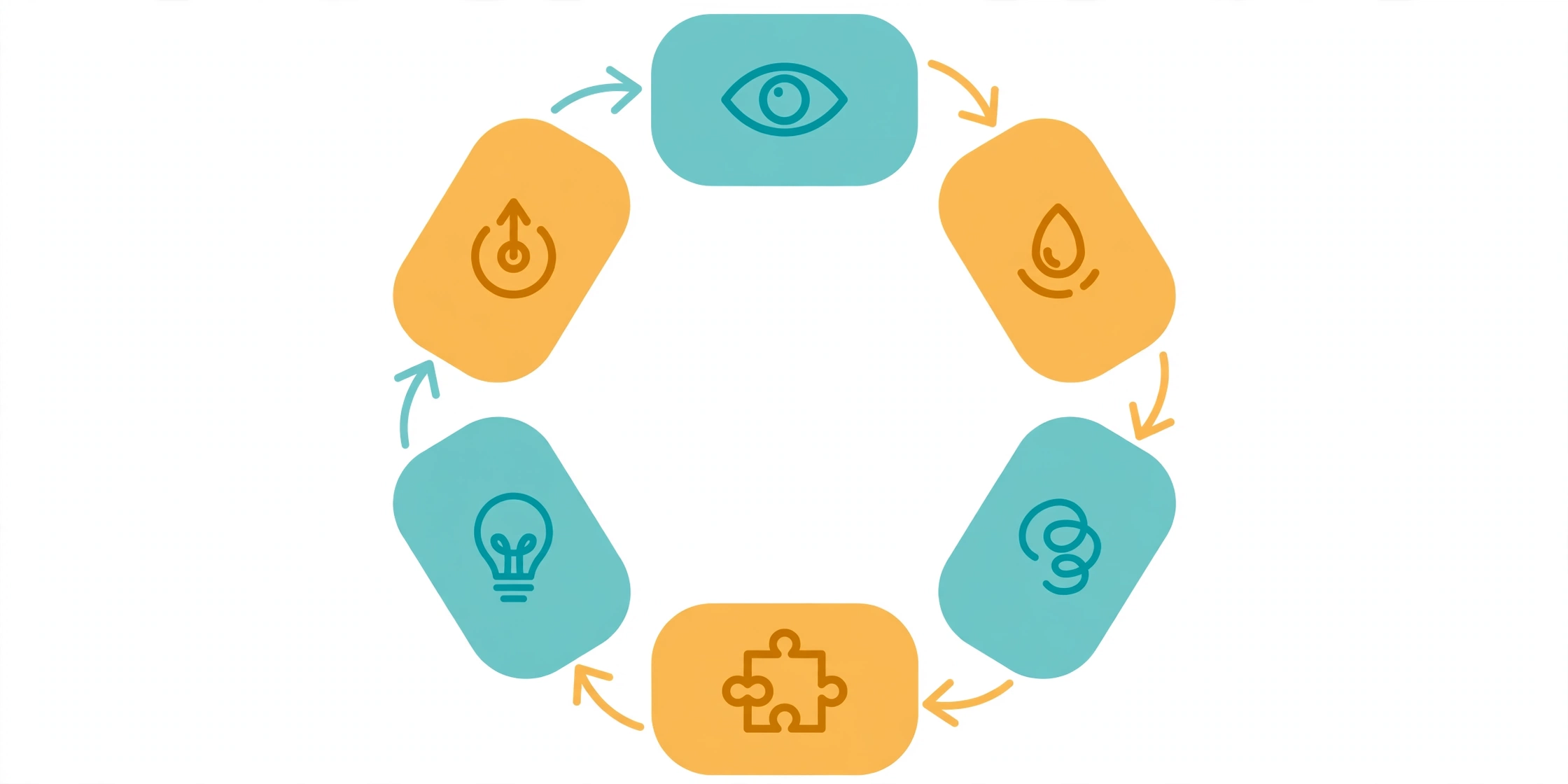
The Gibbs reflective cycle is a structured model of reflection developed by Professor Graham Gibbs in 1988. It breaks reflection into six stages — Description, Feelings, Evaluation, Analysis, Conclusion, and Action Plan — and asks you to work through them in order, returning to the start with each new experience. The cycle is deliberately circular: reflection is not a one-off exercise but a habit you repeat every time you encounter something worth learning from.
Who Uses the Gibbs Cycle — and Why Markers Like It
Gibbs’ reflective cycle is used most widely in nursing, teaching, social work, medicine, and other professional and placement-based courses, where students must show they can learn from real practice. Markers like it because it is explicit — a marker can see exactly where description ends and analysis begins — because it forces balance, and because it ends with action: not just what you thought, but what you will do differently. A reflection that ends with “I learned a lot” tells a marker very little; one that ends with a specific, testable action plan tells them you are ready for the next placement.
The 6 Stages of Gibbs’ Reflective Cycle at a Glance
Here is the whole reflective cycle in one view:
- Description — What happened?
- Feelings — What were you thinking and feeling?
- Evaluation — What was good and bad about the experience?
- Analysis — What sense can you make of the situation?
- Conclusion — What else could you have done?
- Action Plan — If it arose again, what would you do?
Each stage builds on the one before it. Description gives you the facts; feelings give you the human response; evaluation weighs the experience; analysis explains it with theory and evidence; conclusion draws the learning together; and the action plan turns that learning into a commitment. Skipping a stage is the most common reason a reflection feels thin.
The Worked Example We Will Use Throughout
To keep this guide concrete, every stage below draws on the same short scenario — a Gibbs cycle example built from a common placement situation: a student nurse’s first difficult conversation with a patient.
The scenario: A first-year student nurse on a ward placement is asked to explain to an elderly patient, Mrs A, that her discharge has been delayed by a day. The student rushes the explanation, uses clinical jargon, and leaves before Mrs A has finished asking questions. Mrs A becomes upset; the student’s mentor later talks through what happened.
Each stage below shows what to write, what not to write, and one or two short example sentences from this scenario. Short illustrative sentences only — this is a guide to the method, not a model reflective essay.
Stage 1: Description — What Happened?
Description is the foundation of the Gibbs reflective cycle. Here you set out the facts as clearly and neutrally as you can: who was involved, where and when it happened, what you did, what others did, and what the outcome was. Keep it brief — a paragraph is usually enough — and stick to what a witness could have observed.
What to write: the context, the sequence of events, and the outcome, in plain language. What NOT to write: your feelings (those come next), your analysis, or a judgement about whether the experience went well.
Example sentences: “On my second week of placement, my mentor asked me to tell Mrs A, an elderly patient, that her discharge had been delayed by a day. I explained the delay quickly, using the term ‘awaiting blood results’, and left the bedside before she had finished her questions. She became visibly upset, and my mentor spoke to me about the conversation afterwards.”
Notice how factual that is. It does not say the student felt guilty or that the explanation was poor — those belong in later reflective cycle stages.
Stage 2: Feelings — What Were You Thinking and Feeling?
The feelings stage is where many students either freeze or overdo it. Gibbs asks you to record what you thought and felt during the experience and afterwards — honestly, but with proportion. You are not writing a diary; you are showing a marker that you can notice your own emotional responses and understand how they shaped your behaviour.
Example sentences: “At the time I felt nervous and keen to finish quickly, because I was worried about using the wrong words. Afterwards I felt embarrassed that I had left before Mrs A finished speaking. I imagine she felt confused and unheard, which helps explain why she became upset.”
A useful habit is to name the feeling and link it to a behaviour: “I felt nervous, so I rushed.” That single link — feeling to action — is exactly what markers look for in reflective writing in nursing and other practice-based subjects.
Stage 3: Evaluation — What Was Good and Bad?
Evaluation asks you to make a balanced judgement about the experience: what went well and what went badly. Both halves matter. Students often write only about what went wrong, but a fair evaluation also notices what worked — otherwise the analysis has nothing positive to build on.
What to write: a clear, honest weighing of the good and the bad, with reasons for each judgement. What NOT to write: a verdict without evidence (“It was a disaster”) or positives invented to soften a bad experience.
Example sentences: “The conversation went badly in one respect: Mrs A did not understand the reason for the delay and was left upset. It went well in another: I did volunteer for the task, and my mentor’s debrief gave me clear feedback about slowing down and checking understanding.”
That balance is the point. Evaluation is not self-punishment; it is an honest audit you can learn from.
Stage 4: Analysis — What Sense Can You Make of It?
Analysis is the stage that separates a strong reflection from a weak one. Here you make sense of the experience using theory, evidence, and wider knowledge — not just your own opinion. In reflective writing for nursing, for example, this might mean drawing on communication theory or patient-centred care. In teaching or social work placements the theory will differ, but the move is the same: connect your experience to something beyond it.
What to write: the reasons behind what happened, supported by a concept, model, or piece of evidence from your course reading, and linked back to your evaluation. What NOT to write: unsupported opinion (“I think communication is important”) or a literature review disconnected from your experience. Every theoretical point should help explain something that actually happened.
Example sentences: “Communication research emphasises that patients understand less when information is given quickly and in technical language, which explains why my use of the phrase ‘awaiting blood results’ confused Mrs A. My nervousness also fits the pattern described in placement literature, where students under pressure tend to prioritise completing a task over checking the other person’s understanding.”
If you are unsure how to bring sources into a reflective piece, our guide on how to write a literature review will help you handle evidence cleanly: cite purposefully, and always tie the source back to your own experience.
Stage 5: Conclusion — What Else Could You Have Done?
The conclusion stage asks you to pull the learning together. What have you learned from this experience? What could you have done differently? What would you keep the same? This is a short stage — usually a few sentences — but it should feel earned, because it summarises everything the earlier stages have shown.
What to write: the main learning point, stated specifically, and one or two realistic alternatives to what you did. What NOT to write: a generic claim such as “I have learned the importance of communication” with no detail about what, precisely, you would change.
Example sentences: “I learned that explaining something clearly matters more than finishing quickly, and that checking a patient’s understanding is part of the task, not an optional extra. I could have used plain language, paused after the main point, and asked Mrs A what questions she had before leaving.”
Stage 6: Action Plan — If It Arose Again, What Would You Do?
The action plan is where the Gibbs reflective cycle turns reflection into professional development. You set out specific, practical steps you will take if a similar situation arises again — or steps you will take now to prepare for one. Vague intentions are not enough; the plan should be concrete enough that you (or a mentor) could check whether you did it.
What to write: two or three specific actions, each with a how and a when. What NOT to write: a wish list of qualities (“I will be more confident”) with no steps attached, or a plan so ambitious that nobody could follow it.
Example sentences: “If I need to give a patient difficult news again, I will plan two or three plain-language sentences in advance, pause after the main point, and use a teach-back check — asking the patient to explain the plan in their own words — before I leave. I will also ask my mentor to observe my next patient conversation and give me feedback on my pacing.”
Applying the Full Gibbs Cycle End to End: The Worked Example
Here is the same scenario run through all six reflective cycle stages in condensed form, so you can see how the stages connect into a coherent piece of reflective writing.
Description: On my second week of placement, I was asked to tell Mrs A that her discharge had been delayed by a day. I explained quickly, used the phrase “awaiting blood results”, and left before she finished her questions. She became upset, and my mentor debriefed me afterwards.
Feelings: I felt nervous and keen to finish quickly, then embarrassed that I had left too soon. Mrs A, I imagine, felt confused and unheard.
Evaluation: The conversation failed in its main purpose — Mrs A did not understand the delay — but volunteering for the task and receiving honest feedback were positives.
Analysis: Communication theory explains the failure: technical language delivered quickly leaves patients with little to hold on to, and my nervousness pushed me to prioritise finishing over checking understanding.
Conclusion: I learned that clear, checked understanding matters more than speed, and that I could have used plain language and paused for questions.
Action plan: Next time I will plan plain-language sentences in advance, pause after the main point, use a teach-back check, and ask my mentor to observe and give feedback.
Read as a whole, the reflection has a clear arc: facts, feelings, judgement, explanation, learning, and a plan. That arc is what the Gibbs reflective cycle is for. Use this condensed version as a template for your own reflective essay examples — just keep each stage in proportion and let the analysis do the heavy lifting.
4 Common Mistakes in Gibbs’ Reflective Writing (and How to Fix Them)
Mistake 1: Staying in Description
The most frequent weakness in Gibbs cycle examples written by students is a reflection that is almost all description: three paragraphs of what happened, then a sentence of conclusion.
Weak example: “I went to the ward, spoke to Mrs A, and then my mentor talked to me.”
Fix: Cap description at one paragraph. If you find yourself adding more detail, ask whether it changes your evaluation or analysis. If it does not, cut it.
Mistake 2: Skipping Feelings
Some students skip the feelings stage entirely, treating it as unacademic. In fact, omitting feelings leaves a gap in the logic: without them, your evaluation has no explanation for why you acted as you did.
Weak example: “The conversation did not go well. I will do better next time.”
Fix: Name one or two feelings and link each to a behaviour — “I felt nervous, so I rushed” — and consider how the other person may have felt. Two or three honest sentences are enough.
Mistake 3: No Theory or Evidence in Analysis
Analysis without theory is just opinion. A reflection that explains an experience only with “I think” and “I feel” will score lower than one that connects the experience to a concept from the course.
Weak example: “I think communication is very important in nursing and I should communicate better.”
Fix: Bring in one relevant idea from your reading — a communication model, a concept like patient-centred care, a study you have covered — and use it to explain something specific that happened.
Mistake 4: A Vague Action Plan
“I will try harder” is not an action plan. Neither is a list of qualities you hope to develop. Markers look for actions they could observe: something you will do, by when, and how you will know it worked.
Weak example: “In future I will be more confident and communicate better with patients.”
Fix: Write actions with a verb, a context, and a check: “Before my next placement I will practise explaining procedures in plain language with my mentor, and I will use a teach-back check in my next three patient conversations and note the results in my placement log.”
When to Use Gibbs vs Other Models
Gibbs is not the only reflection model. Kolb’s experiential learning cycle is broader and more theoretical — useful when an assignment asks you to connect experience with learning theory in general. Schön’s model distinguishes reflection-in-action (thinking while you act) from reflection-on-action (thinking afterwards), and suits situations where you made decisions in the moment under pressure. Gibbs is usually the better choice when an assignment asks for a structured, stage-by-stage reflection on a specific event, especially in nursing, teaching, or social work placements. If your brief names a model, use that one; if it does not, Gibbs is the safest default for a single-incident reflection.
Frequently Asked Questions
How long should each stage of the Gibbs reflective cycle be?
Description should be the shortest — roughly a paragraph. Feelings, evaluation, and conclusion are usually a paragraph each. Analysis is the longest stage, often two or three paragraphs, because it carries the theory and evidence. The action plan is short but specific.
Can I use Gibbs’ reflective cycle in a nursing essay?
Yes — reflective writing in nursing is one of the most common uses of the Gibbs model of reflection. Placement portfolios, reflective accounts, and assessed essays all use it. Just keep patient details anonymous and generic, as in the example in this guide, and follow your institution’s confidentiality rules.
Do I have to follow the six stages in order?
In most assignments, yes. The stages build on each other, and markers often check that each one is present. In a short reflective piece you can combine stages briefly — for instance, folding the conclusion into the action plan — but never drop the analysis or the action plan.
What is the difference between Gibbs’ cycle and Kolb’s cycle?
Kolb’s cycle is a general theory of how people learn from experience, with four stages and a strong emphasis on abstract conceptualisation. Gibbs’ reflective cycle is a practical tool for writing about a specific experience, with six stages including an explicit feelings stage and an action plan. Gibbs is more prescriptive and easier to follow for a single reflective essay; Kolb is more useful for discussing learning in general.
Final Thoughts
The Gibbs reflective cycle works because it is honest about how learning from experience actually happens: you describe what happened, notice how you felt, judge what went well and badly, explain it with theory, draw out the learning, and commit to a specific change. Start with the facts, be honest about the feelings, let the analysis do the work, and finish with a plan you could actually follow.