


Choosing compare and contrast essay topics is easier when the pair itself does the thinking for you. The best pairs are related but not identical: two things that share enough ground to be compared fairly, yet differ in ways that matter. Online classes and in-person classes work because both aim to teach, but they organise time, attention and interaction very differently. Two unrelated subjects, by contrast, leave you with nothing useful to say.
This list gives you 80 compare and contrast essay topics for students, grouped by theme. Every topic comes with an angle — the aspect worth focusing on — and a deciding question, the question your essay should answer. Once you can answer it with evidence, you have an essay, not just a list of similarities and differences. For a fuller method, read our guide on how to write a compare and contrast essay.
How to Choose a Compare and Contrast Essay Topic
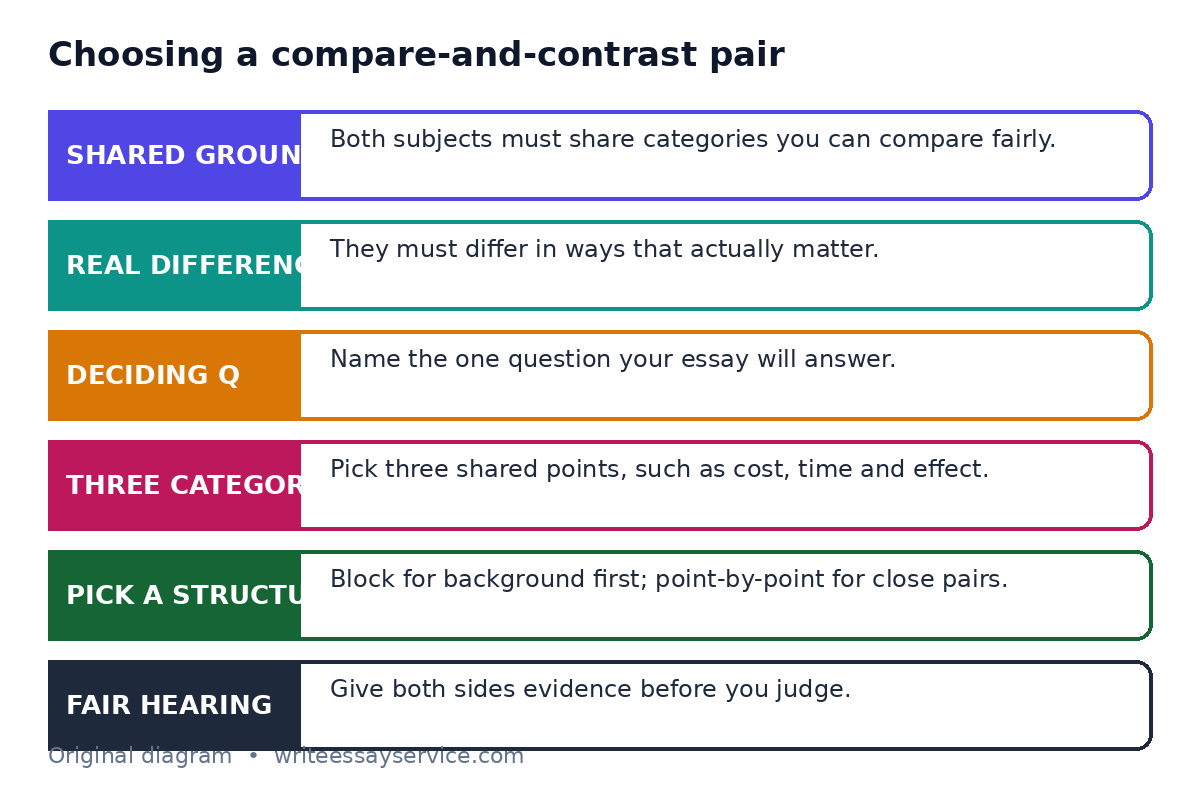
Start with shared categories, not with a vague feeling that two things are "similar". A workable pair can be compared on the same points: cost, time, effort, health, learning, freedom, environmental impact, or social effect. If you cannot name three categories that apply to both subjects, the pair is probably too loose. A good test is to write the categories down first — for example, flexibility, concentration and social contact for online versus in-person classes — and check that each one genuinely applies to both sides.
Then choose your structure. In a block structure, you discuss one subject fully, then the other. In a point-by-point structure, you take one category at a time and compare both subjects under each heading. Point-by-point usually works better for close pairs; block structure suits pairs where each subject needs its own context first. Your introduction should name the pair, explain why the comparison matters, and state the deciding question.
School and Learning
These comparison essay topics 2026 work well for education, study skills and classroom assignments, because every student has direct experience of both sides.
- Online classes vs in-person classes
Angle: flexibility, focus and social contact. Deciding question: Which setting helps a particular kind of student learn better, and why? - Public schools vs private schools
Angle: funding, class size and opportunity. Deciding question: Does the difference in resources change what students actually learn? - Studying alone vs studying in a group
Angle: concentration, motivation and depth of understanding. Deciding question: Which approach produces better long-term recall for difficult material? - Handwritten notes vs typed notes
Angle: memory, speed and organisation. Deciding question: Does slower, handwritten note-taking lead to deeper processing of ideas? - Traditional exams vs project-based assessment
Angle: what each method actually measures. Deciding question: Which method gives a fairer picture of what a student knows and can do? - Homeschooling vs classroom schooling
Angle: personalisation, social life and structure. Deciding question: What does a child gain, and what does a child miss, in each setting? - Learning a language through an app vs in a class
Angle: speaking practice, feedback and consistency. Deciding question: Which route builds usable speaking skill faster for a beginner? - Reading a textbook vs watching a video lesson
Angle: pace, revision and attention. Deciding question: Which format helps a student master a difficult concept first time? - Morning classes vs evening classes
Angle: alertness, routine and attendance. Deciding question: Does the time of day change how much students take in? - Memorisation vs understanding concepts
Angle: exam results and long-term use. Deciding question: When, if ever, is memorisation the more useful strategy? - Single-sex schools vs co-educational schools
Angle: confidence, classroom dynamics and social development. Deciding question: Does separating students by sex change participation or achievement? - Essay exams vs multiple-choice exams
Angle: depth, fairness and marking. Deciding question: Which format better rewards real understanding rather than recognition? - One-to-one tutoring vs learning in a large class
Angle: personal feedback, cost and pace. Deciding question: Is individual attention worth the extra cost for a struggling student? - Taking a gap year vs starting university straight away
Angle: maturity, motivation and money. Deciding question: Does a year out make a student more ready, or less? - Vocational training vs a university degree
Angle: employability, debt and practical skill. Deciding question: Which route leads to steadier work for a school leaver? - School uniforms vs free dress
Angle: identity, equality and cost. Deciding question: Do uniforms reduce pressure, or simply move it elsewhere?
Technology
Technology pairs change fast, so these compare and contrast essay ideas reward up-to-date examples and honest weighing of trade-offs rather than hype.
- Smartphones vs laptops for studying
Angle: portability, distraction and screen size. Deciding question: Which device supports focused study, and which invites interruption? - E-books vs printed books
Angle: convenience, eye strain and retention. Deciding question: Does the format change how much a reader remembers? - Social media vs face-to-face conversation
Angle: connection, misunderstanding and depth. Deciding question: Which form of contact builds stronger relationships? - AI tutors vs human teachers
Angle: instant feedback, patience and encouragement. Deciding question: What can a human teacher do that an AI tutor cannot? - Streaming services vs the cinema
Angle: cost, choice and shared experience. Deciding question: Is watching at home a replacement for cinema, or a different experience altogether? - Email vs instant messaging at school or work
Angle: formality, speed and record-keeping. Deciding question: Which channel suits a message that matters? - Video games vs board games
Angle: social play, creativity and screen time. Deciding question: Which kind of game teaches cooperation better? - Cloud storage vs an external hard drive
Angle: access, security and cost over time. Deciding question: Which option protects important files more reliably? - Virtual reality lessons vs traditional classroom lessons
Angle: immersion, cost and accessibility. Deciding question: Does immersion improve learning enough to justify the equipment? - Android vs iPhone
Angle: choice, price and ease of use. Deciding question: Which system gives an ordinary user more control over their phone? - Search engines vs AI chatbots for research
Angle: sources, accuracy and verification. Deciding question: Which tool makes it easier to check whether an answer is true? - Online news vs printed newspapers
Angle: speed, depth and trust. Deciding question: Which format helps a reader understand a story rather than just hear about it? - Passwords vs biometric login
Angle: security, convenience and privacy. Deciding question: Which method is safer when a device is lost or stolen? - Remote work vs office work
Angle: productivity, collaboration and wellbeing. Deciding question: Which arrangement suits work that depends on teamwork? - Podcasts vs audiobooks
Angle: learning, entertainment and attention. Deciding question: Which audio format teaches a new subject more effectively? - Digital calendars vs paper planners
Angle: reminders, habit and focus. Deciding question: Which system is a busy student more likely to keep using?
Books, Film and Media
These topics suit literary analysis and media studies, where the comparison should stay close to the texts themselves rather than general opinion.
- A novel vs its film adaptation
Angle: what film gains in image and loses in interior thought. Deciding question: Which version tells the story more powerfully, and for whom? - Fiction vs non-fiction
Angle: truth, imagination and persuasion. Deciding question: Which form changes a reader's mind more effectively? - Poetry vs prose
Angle: compression, rhythm and meaning. Deciding question: What can a poem say in a few lines that prose needs pages to say? - Superhero films vs historical dramas
Angle: spectacle, accuracy and moral clarity. Deciding question: Which genre helps audiences think harder about right and wrong? - Documentaries vs dramas based on true events
Angle: evidence, emotion and invention. Deciding question: When does dramatising a true story mislead the audience? - Short stories vs novels
Angle: focus, character and time. Deciding question: Which form suits a single turning point in a life? - Comedy vs tragedy
Angle: audience response, truth and relief. Deciding question: Which genre reveals human weakness more honestly? - Children's picture books vs young adult novels
Angle: image, language and theme. Deciding question: How does each form introduce a young reader to a difficult idea? - Print journalism vs online journalism
Angle: deadlines, depth and correction. Deciding question: Which form produces more careful reporting? - Reality TV vs scripted TV
Angle: authenticity, editing and entertainment. Deciding question: How real is "reality" once a camera and an edit are involved? - Biographies vs autobiographies
Angle: perspective, bias and evidence. Deciding question: Whose account of a life should a reader trust more? - Fantasy vs science fiction
Angle: imagined worlds, rules and relevance. Deciding question: Which genre says more about the world we actually live in? - Classic literature vs contemporary literature
Angle: language, theme and accessibility. Deciding question: Does a classic earn its reputation, or survive on it? - Musicals vs straight plays
Angle: music, emotion and storytelling. Deciding question: When does a song advance a story better than dialogue? - Horror films vs thrillers
Angle: fear, suspense and resolution. Deciding question: Which genre keeps an audience engaged after the shock fades? - Graphic novels vs traditional novels
Angle: image, pacing and interpretation. Deciding question: Does showing a scene in pictures limit or expand the reader's imagination?
Daily Life and Choices
Everyday pairs are ideal compare and contrast essay topics for students who want a topic they can research from experience, observation and simple data.
- Cooking at home vs eating out
Angle: cost, health and time. Deciding question: Which option is genuinely cheaper once time and waste are counted? - Walking vs cycling to school or work
Angle: health, speed and safety. Deciding question: Which journey is more practical for a daily commute? - Living in a city vs living in a small town
Angle: opportunity, cost and community. Deciding question: Which setting gives a young person a better start? - Renting a home vs buying a home
Angle: freedom, stability and long-term cost. Deciding question: When does renting make better financial sense than buying? - Saving money vs spending on experiences
Angle: security, memory and regret. Deciding question: Which choice leaves people more satisfied a year later? - Being an early riser vs being a night owl
Angle: energy, productivity and health. Deciding question: Does the best working time depend on the person or the task? - Tea vs coffee
Angle: culture, caffeine and ritual. Deciding question: Which drink shapes daily routine more, and how? - Travelling by train vs travelling by plane
Angle: time, cost and carbon footprint. Deciding question: For a medium-distance journey, which option wins overall? - Living alone vs living with flatmates
Angle: privacy, cost and companionship. Deciding question: Which arrangement supports a student's studies better? - Shopping online vs shopping in stores
Angle: choice, price and experience. Deciding question: Which method leads to fewer regretted purchases? - Keeping a paper diary vs a digital journal
Angle: privacy, habit and reflection. Deciding question: Which format encourages more honest reflection? - Exercising at home vs at a gym
Angle: motivation, equipment and cost. Deciding question: Which setting helps a beginner keep exercising after the first month? - A vegetarian diet vs an omnivorous diet
Angle: health, cost and environmental impact. Deciding question: Which diet is easier to sustain well on a student budget? - Living with parents as an adult vs moving out
Angle: independence, money and family. Deciding question: What is gained and lost by leaving home early? - Paying by cash vs paying by card
Angle: budgeting, security and convenience. Deciding question: Which payment method helps people spend less? - Summer holidays vs winter holidays
Angle: weather, cost and activity. Deciding question: Which season offers better value for a family holiday?
Society and the Environment
These pairs connect personal choices to public questions, so they work well when your essay needs evidence beyond personal opinion.
- Electric cars vs petrol cars
Angle: running cost, range and emissions. Deciding question: Which car is the better choice for an ordinary driver today? - Recycling vs reducing what you buy
Angle: effort, impact and habit. Deciding question: Which action cuts household waste more effectively? - Solar power vs wind power
Angle: weather, land and reliability. Deciding question: Which source suits a particular region better, and why? - Public transport vs private cars
Angle: congestion, cost and freedom. Deciding question: What would make public transport the obvious choice in a city? - Working in the public sector vs the private sector
Angle: security, pay and purpose. Deciding question: Which sector offers a more satisfying career for a graduate? - Volunteering time vs donating money
Angle: impact, commitment and reach. Deciding question: Which contribution helps a charity more? - Living in a high-rise flat vs a house with a garden
Angle: space, community and nature. Deciding question: Which home supports wellbeing better for a family? - Paper bags vs reusable cloth bags
Angle: production, reuse and waste. Deciding question: How many times must a cloth bag be reused to beat paper? - Protecting wildlife in zoos vs in nature reserves
Angle: safety, freedom and education. Deciding question: Which approach protects a species better in the long term? - Small local shops vs large supermarkets
Angle: price, choice and community. Deciding question: What does a town lose when its local shops close? - A four-day working week vs a five-day working week
Angle: productivity, rest and pay. Deciding question: Does a shorter week produce the same work with less strain? - Mandatory voting vs voluntary voting
Angle: turnout, freedom and legitimacy. Deciding question: Does forcing people to vote make democracy stronger? - Planting new trees vs protecting existing forests
Angle: time, carbon and habitat. Deciding question: Which action protects wildlife and climate faster? - Eating locally grown food vs imported food
Angle: freshness, cost and food miles. Deciding question: Is local food always the lower-impact choice? - Banning single-use plastic vs taxing it
Angle: behaviour, fairness and enforcement. Deciding question: Which policy changes habits without punishing low-income shoppers? - Climate activism online vs climate activism in person
Angle: reach, commitment and results. Deciding question: Which form of activism turns attention into action?
How to Turn a Topic into an Essay
Pick one topic and one deciding question, then commit to it: a comparison that tries to answer three questions at once usually answers none of them. Gather evidence for both sides under the same categories — for example, cost, time and effect — and note where the evidence is strongest and where it is thin.
Draft a thesis that answers the deciding question directly, not one that merely says the two subjects are similar and different. "Online classes suit self-directed learners better than in-person classes, because flexibility matters more than classroom discussion for that group" is a thesis; "Online and in-person classes have similarities and differences" is not. Organise the body point by point or in blocks, give each side a fair hearing, and finish by returning to the question with a clear, qualified answer. Learning how different essay types argue will also sharpen your comparison — see the difference between persuasive vs argumentative essays before you choose your tone.
Frequently Asked Questions
What makes a good compare and contrast essay topic?
A good compare and contrast essay topic pairs two subjects that share clear categories — such as cost, time or effect — but differ in ways worth discussing. If you can name three shared categories and a deciding question, the topic is workable.
How do I choose a compare and contrast topic for school?
Start from your subject and your own experience, then test the pair: can both sides be compared on the same points, and is there enough reliable evidence for each? Compare and contrast essay topics for students work best when the answer is not obvious before you start researching.
Should I use block or point-by-point structure?
Use point-by-point when the subjects are closely matched and the reader benefits from seeing each contrast at once. Use block structure when each subject needs its own background first, then compare them explicitly in your conclusion.
How many points of comparison should an essay have?
Three or four well-developed points are usually enough. More points often mean thinner paragraphs; fewer points can leave the comparison feeling one-sided. Choose the points that matter most to your deciding question.