



The introduction is the first thing a marker reads, and it sets the standard for everything that follows. A strong opening tells the reader exactly what the essay will argue and why it matters; a weak one makes the marker work to find the point — and markers rarely reward them for the effort.
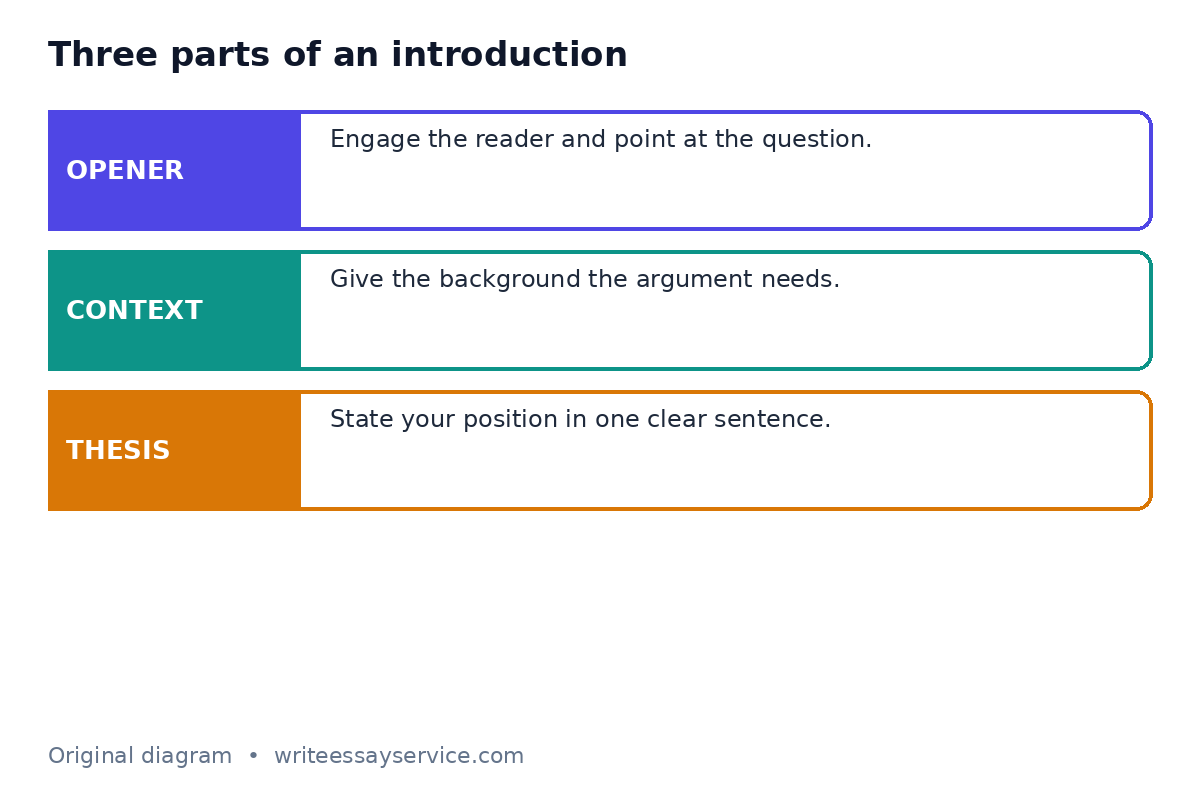
Learning how to write an essay introduction is not about finding a clever first sentence. It is about building a short paragraph that does three jobs: it engages the reader, it gives the context the argument needs, and it states a clear thesis. This guide explains how to write an introduction for an essay that does all three, with five openers you can adapt, each with a worked example.
What Markers Look for in an Introduction
A clear thesis. The single most important sentence in an introduction is the thesis statement — the claim your essay will defend. A marker should be able to underline it. If your introduction ends without a clear position, the essay reads as a tour of the topic rather than an argument. Our guide to how essays are marked, including command words and mark schemes explains how examiners use the question wording to judge every part of an essay, including the opening.
Relevance from the first line. Every sentence in the introduction should point towards the question asked. General background that could open any essay on the topic — “Since the beginning of time, people have…” — wastes the reader’s attention and signals that the writer has not yet thought about this particular question.
Control of scope. A good introduction tells the reader what the essay will cover and, just as importantly, what it will not. A short sentence that narrows the question — “This essay focuses on…” — shows the marker you are in charge of the argument.
A sense of direction. The reader should finish the introduction knowing the route the essay will take: the main points, in the order they will appear. That map is what separates a confident essay from one that wanders.
The Job of an Introduction: Three Parts
1. The opener. One or two sentences that engage the reader and point at the question. This is the part most students overthink. It does not need to be dramatic — it needs to be relevant.
2. The context. Two or three sentences that give the reader the background the argument needs: the key terms, the debate, or the situation the question arises from. Keep it short. Context is a bridge, not a second essay.
3. The thesis. One sentence that states your position clearly, followed if useful by a brief map of the points that will support it. The thesis is the destination; the opener and the context are the road to it.
A typical school or college introduction runs 100 to 150 words — roughly five to seven sentences. If yours is longer, you are probably writing the body in the introduction.
Five Openers That Earn Marks
Each opener suits a different kind of essay. Choose the one that fits your question and your thesis. Every example below is a complete model introduction for a practice question — study the pattern, then apply it to your own topic.
1. The Surprising Fact
The surprising fact opens with a specific number or finding that makes the reader pause, then connects it to the question. It works because it gives the essay an evidence-based starting point rather than a vague generalisation.
Worked example: “In 2025, a survey of UK undergraduates found that 92 per cent had used AI tools in their studies. Yet most universities still had no clear rule on what counted as acceptable help. This essay argues that students should be allowed to use AI for research and drafting, provided they disclose it and cite it like any other source — because the skills that matter are judgement and honesty, not pretending the tools do not exist.”
When it works best: When the question concerns a topic with real data behind it — technology, health, education, the environment — and when the fact genuinely surprises. When it fails: When the “fact” is vague (“Many people…”), unverified, or so loosely connected to the question that the reader wonders why it is there.
2. The Question
The question opener asks the reader the essay’s central question directly, then answers it in the thesis. It is simple, honest and hard to get wrong — which is why it is a good choice under exam pressure.
Worked example: “Should schools ban mobile phones? The question divides parents, teachers and pupils, and the answer is less simple than either side admits. This essay argues that a blanket ban goes too far: phones are a genuine distraction in lessons, but they are also a tool for research, safety and organisation, so the sensible policy is to restrict them in class while teaching pupils to use them well.”
When it works best: For “Should…?”, “To what extent…?” and “Is…?” questions, where the essay’s job is to answer a clear question. When it fails: When the question is rhetorical decoration — asked and then ignored — or when the essay asks three questions and answers none of them.
3. The Short Scene
The short scene opens with one concrete moment — a person, a place, a small event — and uses it to raise the essay’s question. It suits reflective and narrative essays, and any discursive essay where a human moment makes the issue real.
Worked example: “At eight o’clock on a Monday morning, a Year 10 pupil opens her school bag and finds her homework soaked through. The night before, she had finished it carefully. The rain, the bus and a broken umbrella did the rest. This essay argues that homework should be set with the realities of pupils’ lives in mind: tasks that depend on perfect conditions punish the unlucky, not the lazy.”
When it works best: When the topic is human and concrete — school life, family, community, work — and when the scene genuinely raises the question your thesis answers. When it fails: When the scene is invented to be dramatic rather than relevant, or when it runs so long that the introduction becomes a story with no argument.
4. The Definition
The definition opener takes a key word from the question, explains what it means — and, more usefully, where its meaning is disputed — and builds the thesis from that disagreement. It is the strongest opener for definition and conceptual questions.
Worked example: “Success is usually defined by results: grades, salary, trophies. Yet ask ten people what success means and you will get ten different answers — and some of them will contradict the results entirely. This essay argues that success is better understood as the ability to keep learning from failure than as any single achievement, because achievements end while learning does not.”
When it works best: When the question turns on a word whose meaning is genuinely contested — success, freedom, justice, fairness, intelligence. When it fails: When the definition is copied from a dictionary and adds nothing, or when the essay defines a word nobody disputes and then never returns to it.
5. The Contrast
The contrast opener places two things side by side that do not fit together, and lets the tension between them raise the question. It signals to the marker that the essay will handle complexity rather than picking one side and ignoring the other.
Worked example: “The same phone that lets a teenager translate a menu in Tokyo also keeps her awake until 2 a.m. scrolling through videos she does not remember watching. Technology in education carries the same contradiction: it is both the most powerful learning tool ever built and the most reliable distraction in the classroom. This essay argues that schools should teach pupils to manage that contradiction, rather than pretending it can be solved by banning the device.”
When it works best: For topics with genuine tension — technology, tradition and change, freedom and safety — where the essay’s argument will weigh both sides. When it fails: When the contrast is forced, or when the two sides are not really in tension and the opening feels like a trick.
How to Choose Between the Five Openers
If the question asks for a judgement, start with the question. If the topic has striking data, start with the surprising fact. If the topic is human and concrete, start with a short scene. If the question turns on a contested word, start with the definition. If the topic holds a real tension, start with the contrast.
Whichever opener you choose, write it after you have planned the essay — our guide to planning a 500-word essay in 10 minutes shows how to settle your thesis before you write a word. An introduction written before the plan usually has to be rewritten; an introduction written after the plan almost writes itself.
Good essay introduction examples all share the same shape: an opener that earns attention, two or three sentences of context, and a thesis that states a position. If you are learning how to start an essay, practise that shape with different openers on the same question — you will quickly feel which one fits.
What to Avoid in an Essay Introduction
“Since the beginning of time…” and other empty openers. Phrases like “Throughout history”, “In today’s modern world” and “Since the dawn of civilisation” say nothing about your question. Cut them and start with something real.
Announcing the essay instead of arguing. “This essay will discuss…” tells the reader what you are about to do; a thesis tells them what you think. State the position, not the plan.
A thesis that is really a topic. “This essay is about school uniforms” is a topic, not a thesis. “School uniforms reduce visible inequality but limit self-expression, and on balance the cost is too high” is a thesis — it takes a position a reader could disagree with.
Saving the argument for later. Some students write an introduction that only describes the topic and hope the argument will appear in the body. It rarely does. Put your position in the introduction, even if you refine the wording later.
Writing the introduction first. The introduction is the hardest paragraph to write before you know what you think. Plan the essay, draft the body, then write the introduction last — it will be shorter, sharper and truer to the argument you actually made.
Frequently Asked Questions
How long should an essay introduction be?
For a typical school or college essay, aim for 100 to 150 words — roughly five to seven sentences. That is enough for an opener, two or three sentences of context, and a thesis with a brief map of your points. Longer introductions usually contain body material that belongs later.
What is the difference between a hook and an introduction?
A hook is the first sentence or two — the part that grabs attention. The introduction is the whole opening paragraph: the hook, the context and the thesis together. Our guide to hooks that work, and when each one fails explains seven hook types in detail; this guide shows you how to build the full paragraph around one.
Can I start an essay with a question?
Yes — provided the essay answers it. A question opener works well for “Should…?” and “To what extent…?” questions, because it states the essay’s central question plainly. It fails when the question is asked and then ignored, so make sure your thesis answers the question you opened with.
Should the introduction contain evidence?
A single striking fact can open an introduction well, but detailed evidence belongs in the body. Keep the introduction to one fact at most; its job is to set up the argument, not to prove it.
How do I write a thesis statement for my introduction?
State your position in one sentence that a reasonable person could disagree with, then add the strongest reason for it. For example: “Schools should restrict phones in lessons, because the evidence shows they reduce concentration, even though they are useful tools outside class.” If your sentence could not be argued against, it is a fact, not a thesis — sharpen it until someone could disagree.

