



Introduction
If you have ever finished an essay, felt pleased with it, and then received a lower mark than you expected, you are not alone. The gap is rarely about effort: students write what they think a good essay looks like, while markers reward something more specific.
An essay mark scheme is a set of criteria that tells a marker what to look for and what separates a good answer from an excellent one. Once you understand those criteria, and once you answer the exact question the command word is asking, your writing becomes far more focused.
This guide explains, in plain English, how a mark scheme is built, what each common command word asks you to do, and how grade boundaries work. It is general, exam-board-neutral advice.
How Essays Are Marked: What a Mark Scheme Really Is
A mark scheme, sometimes called a marking rubric, is the document a marker uses to judge your work fairly and consistently. Instead of relying on a general impression, the marker checks your essay against a list of qualities, each linked to a number of marks.
Think of it as a recipe rather than a single score. A marker asks smaller questions: Is there a clear argument? Is it supported by evidence? Is the essay organised logically? Is the language clear? Are sources used properly? Your final mark is the sum of the answers.
Most mark schemes share the same building blocks, even when the wording differs. A strong essay does not need to be perfect in every area, but it does need to perform well across most of them. Markers also look for relevance: every paragraph should connect back to the question. Interesting but off-topic material does not earn credit, however well written it is.
The Five Criteria in an Essay Mark Scheme
Although wording varies between courses, an essay mark scheme usually covers five broad areas.
| Criterion | What the marker looks for | Where marks are often lost |
|---|---|---|
| Argument and analysis | A clear, focused answer, developed step by step | No clear position; points listed without explanation |
| Evidence and sources | Relevant evidence from reading, used to support points | Claims with no support; sources quoted but not explained |
| Structure | A logical flow, with an introduction, linked paragraphs and a conclusion | Repetition; paragraphs that mix several ideas |
| Language and style | Clear, accurate academic English, easy to follow | Long, tangled sentences; vague wording; frequent errors |
| Referencing | Sources acknowledged correctly and consistently | Missing citations; a reference list that does not match the text |
Argument and analysis
This is usually the most heavily rewarded part of an essay. A marker wants a reasoned response, visible early in the introduction and developed through the essay. Each paragraph should make a point that supports that central argument.
Good analysis goes beyond description. It explains why something matters and how it connects to the question. If you write paragraphs of summary with little comment of your own, the analysis needs more work. After each paragraph, ask, “So what?” If you cannot answer, add a sentence explaining its significance. Learning how to write a thesis statement is a practical starting point, because a clear thesis gives your essay direction.
Evidence, structure, language and referencing
Evidence turns an opinion into an argument. Choose fewer, stronger sources, and explain each one: a quotation followed by a sentence saying what it shows earns far more than a quotation left on its own. Sources should support your reasoning, not replace it.
Structure is the skeleton of your essay. Start each paragraph with a clear topic sentence, develop the point, and end with a sentence linking back to the question. Signposting words such as “however” and “therefore” make those connections visible. Markers want clarity, not complicated vocabulary: short, well-built sentences beat long, tangled ones, and precise words beat vague ones. Read the essay aloud at the end; awkward sentences and small errors are much easier to spot that way.
Referencing shows where your ideas came from. Markers check that citations are present, match the reference list, and use one style consistently. Note full source details as you read. If you are unsure how to present a citation, learning how to cite sources in an essay will help you get the basics right.
Essay Command Words: What Analyse, Evaluate and Discuss Actually Ask You To Do
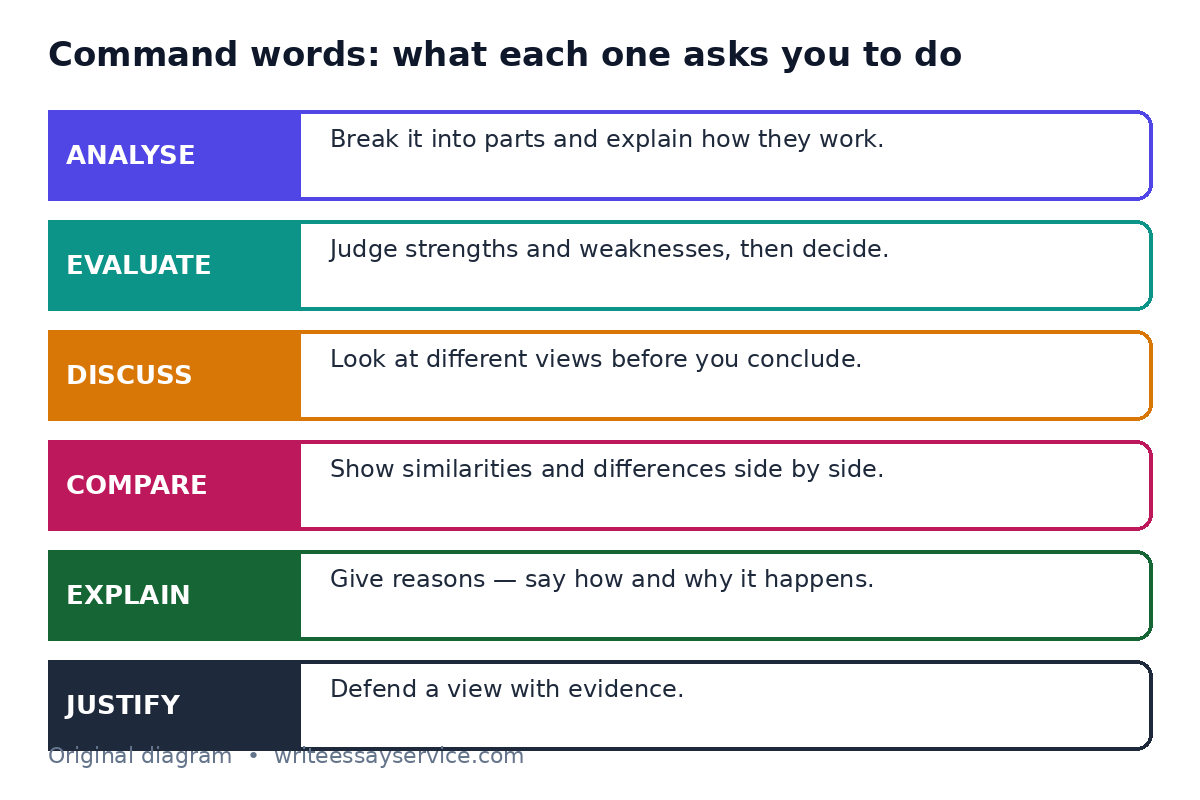
The command word in an essay question is an instruction, not decoration. It tells you what kind of thinking the marker will reward. Many students lose marks not because their knowledge is weak, but because they answer a different question from the one set.
| Command word | One-line action | Strong response | Weak response |
|---|---|---|---|
| Analyse | Break the topic into parts; explain how they relate | Examines each cause, then explains how they combine | Retells the topic without explaining why parts matter |
| Evaluate | Make a reasoned judgement, using evidence | Weighs strengths and weaknesses, then concludes | Lists pros and cons without a clear judgement |
| Discuss | Explore different views and their implications | Compares perspectives and explains what follows | Gives one side only, or lists views without comment |
| Compare | Show similarities and differences, and why they matter | Pairs points side by side, using the same features | Describes one thing, then the other, with no comparison |
| Explain | Give reasons, or show how something works, step by step | Sets out the process clearly, step by step | States that something happened, without reasons |
| Assess | Judge how important or effective something is | Uses clear criteria and reaches a balanced judgement | Gives a personal opinion with little evidence |
| Justify | Give reasons supporting a decision, view or claim | Builds a case with evidence; answers the main objection | Repeats the claim without adding reasons |
| Describe | Give an accurate, detailed account | Covers key features in a logical order | Gives a vague outline, or drifts into evaluation |
Analyse, evaluate and discuss
To analyse is to take something apart. Group the causes, look at each in turn, and explain how they interact. Which was most important? Did one cause lead to another? A strong analysis shows the connections between parts, not just the parts themselves.
To evaluate is to judge, and the marker wants a conclusion that is earned, not asserted. Set out the evidence on both sides, weigh it, and then decide. Name your criteria: effective at what, for whom, and compared with what? Avoid sitting on the fence, and avoid a one-sided verdict that ignores the evidence against it.
To discuss is to explore. Consider more than one interpretation, explain the reasoning behind each, compare them, and say what follows if each is correct. End with a short synthesis: which view is most convincing, and why?
Compare, explain, assess, justify and describe
Match your method to the word. To compare, use the same points of comparison for both sides. To explain, work through causes in order. To assess, judge significance against clear criteria. To justify, build a case and deal with the strongest objection. To describe, give an accurate account, and resist evaluating when the question has not asked you to.
Underline the command word when you first read the question, and write it at the top of your plan. Check every paragraph against it; if a paragraph does not help you do what the question asks, cut it or rewrite it.
How Essay Grade Boundaries Work in Plain English
A grade boundary is the lowest mark needed to reach a particular grade. That sounds simple, but the way boundaries are set is often misunderstood.
Boundaries are not always fixed in advance, and they are not the same every year. In many systems, they are set after marking, once examiners have seen how students performed. The aim is to keep standards consistent, so a grade means roughly the same thing even if one year’s paper was slightly harder or easier than the last.
So it is unwise to aim for an exact number. You cannot know in advance where the boundary will fall, and different institutions set their own scales. Think in levels, not numbers: a lower-level answer describes and lists, a mid-level answer explains and uses evidence, and a higher-level answer analyses, evaluates and reaches a reasoned conclusion.
Marking is not an exact science, and small differences of judgement can occur. That is why some systems use moderation or second marking. You cannot control that, but you can make your essay easy to mark well: clear structure, a visible argument and explicit signposting help a marker see what the mark scheme rewards.
A Checklist for Targeting Marks Before You Submit
Use this checklist after your first draft. It catches the most common reasons for lost marks.
- Command word: does every main paragraph help you do what the question asks?
- Argument: can a reader state your answer in one sentence after the introduction?
- Paragraphs: does each paragraph make one point, stated in its first sentence?
- Evidence: have you explained every quotation or example, saying what it shows?
- Other views: have you dealt with a counter-argument where the question asks for one?
- Structure: read only the topic sentences in order — do they tell the story of your argument?
- Conclusion: does it pull the argument together, without new evidence?
- Sources: does every source in the text appear in the reference list, and vice versa?
- Proofreading: have you read the essay aloud and fixed long sentences and vague words?
- Relevance: have you cut anything off-topic, however interesting it is?
Work through the list and fix what it finds, and the essay will usually be shorter, clearer and stronger than the first draft. Good essays are often made in the revision.
Frequently Asked Questions About How Essays Are Marked
What do essay markers look for first?
Markers look first for relevance and a clear argument. They want to see that you have answered the question set and developed a position through the essay. Evidence, structure and language matter too, but they support the argument rather than replacing it.
How can I tell what an essay command word is asking me to do?
Start with the verb. Analyse means break the topic into parts and explain the links. Evaluate and assess mean make a supported judgement. Discuss means explore different views. Compare means show similarities and differences. Explain means give reasons. If unsure, rewrite the question as an instruction: “In this essay, I need to…”
What is the difference between describing and analysing in an essay?
Describing tells the reader what something is or what happened. Analysing explains why it matters, how its parts fit together, and what it means for the question. Most essay questions reward analysis more than description, so keep description brief.
Do essay grade boundaries stay the same every year?
Not necessarily. In many systems, grade boundaries are set after marking, so standards stay broadly consistent even when papers vary in difficulty. The same raw mark can therefore lead to a different grade in different years. Focus on the qualities that distinguish one level from the next, such as depth of analysis.
How much does referencing affect my essay mark?
Referencing usually forms part of the mark scheme. Clear, consistent referencing shows you have used sources honestly and lets the marker check your evidence. Missing citations, a mismatched reference list, or paraphrasing too close to the original can all lose marks.
Can a well-structured essay still get a low mark?
Yes, if the content does not match the question. Structure helps a marker follow your argument, but it cannot replace the argument itself. An essay will still score poorly if it describes instead of analysing, lacks evidence, or never reaches a judgement when the question asked for one.
Final Thoughts
Understanding how essays are marked does not make writing easy, but it does make it fairer. You no longer have to guess what the marker wants: you can plan around the criteria and check your work against a clear standard before you submit it.
Start with the question, not with the first sentence. Decide what the command word asks you to do, plan an argument that answers it, and choose evidence that supports each step.