



A literature review is one of the most misunderstood assignments in university. Students treat it as a summary of everything they read — a list of studies, one after another — and then wonder why the mark is low. The problem is not the reading. It is the missing step: a literature review is not a summary of sources. It is an argument about what those sources, taken together, show.
Learning how to write a literature review means learning to synthesise: to put sources into conversation with each other, to find where they agree and disagree, and to show the gap your own work will fill. This guide explains the structure, the method, and the mistakes to avoid.
What a Literature Review Actually Is
A map of the field. A good review shows the reader the shape of the research on a topic: the main approaches, the key debates, and the questions that are still open. It is organised by ideas, not by authors.
An argument, not a list. Every literature review makes a claim — usually that something is known, something is disputed, and something is missing. The sources are the evidence for that claim, not the claim itself.
A justification for your work. In a dissertation or thesis, the review ends by showing the gap your research will fill. Even in a standalone review, the conclusion should say what the field still needs.
Not a summary. A paragraph that says “Smith (2021) found X. Jones (2022) found Y. Brown (2023) found Z” is a list, not a review. A review says “Smith and Jones agree on X, but Brown’s study challenges both, because…” — and that “because” is where the marks are.
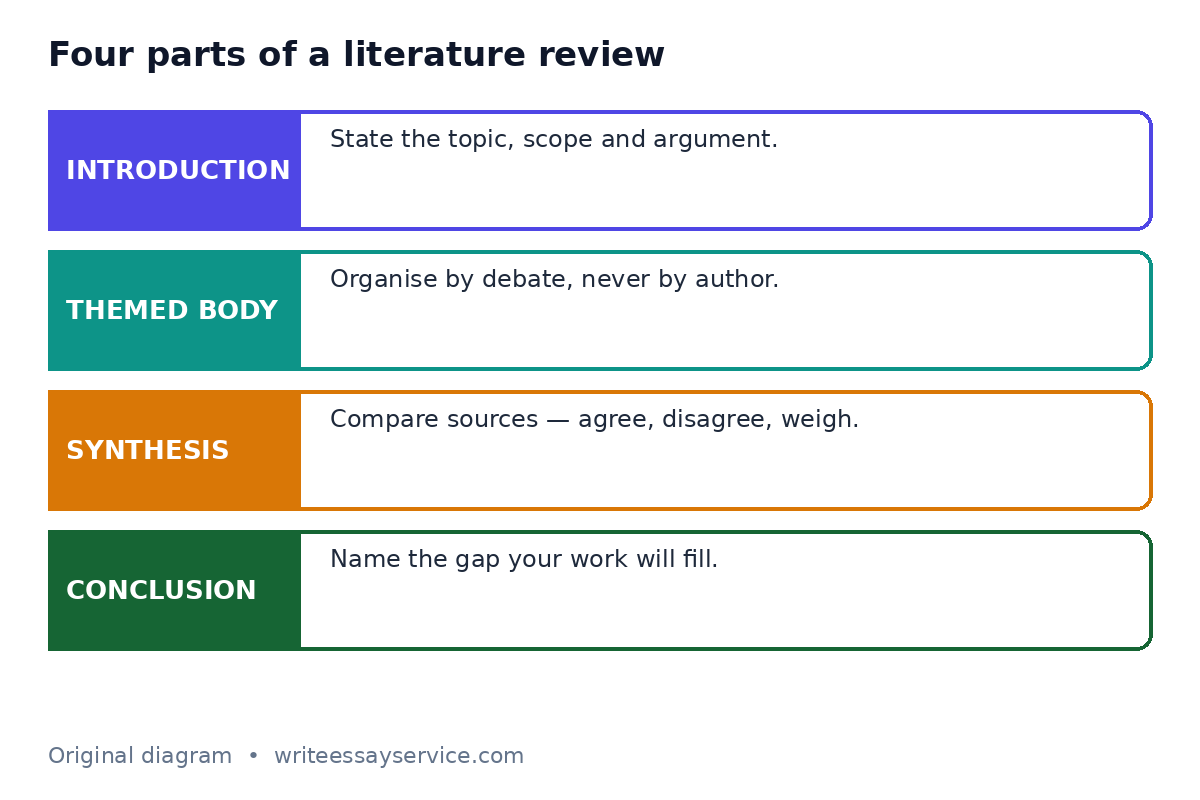
The Structure: Four Parts
1. The Introduction
The introduction does three things: it states the topic and why it matters, it defines the scope (what you included and what you left out, and why), and it states the argument your review will make — the shape of the field as you see it. Keep it short: one or two paragraphs for a short review, a page or so for a dissertation chapter.
2. The Body, Organised by Theme
The body is organised by themes, debates or approaches — never by author, and never by date alone. If your sources fall into three camps — those who blame social media for falling attention spans, those who blame sleep loss, and those who say the evidence is weak — those three camps are your three sections. Each section brings several sources together and compares them.
3. Synthesis Inside Each Section
Synthesis is the skill that separates a good review from a list. Inside each section, you should compare sources: where they agree, where they disagree, which methods are stronger, and what the disagreement means. Use phrases like “While Smith argues…, Jones counters…” and “The strongest evidence comes from…” to show the reader you are thinking, not just reporting.
4. The Conclusion
The conclusion summarises the state of the field in a few sentences, names the gap — the question nobody has answered, the method nobody has tried, the population nobody has studied — and, in a dissertation, points directly at your own research question. A literature review that ends without a gap has not finished its job.
A Step-by-Step Method
Step 1: Define your question. A review without a question drifts. “What does the research say about homework and achievement?” is a question. “Homework” is not. Write your question down before you start reading.
Step 2: Search systematically. Use your university library’s databases, not only a general web search. Record your search terms and the databases you used — a good review can say how it was built. Aim for quality over quantity: twenty strong, relevant sources beat sixty loosely related ones.
Step 3: Read with a purpose. For each source, note four things: the question it asked, the method it used, what it found, and its limits. A simple table with these four columns will save you hours later — and it is the raw material for synthesis.
Step 4: Find the themes. Spread your notes out and look for patterns. Which sources agree? Which disagree? Which methods keep appearing? The patterns you find are your section headings. If no patterns appear, your question may be too broad — narrow it.
Step 5: Draft the argument first. Before writing, write one sentence for each section: “This section shows that…”. If you cannot write that sentence, you do not yet know what the section argues, and the paragraph will drift.
Step 6: Write, then check the balance. A good review spends most of its words on synthesis and evaluation, not on description. If a paragraph is mostly summary, rewrite it to compare. If you are unsure how to cite your sources correctly as you go, our guide to how to cite sources in an essay, in APA, MLA and Harvard covers the formats you will need. For citing AI tools you used during research, see our guide on how to cite AI in an essay.
A Worked Outline
Imagine your question is: “Does homework improve achievement in secondary school?” Your outline might look like this:
Introduction. Homework is one of the most debated topics in education; this review covers research from 2010 to 2025 on secondary-school pupils, and argues that the evidence supports short, purposeful homework but not long, repetitive tasks.
Theme 1: Homework and achievement. Studies that find a positive link — and the limits of that link (small effects, mostly in older pupils).
Theme 2: Homework and wellbeing. Studies that find stress, sleep loss and family conflict — and how these effects grow with the amount set.
Theme 3: What kind of homework works. The emerging agreement: feedback, purpose and moderate length matter more than quantity.
Conclusion. The field agrees that homework can help but disagrees on how much and what kind; the gap is research on homework designed with pupil wellbeing in mind — which is where your study comes in.
Notice what the outline does not do: it never lists authors one by one. Each theme holds several sources, compared with each other.
Synthesis in Practice: Before and After
Before — a list: “Smith (2021) studied 200 pupils and found homework improved test scores. Jones (2022) studied 150 pupils and found homework increased stress. Brown (2023) studied 300 pupils and found homework had no effect on younger pupils.”
After — a synthesis: “Smith (2021) and Brown (2023) both find that homework helps older pupils, but they disagree about younger ones — a difference Brown attributes to the shorter tasks in her study. Jones (2022) adds a cost neither study measures: stress, which rose with the amount set. Taken together, the evidence points to a trade-off, not a verdict: homework helps when it is short and purposeful, and harms when it is long.”
The second version uses the same three sources and earns far more marks, because it does the thinking the assignment asks for.
What to Avoid in a Literature Review
Organising by author. “Smith says… Jones says… Brown says…” is the most common mistake, and the easiest to fix. Reorganise by theme, and bring the authors together inside each theme.
Describing instead of evaluating. Every source has limits: a small sample, one country, one age group, a method that cannot prove causation. Naming those limits is not criticism for its own sake — it is how you show judgement.
Cherry-picking. A review that only cites sources supporting one view is not a review. Include the studies that disagree with you, and explain why they do not change your conclusion — or admit that they do.
Citing without reading. Never cite a source you have only seen quoted in someone else’s work. If you must use a secondary citation, say so — “as cited in…” — and be honest about it. Markers check, and a misrepresented source destroys trust.
No gap, no conclusion. A review that ends with “more research is needed” has said nothing. Name the gap precisely: which question, which population, which method. The gap is the whole point of the review.
Plagiarism by paraphrase. Changing a few words in a source’s sentence is still copying. Take notes in your own words, close the source, and write from your notes. If a sentence sounds too close to the original, it probably is. Our guide on how to use AI help for an essay without breaking your school’s rules explains disclosure and honest drafting — the same principles apply to reviews.
Frequently Asked Questions
How long should a literature review be?
It depends on the assignment. A standalone review for a course is often 1,500 to 3,000 words; a dissertation chapter can run 5,000 to 8,000. Whatever the length, the structure is the same: introduction, themed body, conclusion with a gap. Agree the length with your supervisor before you start.
How many sources do I need?
There is no magic number. A short review might use 15 to 25 sources; a dissertation chapter might use 60 or more. What matters is coverage: have you included the key studies, the main debates, and the recent work? A supervisor would rather see twenty sources you understand than sixty you only listed.
What is the difference between a literature review and an annotated bibliography?
An annotated bibliography lists sources one by one, each with a short summary. A literature review synthesises them into an argument organised by theme. The bibliography is a list; the review is an essay. If your draft reads like a bibliography, reorganise it by theme.
Can I include sources I disagree with?
Yes — you should. A review that only includes sources you agree with is not a review. Include the strongest counter-evidence, explain it fairly, and then explain why your reading of the field still holds. That is what markers mean by critical evaluation.
How do I find the gap in the literature?
Look for three things: questions nobody has asked, populations nobody has studied, and methods nobody has tried. Compare the studies you have read and ask what they all leave out. The gap is usually visible once the sources are grouped by theme — it is the empty space between the groups.