


If you used an AI tool while writing an essay, the question is not whether to mention it — it is how. Knowing how to cite AI in essay writing has become an essential academic skill: schools now expect AI use to be disclosed and cited like any other source where it contributed ideas, wording or structure.
There is no single universal rule. APA, MLA and Chicago each treat AI output differently, and your institution may have its own policy that overrides them. Before formatting a single reference, check your school’s policy first: some departments require a disclosure statement, some accept citations alone, and some restrict AI use to particular stages, such as brainstorming or proofreading. This guide follows the rules as generally published by each style authority, flagging points where a rule is uncertain or institution-dependent. Example model names and dates below are illustrative — always record the model and version you actually used, and the date.
The Principles: What Counts as AI Use, Disclosure vs Citation
AI use includes: generating text you keep, whether a paragraph, a thesis statement or a single sentence; generating or refining ideas you went on to use; summarising, paraphrasing or translating sources through an AI tool; and rewriting or editing your own draft. Routine help such as a spellchecker sits at the low end of this scale; a brief disclosure is still the safer course when in doubt.
Disclosure tells the reader that AI was used, what tool you used, and what it was used for. It usually appears in a short statement near the start of the essay, or in a methodology note: “I used ChatGPT (OpenAI) to brainstorm topic ideas and to rephrase two paragraphs in the discussion section. All arguments, analysis and final wording are my own.” For more on drawing that line well, see our guide to using AI help without breaking your school’s rules.
Citation identifies the specific AI output you relied on: the tool, the model and version, the date, and the prompt or a description of it. Citations appear in the reference list or works cited, and in in-text citations or footnotes.
In short, disclosure answers “did you use AI, and how?”, while citation answers “which output, exactly?” AI outputs are not published, retrievable sources, so the style guides treat AI citation as a record of a private exchange — and the details differ between them.
How to Cite AI in APA 7th Edition
APA 7th edition treats AI-generated text as personal communication or software output, because the output is not retrievable by your reader. The reference-list entry therefore records the tool, model and version, and date of use, rather than a URL. Many APA guides also advise treating the in-text citation like a personal communication, which in strict APA would not appear in the reference list at all. Practice varies, and some universities do ask for a reference-list entry. If yours does, use the format below; if yours follows the strict route, keep the citation in the text only. This is institution-dependent, so follow your department’s guidance.
APA reference-list entry
The entry names the developer as author, gives the year, the model name and version in italics, and the publisher. There is no URL, because the output is not publicly retrievable.
OpenAI. (2026). ChatGPT (Nov 2026 version) [Large language model]. https://chat.openai.com/
Illustrative example only: use the model and version you actually used.
APA in-text citation
In the text, cite the developer and the year, with a brief description of the prompt.
(OpenAI, 2026)
For example: “When asked to summarise the arguments for and against carbon taxes, ChatGPT (OpenAI, 2026) listed revenue recycling and regressive effects as the two main points of contention.”
Illustrative example only.
APA worked example
Suppose you asked ChatGPT on 19 November 2026 to outline arguments for a shorter working week, and used its outline to structure one section. Your disclosure might read: “I used ChatGPT (Nov 2026 version) to outline arguments for a shorter working week, which I then researched and wrote up in my own words.” Your in-text citation would be (OpenAI, 2026), and your reference-list entry would be the one shown above, adjusted to the version and date you actually used. You can also reproduce the full prompt and response in an appendix — the most transparent option. Note that AI has no authorship in APA’s sense: name the developer and the model and version, and keep the intellectual responsibility with yourself.
How to Cite AI in MLA 9th Edition
MLA 9th edition takes a different approach. Because MLA citations are built around a title, its guidance is to use the prompt itself as the title of the source, in quotation marks, followed by the tool name in italics, the version, the publisher, and the date. A reader can see exactly what you asked and when; a vague entry — “ChatGPT” with no prompt and no date — tells the reader almost nothing.
MLA works-cited entry
The template is: “Prompt text.” Tool Name, version, Publisher, date of conversation.
“Explain the difference between correlation and causation, using an example from public health.” ChatGPT, Nov 2026 version, OpenAI, 19 Nov. 2026.
Illustrative example only: the prompt and date are examples. Use your own prompt and the date you used the tool.
MLA in-text citation
In the text, use a shortened version of the prompt in quotation marks, so the reader can match it to the works-cited entry.
(“Explain the difference”)
For example: “The tool’s public-health example — that ice-cream sales and drownings rise together in summer — illustrates why correlation alone cannot establish causation (“Explain the difference”).”
MLA worked example
Suppose you asked ChatGPT on 19 November 2026 to explain the difference between correlation and causation using a public-health example, and used its example in your methodology section. Your works-cited entry would be the one above, and your in-text citation would be (“Explain the difference”). Shorten a long prompt in the in-text citation, but keep the full prompt in the works-cited entry. If you had a longer exchange, cite the prompt that produced the material you actually used. MLA also expects you to treat the AI’s output as a source to be evaluated, not as an authority: check any factual claim against a published source, and cite that source for the fact itself. For a refresher on that habit, see our guide to how to cite sources in an essay.
How to Cite AI in Chicago 17th Edition
Chicago 17th edition handles AI in notes. Because AI output is not a published, retrievable source, Chicago advises citing it in a footnote (or endnote) rather than in the bibliography, giving the prompt, the tool and version, the developer, and the date. Some institutions also ask for a bibliography entry; if yours does, the form below can be adapted, but the note is the essential part.
Chicago footnote form
The note gives the prompt in quotation marks, the tool and version, the developer, and the date.
1. ChatGPT, response to “Summarise the main criticisms of the five-paragraph essay,” Nov 2026 version, OpenAI, 19 November 2026.
Illustrative example only: the prompt and date are examples. Use your own prompt and the date you used the tool.
Subsequent notes to the same exchange can be shortened: 2. ChatGPT, response to “Summarise the main criticisms,” 19 November 2026.
Chicago bibliography form
If your institution requires a bibliography entry, adapt the note:
OpenAI. ChatGPT, Nov 2026 version. Response to “Summarise the main criticisms of the five-paragraph essay.” 19 November 2026.
Illustrative example only.
Chicago worked example
Suppose you asked ChatGPT on 19 November 2026 to summarise the criticisms of the five-paragraph essay, and used its point that the format can discourage genuine argument in your introduction. Your first footnote would be the one shown above, and your text might read: “Critics of the five-paragraph essay argue that its rigid structure can discourage genuine argument, a point the AI summary also raised.¹” The superscript 1 leads to the footnote, where the reader can see the prompt, the tool, the version and the date at a glance. Each new prompt gets its own note; do not reuse a note for a different prompt.
APA vs MLA vs Chicago: The Three Styles Side by Side
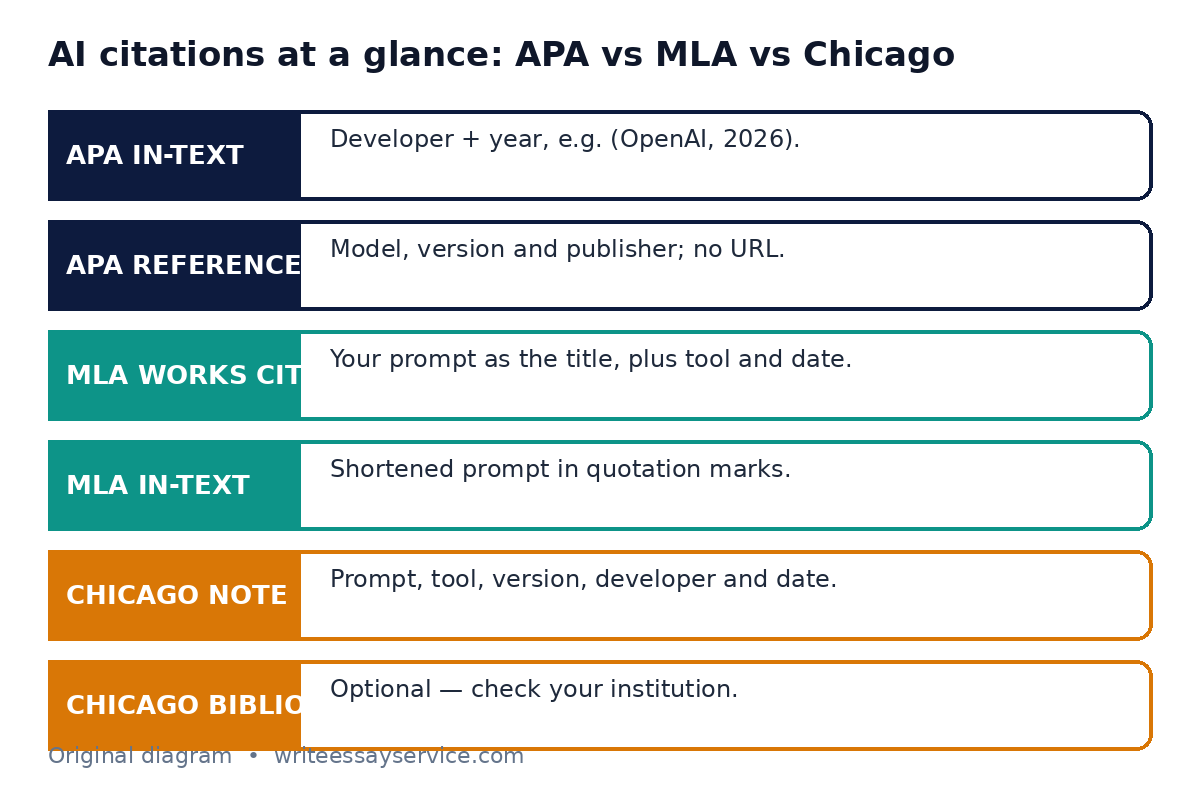
The three styles agree on the substance — disclose the tool, name the model and version, give the date, and show the prompt — but differ in where the information lives.
- APA 7th: Treats AI output as personal communication or software output. In-text citation names the developer and year, e.g. (OpenAI, 2026). A reference-list entry names the developer, year, model and version, and publisher; no URL, as the output is not retrievable. Some institutions prefer the in-text citation only — check your department’s rule.
- MLA 9th: Uses the prompt as the title of the source. The works-cited entry reads: “Your prompt.” Tool Name, version, Publisher, date. The in-text citation is a shortened form of the prompt in quotation marks, e.g. (“Explain the difference”).
- Chicago 17th: Cites AI in a footnote or endnote, giving the prompt, tool, version, developer and date. A bibliography entry is optional and institution-dependent. Subsequent notes can be shortened.
Two practical points follow. First, the same AI exchange needs a different format in each style, so you cannot carry a citation across unchanged. Second, whichever style you use, record the same information at the time: the tool, the exact model and version, the date, and the full text of each prompt you relied on. Keep a screenshot or saved transcript of the exchange.
Common Mistakes When Citing AI
Treating AI as an author. AI tools do not author work in the academic sense, and no major style guide lists them as authors of ideas. Attribute the output to the tool and its developer; never imply the tool is a scholarly authority: “ChatGPT argues that…” is weak; “The AI-generated summary listed three arguments, of which I found two supported by the literature…” is strong.
Citing without a date or version. A citation that says only “ChatGPT” is almost useless: models and versions change, and the same prompt produces different answers over time. Always include the model, version and date of use. If you cannot find the version number, say so: “version unknown, accessed 19 November 2026” is honest; an invented version number is not.
Hiding AI use. The most serious mistake is not a formatting error at all: it is omitting the AI’s contribution entirely. Disclosure protects you: markers are far more forgiving of declared AI use than of undisclosed use discovered afterwards.
Over-citing routine help. The opposite error is also real: if an AI tool only fixed a typo or suggested a synonym, a full citation for every correction would bury your essay in notes. Cite and disclose where the tool shaped ideas, structure or wording in a meaningful way, and use a brief disclosure statement for light editing help. If your institution’s policy draws the line differently, follow its line.
Frequently Asked Questions
Do I need to cite AI if it only helped me brainstorm?
You should disclose it, and cite it if you used a specific idea or structure it produced. A brainstorming session that shaped your argument counts as a contribution, even if no AI wording survives in the final draft. A one-line disclosure naming the tool, date and purpose is usually enough.
How do I cite ChatGPT in APA, MLA or Chicago?
The rules for how to cite AI in essay work differ by style: in APA, cite the developer and year in text, e.g. (OpenAI, 2026), with a reference-list entry naming the model and version; in MLA, use your prompt as the title in the works-cited entry and a shortened prompt in the text; in Chicago, cite the prompt, tool, version and date in a footnote. In every style, use your real prompt, not the example prompts here.
What if my university has no AI citation policy?
Follow the style guide for your subject — APA, MLA or Chicago as appropriate — and add a clear disclosure statement naming the tool, the model and version, the date, and what you used it for. That combination satisfies most markers, because it is transparent and checkable. Keep a copy of the AI exchange.
Can I cite AI as a source for facts in my essay?
No — not as your only source. AI tools can invent references, misstate dates and present outdated information confidently. Use AI to find leads, then verify every factual claim against a published, retrievable source, and cite that source for the fact. Cite the AI for the help it gave you, and the published source for the claim itself.
Citing AI is simple once you separate its two questions: what did the tool do, and how do I show that in my style? Record the tool, model, version, date and prompt when you use it; disclose the use briefly; and format the citation as your subject requires. Do that, and AI becomes a visible, checkable part of your process — not a hidden shortcut.