



Few school tasks appear as often as a my school essay. Teachers set it in Class 5, and it returns in later classes, because it tests something simple: can you describe a real place, choose the details that matter, and organise your thoughts clearly? It is also easy to get wrong. Many students copy a ready-made paragraph online and hand in something that sounds like everyone else’s work — because it is.
This guide explains how to write my school essay in your own words: a clear structure, useful vocabulary, and three simple ways to make the essay yours.
What a Good “My School” Essay Does
It describes one school, not any school. Your essay should be about your school — its building, its teachers, its playground, its particular habits. If your essay could describe any school in the country, it is too general.
It has an order. A good essay moves in a clear order: the school itself, the people in it, what you learn there, and why it matters to you. The reader should never wonder where they are in the essay.
It uses your own details. The name of your school, the colour of the walls, the tree in the playground, the teacher whose voice you recognise from the corridor — these are the details no one else can write, and they are what make your essay yours.
It ends with a feeling, not a list. “My school is the best school” is a claim anyone can make. “I feel proud when I wear my school uniform” is a feeling only you can describe — and it is far more convincing.
Outline: A Simple Structure That Works
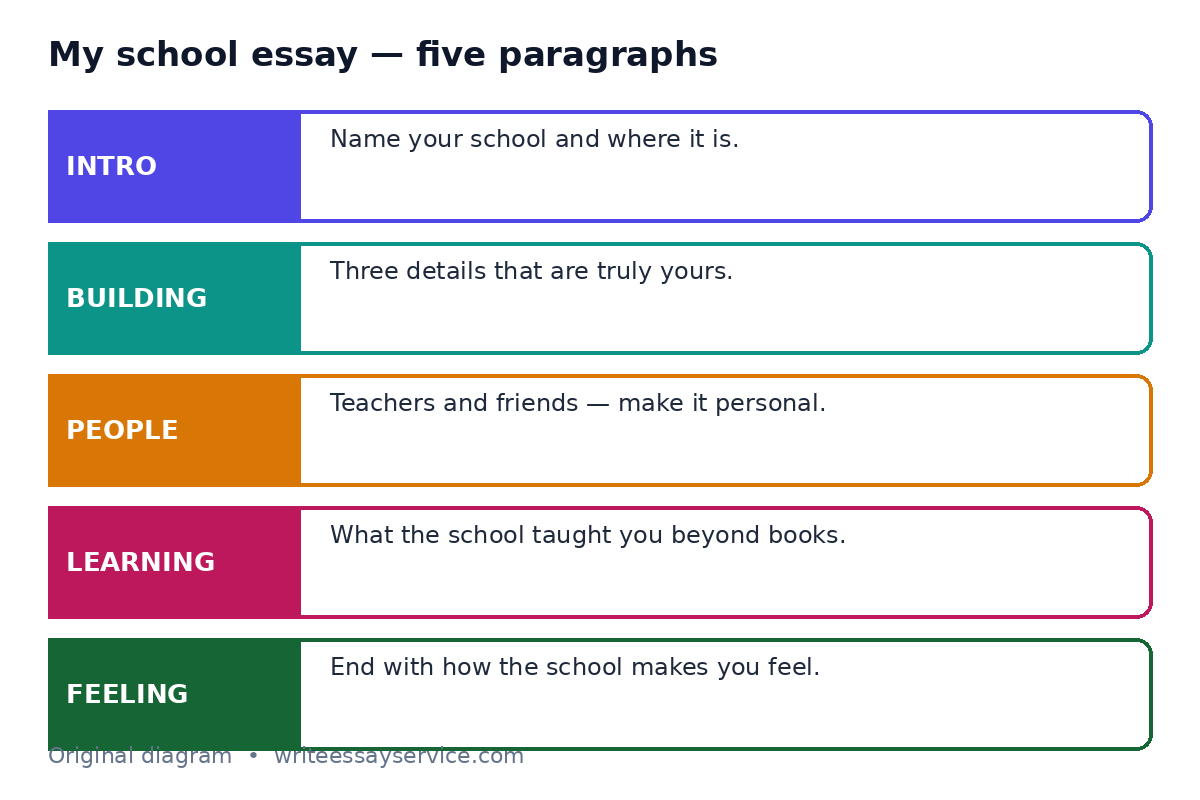
Use this outline for a 250 to 400-word essay. Each part is one paragraph.
Paragraph 1 — Introduction: name your school and where it is. Give the school’s name, its location, and one sentence about what it looks like. End with the idea your essay will develop: for example, that your school is not just a building, but a second home.
Paragraph 2 — The building and the grounds. Describe the school itself: the classrooms, the playground, the library, the garden. Choose three details that are truly yours — the big tree, the assembly ground, the science lab — and describe them in your own words.
Paragraph 3 — The people: teachers and friends. Write about your teachers and your friends. Name one teacher and what they teach you, and say what your friends mean to you. This paragraph is where the essay becomes personal.
Paragraph 4 — What you learn, and why it matters. Write about the lessons, the games, the morning assembly, and what the school has taught you beyond books — discipline, honesty, friendship, hard work.
Paragraph 5 — Conclusion: your feeling about the school. End with how you feel about your school and why you are proud of it. One honest sentence is worth more than a paragraph of praise.
If you are learning to plan essays under time pressure, our guide to planning a 500-word essay in 10 minutes shows the same method in a timed form. For the same “make it yours” approach on other school topics, see our guides to my best friend essay and my favourite book essay.
Vocabulary for a “My School” Essay
Useful words and phrases, grouped so you can pick the ones that fit your school. Use them in your own sentences — do not copy them as a list.
The building: spacious classrooms, a wide playground, a well-stocked library, a science laboratory, a computer room, a clean assembly hall, a shady garden, a high boundary wall, a main gate, a notice board.
The people: kind and hardworking teachers, a strict but fair head teacher, helpful classmates, a friendly librarian, a careful gardener, a watchful gatekeeper.
What happens there: morning assembly, daily lessons, games period, annual sports day, prize distribution, parent-teacher meetings, study tours, debates and speeches.
How it feels: a second home, a place of learning, proud, grateful, safe, happy, disciplined, confident.
Verbs that help: learn, play, grow, respect, practise, compete, help, share, remember, enjoy.
A Model Paragraph — Study It, Then Write Your Own
Read this paragraph, notice how it works, and then write your own version about your school. Do not copy it — use it to see the pattern, then fill the pattern with your own details.
“My school is Government High School, Chakwal, and it stands on the main road near the old bus stop. It has twenty classrooms, a big playground with two mango trees, and a small library where I spend my free periods. Every morning we gather for assembly in the open ground, and our head teacher reminds us that discipline is the first lesson of life. I have studied here for five years, and in that time the school has taught me more than books: it has taught me to be punctual, to respect my teachers, and to help my classmates. That is why I call it my second home.”
Notice the pattern: name and place, three concrete details, one daily habit, and a feeling to finish. Your paragraph should follow the same shape with your own school’s details.
Three Ways to Make It Yours
1. Use one detail only you know. Every school has a detail nobody else would think to mention: the crack in the wall you pass every day, the teacher who always says the same thing before a test, the corner of the playground where your friends sit. One such detail proves the essay is yours.
2. Write one honest sentence. Instead of “My school is the best school in the world”, write one true sentence: “I was nervous on my first day, but my teacher smiled and showed me my seat, and I have never been afraid of school since.” Honest sentences are the ones markers remember.
3. Say what the school changed in you. A good essay is not only a description — it shows growth. What did you learn at this school that you did not know before? How are you different because of it? Answer that, and your essay has a point, not just a description.
Common Mistakes to Avoid
Copying a model essay from the internet. Teachers recognise copied essays immediately — the details do not match your school, and the language does not match your other work. Worse, it teaches you nothing. Write your own, even if it is simpler.
Listing everything. An essay that lists the classrooms, the library, the lab, the office, the garden, the gate and the wall is a list, not an essay. Choose three details and describe them well.
Forgetting the people. A school is not a building. An essay with no teachers and no friends is an essay about an empty place. Give the people at least one paragraph.
Ending without a feeling. “This is my school” is not an ending. End with what the school means to you — pride, gratitude, or the wish to make it proud one day.
Frequently Asked Questions
How long should a my school essay be?
For Class 5 to 7, 150 to 250 words is usually enough. For Class 8 to 10, aim for 250 to 400 words. What matters is not the length but the order: introduction, building, people, learning, conclusion — one paragraph each.
What is the best way to start a my school essay?
Start with the name and place of your school, in your own words: “My school is [name], and it stands in [place].” It is simple, honest and clear — and it immediately tells the reader this essay is about a real school, not a copied paragraph.
Can I write about my school in the first person?
Yes. “My school” essays are personal essays, and “I” is natural: “I study in Class 7”, “My favourite teacher is…”, “I feel proud of my school”. First person is expected here.
How do I make my essay different from my classmates’ essays?
Use details only you would notice and one honest sentence only you could write. Your classmates share the same school, but they do not share your first day, your favourite teacher, or the corner of the playground where you sit. Write from those.
Should I mention my school’s name in the essay?
Yes, always. The name makes the essay real and personal. If your essay could be about any school, it is too general — the name, the place and one or two details that only your school has are what make it yours.

