



Few school tasks appear as often as a my best friend essay. Teachers set it in Class 5, and it returns in later classes, because it tests something simple: can you describe a real person, choose the details that matter, and organise your thoughts clearly? It is also easy to get wrong. Many students copy a ready-made paragraph online and hand in something that sounds like everyone else's work — because it is.
A good my best friend essay in English does not need fancy words. It needs your own observations. Your teacher already knows what a best friend is. What they cannot know, unless you tell them, is what your friend is like when nobody else is watching, what you laugh about together, and what you have learned from them. That is material no website can give you.
This guide shows you how to build the essay yourself: a simple outline, a vocabulary bank, three ways to make it yours, one short model paragraph to learn from, and the mistakes to avoid. The same approach works for other school topics — our my favourite book essay guide follows the same structure, and our essay writing guide covers planning, drafting and checking any essay.
A Simple Outline for Your My Best Friend Essay
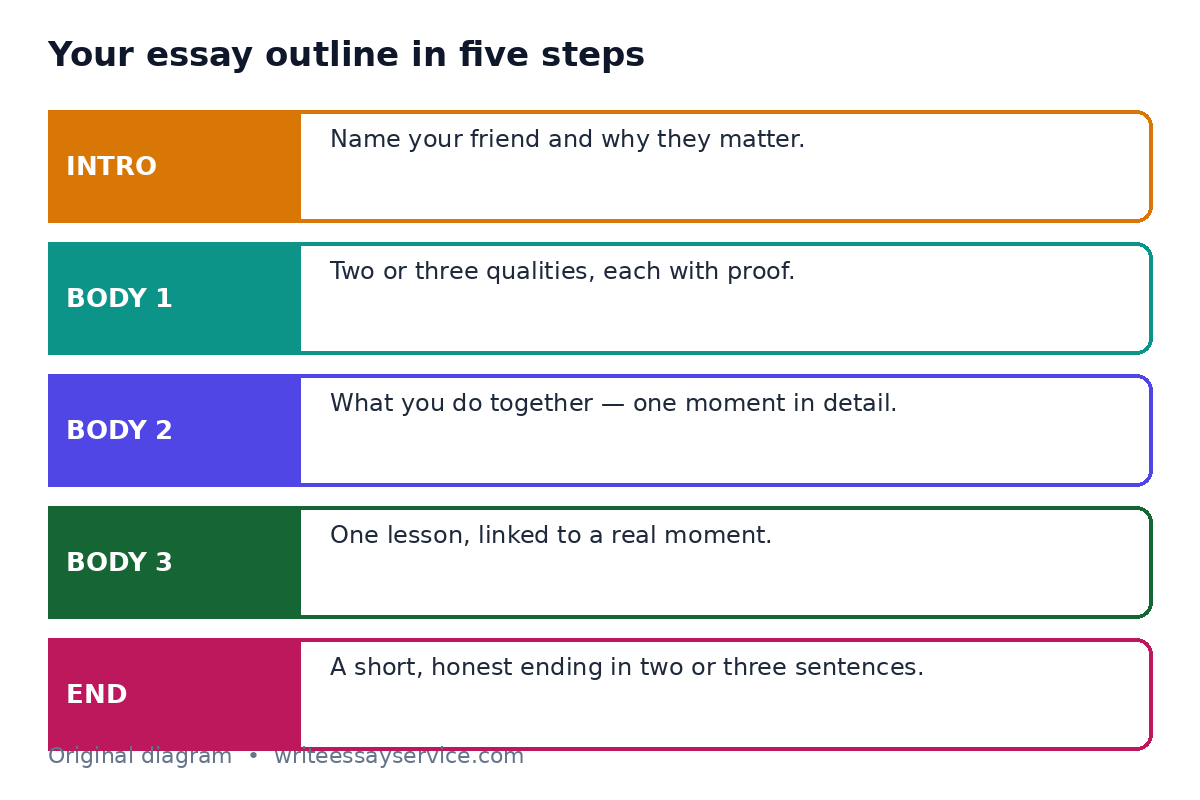
Plan before you write. Five short paragraphs are enough, and each one has a clear job.
Introduction — who, and why they matter. Name your friend and say, in plain words, why this person is your best friend. "My best friend is Ayesha, and she has been my closest friend since Class 4" does the job. Add one sentence about what the friendship means to you, then stop.
Body paragraph 1 — who your friend is. Choose two or three qualities that are genuinely true — kind, funny, patient, brave, honest — and support each one with a small piece of evidence. Instead of "He is very good," write what he does: he shares his lunch, waits for you after school, or explains a maths problem without making you feel foolish. One real detail is worth five adjectives.
Body paragraph 2 — what you do together, and one memory. Describe something you do regularly — playing cricket, walking home, studying together — then tell one short memory that shows the friendship in action. It need not be dramatic: losing a match together or getting caught in the rain can work, if you say what happened and how it felt. A my best friend essay for class 5 can simply describe the memory in order; older students should also reflect on it a little.
Body paragraph 3 — what you have learned from them. Perhaps your friend taught you to stay calm before an exam, to apologise when you are wrong, or to keep practising when something is difficult. Choose one lesson, explain it briefly, and link it to a real moment. This paragraph lifts your essay above description, because it shows thinking, not just remembering.
Conclusion — a short, honest ending. Finish in two or three sentences. Say what you hope for the friendship, or sum up why this person matters to you. Do not start a new story here. A quiet ending — "I hope we stay friends for many years, because she makes me want to be a better person" — beats a grand statement you do not really mean.
Vocabulary Bank: Words and Phrases for Your Essay
You do not need difficult words. You need the right words — words that say exactly what you mean. Choose only the words that fit your friend and your story.
Describing character
- kind, caring, generous, thoughtful — a friend who looks after others
- honest, truthful, trustworthy, loyal — a friend you can rely on
- cheerful, funny, good-humoured, lively — a friend who makes you laugh
- patient, calm, understanding — a friend who listens and does not rush you
- brave, confident, hard-working, determined — a friend who keeps going when things are difficult
- humble, polite, respectful — a friend who treats everyone well
Useful phrases: "always ready to help", "stands by me in difficult times", "is the first person I turn to when I need advice".
Describing shared moments
Useful phrases: "We spend most of our free time together…", "One day I will never forget…", "We laughed so much that…", "At first I was nervous, but then…". Useful linking words: together, every day, after school, once, suddenly, finally, in the end. These small time words keep your story in order and help the reader follow what happened first, next and last.
Expressing gratitude
Useful words: grateful, thankful, lucky, fortunate. Useful phrases: "I am lucky to have a friend like…", "I have learned so much from…", "I hope our friendship lasts for many years…". But do not fill your essay with praise alone. "My friend is the best person in the whole world" tells the reader nothing. Show one kind act, and the reader will reach that conclusion themselves.
Three Ways to Make It Yours
Any student can write "my best friend is kind and helpful." Only you can write the three things below, because only you have lived them.
1. Use a specific memory only you have. Think of one moment that belongs to your friendship alone — a scene, not a general statement. Where were you? What happened? "When I forgot my lunch on the day of our science test, Bilal shared his sandwich without a word and then helped me revise the last chapter" is yours in a way no downloaded paragraph can be. If you cannot remember a big moment, choose a small one and describe it well: the walk home, or the joke that still makes you laugh.
2. Include your friend's own words or a habit. People become real on the page when we can hear them or picture them. Does your friend repeat a saying before every exam, tap their pencil while thinking, or greet you the same way every morning? One small, true detail — "Before every test she says, 'Slow down, read the question twice'" — does more than a paragraph of adjectives. Make sure it is true and kind; never use the essay to embarrass your friend.
3. Say what the friendship changed about you. The strongest my best friend essay answers a question most students never ask: what is different about me because of this person? Name the change, then link it to one moment. "Since I became friends with Sara, I have stopped giving up when homework is difficult, because I have watched her keep trying until she understands" could only come from you.
A Short Model Paragraph to Learn From
The paragraph below is a learning example, not a full essay and not something to submit. Read it, then study the notes underneath.
My best friend is Hassan. We have sat together since Class 6, and he is the most patient person I know. When I did not understand fractions last term, he explained them to me three times after school without once sounding annoyed. That afternoon taught me that a good friend does not just help you pass a test — he helps you believe you can learn.
It works for three reasons. First, it has one clear idea — patience — and every sentence supports it. Second, it proves the quality with a specific event: three explanations after school, about fractions, last term. Third, it ends with a small reflection. Aim for the same discipline — one idea, one piece of evidence, one honest reflection.
Mistakes to Avoid
Copying a paragraph from the internet. Teachers recognise copied work quickly, and it teaches you nothing. A copied paragraph describes a stranger's friend, not yours. If you are stuck, write one honest sentence for each paragraph of the outline.
Listing qualities without evidence. "My friend is kind, honest, brave, intelligent, funny and loyal" is a list, not a description. Choose two or three qualities and prove each one with a small example.
Skipping the plan. Without an outline, your essay will wander: the introduction runs too long, the middle repeats itself, and the conclusion arrives suddenly. Five minutes of planning makes the writing faster and better.
Using words you do not understand. A simple sentence you understand beats a complicated sentence you copied. If you are unsure what a word means, do not use it.
Forgetting the ending. Many students write three good paragraphs and then stop. A conclusion needs only two sentences, but it needs to be there. Return to what the friendship means to you, and leave the reader with one clear thought.
Frequently Asked Questions
How long should a my best friend essay be?
For Class 5 and 6, about 150 to 250 words is enough — often set as a my best friend 10 lines task. For Class 7 to 10, aim for 250 to 400 words, in the five paragraphs above. A short, well-organised essay with real details scores better than a long one that repeats itself.
Can I use the same essay for every class?
Reuse the outline and the memories, but rewrite the essay as you grow. A Class 5 essay describes what you do together; a Class 9 or 10 essay should also reflect on what the friendship has taught you.
What if my best friend has moved away or we are no longer close?
Write honestly about the friendship as it was — what you shared and what you learned. Or write about a friend you are close to now. Never invent a friend or copy someone else's story.
How do I start my best friend essay if I cannot think of a first sentence?
Start simply: name your friend and say how long you have known them. "My best friend is Zara. We have been friends since Class 3." Once the first sentence is on the page, the next one is easier.