



The Short Answer: What Makes an Admission Essay Stand Out
A college application essay stands out when it answers the prompt directly, focuses on one specific story or idea, and shows how you think through vivid detail in your own voice. Admissions readers already have your grades and activity list. The essay is your chance to show who you are beyond those details.
The tips below walk you through choosing a topic, drafting, revising, and polishing an essay that feels unmistakably yours.
What Admissions Readers Look For
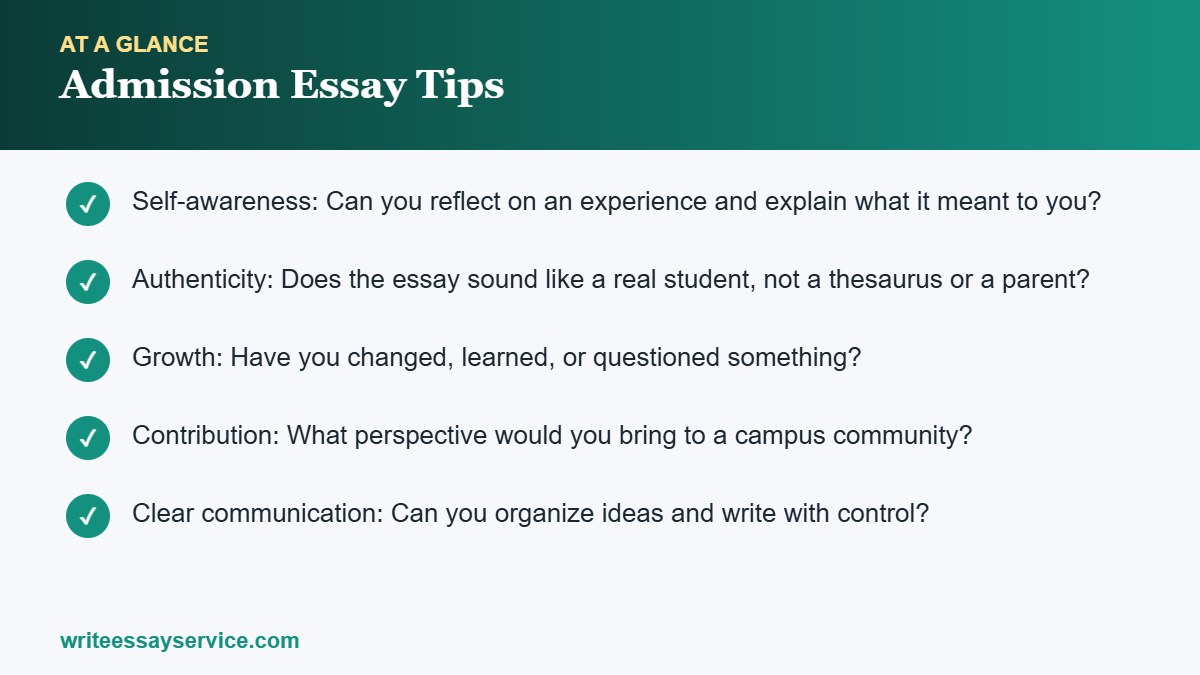
Every institution has its own priorities, but most readers hope to learn a few core things from your essay:
- Self-awareness: Can you reflect on an experience and explain what it meant to you?
- Authenticity: Does the essay sound like a real student, not a thesaurus or a parent?
- Growth: Have you changed, learned, or questioned something?
- Contribution: What perspective would you bring to a campus community?
- Clear communication: Can you organize ideas and write with control?
Notice that “impressive achievements” is not on the list. A modest moment told with insight often lands better than a trophy described without reflection.
How to Choose a Topic and Find Your Angle
Start With Moments, Not Résumé Items
Instead of asking “What’s my biggest accomplishment?”, ask “When did I change my mind?” or “What do I notice that others overlook?” Strong topics often come from ordinary moments: fixing a bike with your grandfather, surviving a chaotic shift at a café, or teaching your sibling to read.
Find the Angle
A topic is what you write about. An angle is what you reveal. “Playing soccer” is a topic. “Learning to lead from the bench after an injury” is an angle. Test yours with one sentence: “This essay shows that I ___.” If you can’t fill in the blank, keep digging.
A Step-by-Step Writing Process
1. Brainstorm
Spend 20 minutes listing memories, objects, places, and people that matter to you. Don’t judge anything yet. Then circle the two or three ideas that bring up specific sensory details and a clear “before and after.”
2. Outline
Map the beginning (the moment), the middle (the tension or challenge), and the end (your reflection and what it means now). Our guide on how to build an essay outline shows how to arrange ideas before you start writing.
3. Draft
Write quickly and imperfectly. Get the full story down, even if it runs long. You can cut later, but you can’t edit a blank page.
4. Revise
Let the draft rest for a day or two, then reread it as a stranger would. Is the focus clear? Is every paragraph earning its place? Does the ending show reflection rather than a tidy moral? Expect several rounds.
Open With a Strong Hook
Your first lines decide whether a reader leans in. Skip dictionary definitions and famous quotes. Try one of these instead:
- Drop into a scene: “The smoke alarm went off for the third time that night, and I was still holding the spatula.”
- Make a surprising statement: “I have read the same instruction manual forty times.”
- Pose a real question you genuinely wrestled with.
For more techniques, see our guide on how to write an essay introduction. If you get stuck moving between paragraphs, this list of sentence starters for essays can help you keep momentum.
Show, Don’t Tell, in Your Own Voice
“I am resilient” tells. “I rewrote the code at 2 a.m. after my robot failed in front of the judges” shows. Concrete actions, dialogue, and details let readers draw conclusions themselves.
Voice matters just as much. Write the way you speak when you’re being thoughtful: clear, honest, and a little personal. If a word feels like something you’d never say out loud, replace it. Readers can often tell when an adult has rewritten a student’s essay, and it rarely helps.
Structure and Word Count
Always follow each institution’s stated word limit and formatting rules. Prompts and limits vary by school and application platform, so check the official instructions for every application. Use most of the space you’re given, but never pad.
A simple structure works well:
- Hook: a scene or idea that pulls the reader in.
- Context: just enough background to follow the story.
- Turning point: the challenge, conflict, or realization.
- Reflection: what you learned and how it shapes you now.
Your ending should connect back to the opening and point forward. Our guide on writing a strong essay conclusion offers ways to close without simply summarizing.

Common Mistakes to Avoid
Clichés
Lines like “I learned that hard work pays off” blend in. Replace general lessons with the specific insight only you could have.
Listing Achievements
Your activities section already covers awards. The essay should go deeper on one experience, not repeat your résumé.
Over-Editing
Too many rounds of feedback can sand away your personality. Stop when the essay is clear and still sounds like you.
Ignoring the Prompt
A beautiful essay that dodges the question still misses. Check that every part of the prompt is addressed.
Proofreading Checklist
- Does the essay answer every part of the prompt?
- Is it within the required word limit?
- Have you read it aloud to catch awkward phrasing?
- Are names, tenses, and pronouns consistent?
- If you reused an essay, did you remove other colleges’ names?
- Did you run spell-check and then reread manually?
- Has one trusted reader reviewed it for clarity, without rewriting it?
For a more thorough method, follow our step-by-step guide on how to proofread an essay.
Frequently Asked Questions
Can I write about a common topic like sports or volunteering?
Yes, as long as your angle is specific. Focus on a small, personal moment rather than summarizing the whole experience.
Should I reuse one essay for multiple colleges?
You can adapt a core essay, but tailor it to each prompt and double-check school-specific details and limits.
Is humor okay in an admission essay?
Humor works when it comes naturally to you and still shows reflection. Don’t force jokes.
How many drafts should I write?
There’s no magic number. Keep revising until the focus is clear and every sentence sounds like you.
Summary and Next Step
An admission essay stands out through focus, specificity, reflection, and an authentic voice. Read the prompt carefully, choose a meaningful angle, follow a brainstorm, outline, draft, and revise process, and proofread thoroughly. Start brainstorming today so you leave time for real revision.
Want Feedback on Your Admission Essay?
Keep learning: see our full Essay Writing Guide for every step of the essay process and sample essays.