

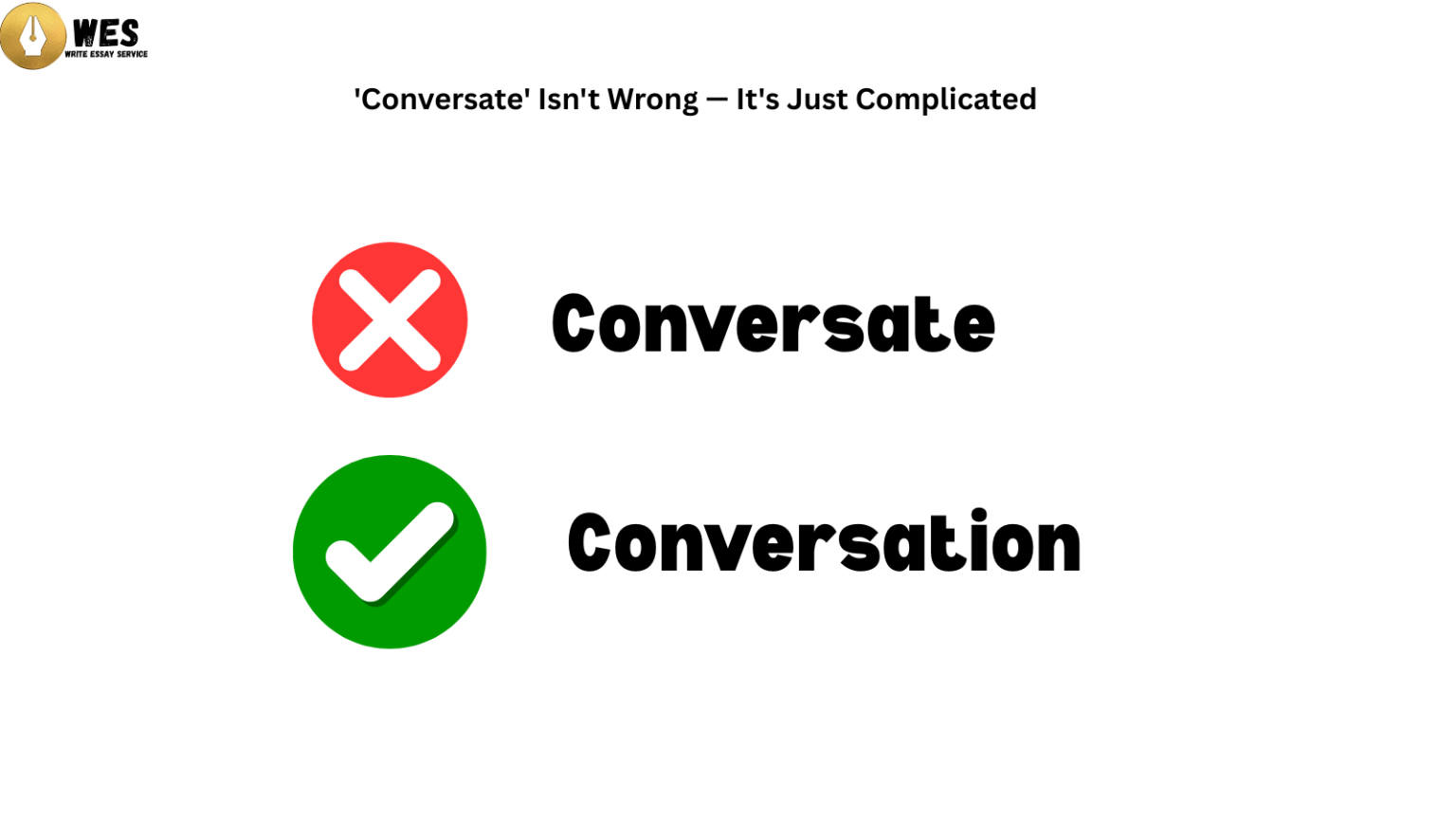
Quick answer: “Conversate” is a nonstandard English verb meaning “to have a conversation.” Although Merriam-Webster includes it in its dictionary, most style guides recommend using “converse” in formal writing. “Conversate” is best suited to informal, casual contexts — and has been in use since at least the early 19th century.
You’ve probably heard it at some point — someone says “we need to conversate about this” and someone else in the room winces. Maybe that person was you. The word has a reputation for being incorrect, uneducated, or simply made up. But the truth is a lot more interesting than that.
“Conversate” has a genuine history. It appears in Merriam-Webster. It has roots that stretch back to the early 1800s. And it reflects a fascinating process in how languages actually grow and evolve — not in classrooms or style guides, but in real conversations between real people.
This post covers everything you need to know: the conversate meaning, where the word came from, how it compares to “converse,” and how a whole family of related words — conversing, conversational, conversant, and even conversely — connect back to the same ancient root. We’ll also look at the meaning of “per our conversation” in professional writing and unpack what “like” really does in everyday speech.
By the end, you’ll know exactly when to use “conversate” — and when to reach for something else instead.
What Does Conversate Mean?
According to Merriam-Webster, conversate (pronounced ˈkän-vər-ˌsāt) is an intransitive verb defined as “to exchange thoughts and opinions in speech; to converse.”
It’s labeled nonstandard, which doesn’t mean it’s fake — it means it falls outside the boundaries of formal, edited English. Think of “ain’t.” It’s in the dictionary, people use it constantly, and nobody would claim it doesn’t exist. But you probably wouldn’t use it in a cover letter.
The conjugated forms of conversate are:
- Conversates (third person singular present)
- Conversating (present participle)
- Conversated (past tense)
Merriam-Webster’s own usage note states: “Despite being in use since the early 19th century, conversate is widely viewed as a nonstandard form and is therefore best reserved for informal contexts.”
That’s the key takeaway. Conversate is real. Use it in informal contexts — casual speech, social media, creative writing with a vernacular character — but not in academic papers, business reports, or formal correspondence.
How Did “Conversate” Come to Exist?
Here’s where it gets genuinely interesting.
“Conversate” is a product of a linguistic process called back-formation — where a new word is created by removing an apparent suffix from an existing one. In this case, speakers took the noun conversation, stripped the -ion ending, added an -e, and started using it as a verb. The result: conversate.
This isn’t as strange as it sounds. English back-formations are everywhere. “Donate” came from “donation.” “Enthuse” came from “enthusiasm.” “Liaise” came from “liaison.” Back-formed words are often labeled nonstandard at first, but many eventually become part of mainstream usage.
According to the Online Etymology Dictionary, “conversate” as a verb meaning “to have a conversation” is attested by 1888 in literary representations of African-American Vernacular English (AAVE). There’s also an isolated, apparently jocular use recorded in an English book from 1851. So this word has been around for well over a century.
Its origins in AAVE are worth noting. AAVE has contributed enormously to the English language — words and phrases like “cool,” “chill,” “GOAT,” and countless others started in Black communities before going mainstream. “Conversate” follows a similar path: born in vernacular speech, dismissed by prescriptivists, and slowly gaining legitimacy through sheer, persistent use.
Conversate vs. Converse: What’s the Actual Difference?
The standard verb for having a conversation is converse. As Grammarly explains, converse is the form you should reach for “if you want to be correct” in formal contexts.
Here’s the practical breakdown:
| Word | Register | Example |
| Converse | Formal/Standard | “They met to converse about the proposal.” |
| Conversate | Informal/Nonstandard | “We need to conversate about this.” |
Both mean the same thing. The difference is entirely about context. Choose converse in formal or professional writing — resumes, emails, essays, academic work. Reserve conversate for casual speech, social media captions, or dialogue in fiction where authenticity matters more than formality.
One more thing: “converse” has multiple uses (as a noun meaning the opposite of something, and as an adjective). “Conversate” fills only the verb role. That narrow definition is part of why it developed in the first place — it’s doing one specific job clearly and efficiently.
What Does “Conversating” Mean?
Conversating is the present participle form of conversate — used to describe an ongoing act of conversation.
You might see it in sentences like:
- “We were conversating for hours.”
- “He was spotted conversating with an unknown person before leaving.”
Like “conversate” itself, “conversating” is nonstandard. It carries the same informal flavor and should be used in the same casual contexts. If you’re writing something that needs to sound polished and professional, use “conversing” instead — that’s the present participle of “converse” and the form most style guides prefer.
The Conversation Meaning: Where Do All These “Conver-” Words Come From?
The word conversation has a surprisingly rich history. According to the Online Etymology Dictionary, it traces back to the Latin conversationem, a noun derived from conversari — meaning “to live with, keep company with, dwell.” That Latin root itself breaks down into com- (“with, together”) and versare (“to turn”), from the Proto-Indo-European root *wer- meaning “to turn or bend.”
The conversation meaning shifted considerably over time. In the mid-14th century, it meant “the place where one lives” — completely removed from speech. By the 1570s, it had settled into its modern sense: “informal interchange of thoughts and sentiments by spoken words.”
That root gave English an entire family of related words:
What Does Conversational Mean?
Conversational is an adjective meaning “of, pertaining to, or characteristic of conversation.” It dates to 1779, according to the Online Etymology Dictionary.
Something described as conversational — a tone, a writing style, a presentation — has the relaxed, natural quality of spoken dialogue. At Write Essay Service, conversational writing is a core skill that improves reader engagement across blog posts, articles, and marketing copy. You can explore more about crafting compelling content through our article writing services guide.
What Does Conversant Mean?
Conversant is an adjective with a different meaning — it describes familiarity with a subject. According to the Cambridge Dictionary, to be conversant with something means to be “familiar with, and have knowledge or experience of, the facts or rules of something.”
Example: “She is conversant with current data privacy regulations.”
Conversant traces back to the Latin conversari — “to keep company with.” The logic: if you keep company with something long enough, you become familiar with it. That etymological thread still makes intuitive sense today.
What Does Conversely Mean?
Conversely is an adverb — and despite sharing a Latin root, it functions very differently from the rest of the “convers-” family.
Conversely means “on the other hand” or “in a contrary way.” It introduces a statement that contrasts with or reverses what was just said. Merriam-Webster offers a clean example: “She cannot stand sugary food; conversely, her husband is fond of sweets.”
Writers use conversely as a logical transition — it signals that two things are opposite, related by contrast rather than similarity. If you’re learning to use transitions effectively in academic writing, our guide to conclusion sentence starters covers a wide range of useful transition words and phrases.
What Does Conversive Mean?
Conversive is an archaic adjective with two possible meanings: (1) capable of being converted or changed, or (2) ready to converse; sociable. It appears so rarely in modern usage that most contemporary dictionaries don’t list it as a primary entry. For practical purposes, you can skip this one — you’re far more likely to encounter conversational, conversant, or conversely in everyday reading and writing.
What Does “Per Our Conversation” Mean in Professional Writing?
“Per our conversation” (and its close cousin, “as per our conversation”) is a formal phrase used in professional written communication — typically emails — to reference something discussed verbally.
It signals: I’m following up on what we already talked about.
Example: “Per our conversation earlier today, I’ve attached the revised proposal for your review.”
The phrase does its job, but many business writing experts find it stiff, even passive-aggressive. Alternatives that feel warmer while staying professional include:
- “As we discussed…”
- “Following up on our conversation…”
- “To recap what we talked about…”
- “As mentioned during our call…”
If you’re writing professional content at scale — for clients, employers, or a business brand — Word choice at the sentence level matters more than most people realize. Take a look at our SEO content service overview to understand how tone and clarity directly affect content performance.
What Does “Like” Mean in a Conversation?
“Like” is one of the most analyzed — and most criticized — words in contemporary English. Most people call it a filler word, something meaningless dropped into sentences out of laziness. But linguists tell a different story.
According to a 2022 article in The Guardian drawing on the work of linguist Alexandra D’Arcy, “like” is “an incredibly versatile and dynamic word” that serves multiple distinct grammatical roles:
- Quotative like: “She was like, ‘That’s incredible.'” (Reporting speech or inner reaction)
- Approximative adverb: “It took like 20 minutes.”
- Discourse marker: “Like, I wasn’t sure what to say.”
- Discourse particle: “That dinner was like the best I’ve had.”
Far from being meaningless, each form of “like” carries nuance — signaling approximation, softening a claim, indicating that a speaker is thinking in real time, or creating rapport with the listener.
Critically, a study published in the Journal of Language and Social Psychology — which analyzed 263 conversational transcripts — found that “conscientious people” who are “thoughtful and aware of themselves and their surroundings” are the most likely to use discourse markers such as “like.” Not the laziest speakers. Among the most self-aware.
So the next time someone criticizes your use of “like” in casual conversation, you have the research to push back.
When Should You Actually Use “Conversate”?
Here’s the short version:
Use “conversate” when:
- You’re speaking casually or informally
- You’re writing dialogue for a character who uses vernacular speech
- You’re writing for social media or content where natural, informal language fits the brand
- You want to consciously reflect a conversational register
Use “converse” when:
- You’re writing academic papers, essays, or formal reports
- You’re in a professional email or business document
- Your audience expects standard, edited English
- Credibility and formality are priorities
The deeper principle: the “right” word is the one that fits your context. Formal writing calls for formal language. Casual communication has its own rules — and “conversate” follows them perfectly.
Need help striking the right tone for different writing contexts? Our freelance writing services connect you with writers who understand the difference.
Language Lives in the Mouths of Speakers, Not Just Dictionaries
“Conversate” is a mirror for how English actually works. It didn’t come from a grammar committee — it came from people talking to each other, finding a word that felt natural, and using it until it stuck.
That’s how language has always grown. Back-formations, dialect borrowings, colloquialisms that slowly inch toward formal acceptance — English is full of them. Today’s nonstandard form can become tomorrow’s standard entry. That’s already happened with dozens of words that once faced the same skepticism “conversate” faces now.
So the next time you hear the word — or use it yourself — you can do so with full context. It’s not ignorance. It’s language in motion.
If you’d like to sharpen your own writing, whether that means using the right register, avoiding common errors, or producing content that ranks and resonates, explore our full range of writing services or check out the Write Essay Service blog for more guides like this one.
Frequently Asked Questions
Is “conversate” a real word?
Yes. “Conversate” is listed in Merriam-Webster’s dictionary as a nonstandard verb meaning “to exchange thoughts and opinions in speech; to converse.” Nonstandard means it falls outside formal, edited English — not that it doesn’t exist. It has documented usage going back to the early 19th century.
What is the difference between “conversate” and “converse”?
Both words mean the same thing: to have a conversation. The difference is register. “Converse” is the standard, formal form preferred in professional and academic writing. “Conversate” is nonstandard and better suited to informal or casual contexts. Choose based on your audience and context.
What does “conversating” mean?
“Conversating” is the present participle of “conversate,” meaning to be in the act of having a conversation. Like “conversate” itself, it’s nonstandard. The standard equivalent is “conversing,” the present participle of “converse.”
What does “conversely” mean, and is it related to “conversate”?
“Conversely” is an adverb meaning “on the other hand” or “in a contrary way.” It shares the same Latin root (conversari) as “conversate” and “converse,” but it functions differently — as a logical contrast word, not a verb for talking. Example: “She loves crowds; conversely, her partner prefers solitude.”
What does “conversant” mean?
“Conversant” is an adjective meaning familiar with or knowledgeable about something. It comes from the same Latin root as “conversation” but describes familiarity with a subject rather than the act of speaking. Example: “She was fully conversant with the company’s data policies.”
What does “per our conversation” mean in an email?
“Per our conversation” is a formal phrase used in professional emails to reference a prior discussion. It tells the reader: “This follows from what we already talked about.” While it’s widely understood, it can feel overly stiff — alternatives like “as we discussed” or “following up on our call” tend to read more naturally.
What does “like” mean when used in casual conversation?
In casual speech, “like” serves multiple functions: it can quote someone’s words or reactions (quotative use), signal approximation (“it took like an hour”), act as a discourse marker to organize thoughts, or create a sense of spontaneity and connection. Research published in the Journal of Language and Social Psychology found that heavy users of such discourse markers tend to be more conscientious and self-aware — not less intelligent, as critics often claim.
What is the conversate meaning in AAVE?
In African American Vernacular English (AAVE), “conversate” functions as a natural back-formation from “conversation,” used to mean “to have a conversation.” According to the Online Etymology Dictionary, it is documented in literary representations of AAVE from 1888. Many AAVE terms have followed a similar path — entering the wider language after being dismissed or stigmatized early on.