



Essay format covers both the structure of your writing (introduction, body and conclusion) and its layout on the page (font, spacing, margins and headings). Knowing both helps you present your work clearly and avoid losing marks. This guide explains the standard five-paragraph structure, the layout rules for common academic styles and a checklist before you submit.
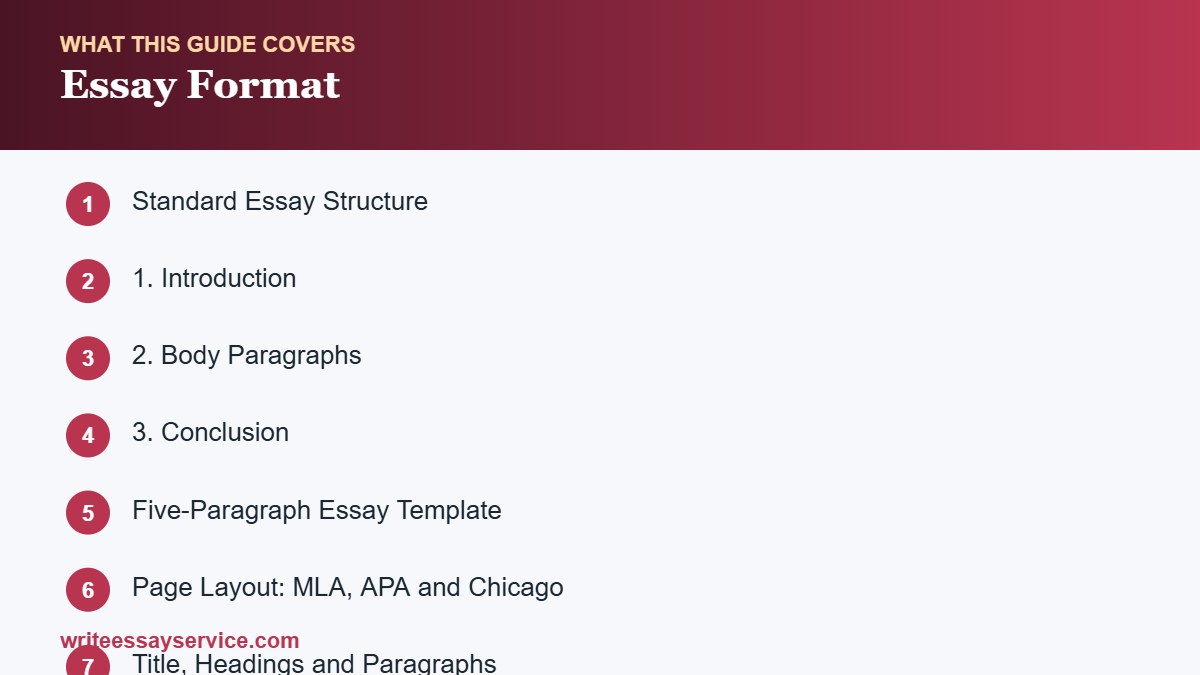
Standard Essay Structure
1. Introduction
The introduction grabs attention, gives short background and ends with the thesis statement. It usually takes 10 to 15 percent of the essay. See how to write an essay introduction and how to write a thesis statement.
2. Body Paragraphs
Each body paragraph covers one main idea. A common pattern is PEEL: Point, Evidence, Explanation, Link back to the thesis. A basic essay has three body paragraphs, while longer essays have more.
3. Conclusion
The conclusion restates the thesis in new words, summarises the main points and leaves the reader with a final thought. Learn more in how to write a conclusion for an essay.
Five-Paragraph Essay Template
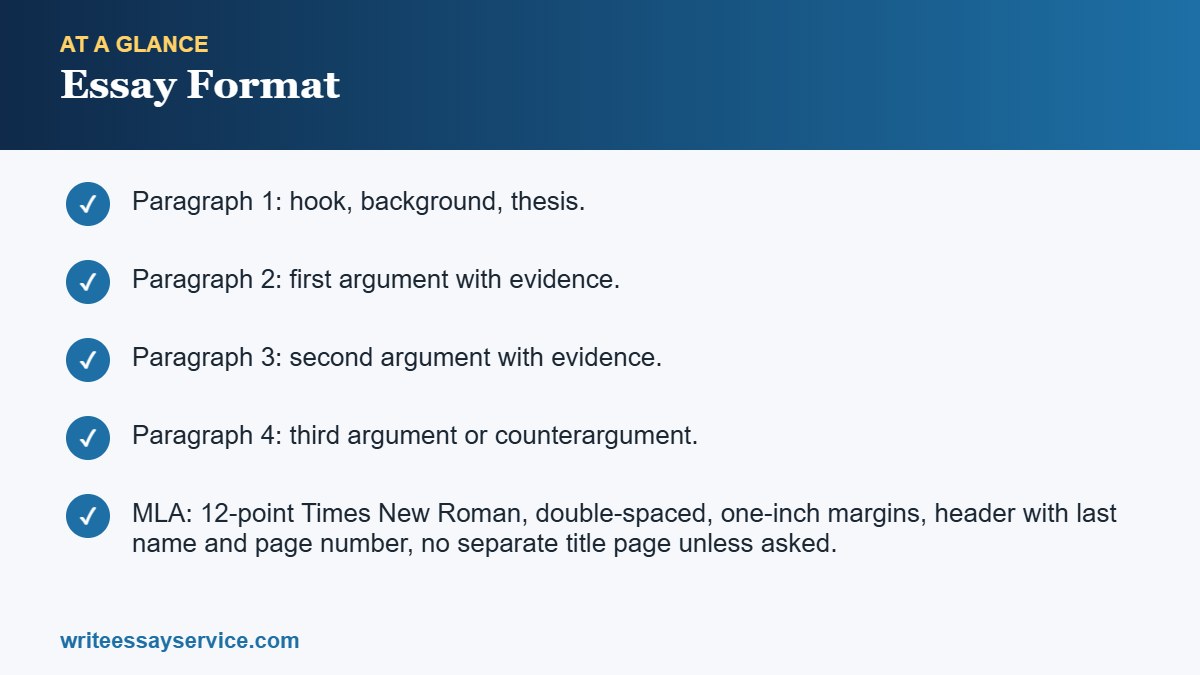
- Paragraph 1: hook, background, thesis.
- Paragraph 2: first argument with evidence.
- Paragraph 3: second argument with evidence.
- Paragraph 4: third argument or counterargument.
- Paragraph 5: conclusion.
Page Layout: MLA, APA and Chicago
Always follow the style your teacher or institution requires. The commonly used settings are below. Check your own assignment guidelines, because requirements can differ.
- MLA: 12-point Times New Roman, double-spaced, one-inch margins, header with last name and page number, no separate title page unless asked.
- APA (7th edition): a readable font such as 11-point Calibri or 12-point Times New Roman, double-spaced, one-inch margins, page numbers in the top right, title page for student papers.
- Chicago: 12-point Times New Roman, double-spaced, one-inch margins, footnotes or endnotes for citations. See our guide on how to write footnotes.
Title, Headings and Paragraphs
- Centre the title and do not bold, underline or put it in quotation marks.
- Indent the first line of each paragraph, or leave a line space between paragraphs if instructed.
- Use headings only in longer papers and keep them consistent.
Formats for Different Essay Types
- Argumentative essay: claim, evidence, counterargument and rebuttal.
- Compare and contrast essay: point-by-point or block structure.
- Explanatory essay: clear explanation of a topic or process.
- DBQ essay: thesis plus document analysis.
- Descriptive essay: dominant impression and sensory details.
Pre-Submission Checklist
- Does the essay answer the question?
- Is the thesis clear and placed at the end of the introduction?
- Does each paragraph have one main idea?
- Are the font, spacing and margins correct?
- Are all sources cited correctly?
- Have you proofread? Use this 10-step proofreading checklist.
To go deeper, read the full Essay Writing Guide or the step-by-step lesson in How to Write an Essay.