




A persuasive essay tries to convince the reader to accept your opinion or take a specific action. It combines clear reasoning, strong evidence and an appeal to the reader’s values and emotions. This guide explains the structure, the persuasion techniques and a step-by-step method to write one.
What Is a Persuasive Essay?
A persuasive essay presents a position and works to bring the reader to your side. It is closely related to an argumentative essay. The main difference is in tone: an argumentative essay focuses on logic and balanced evidence, while a persuasive essay can use more emotional appeal and a direct call to action.
Persuasive Essay Structure
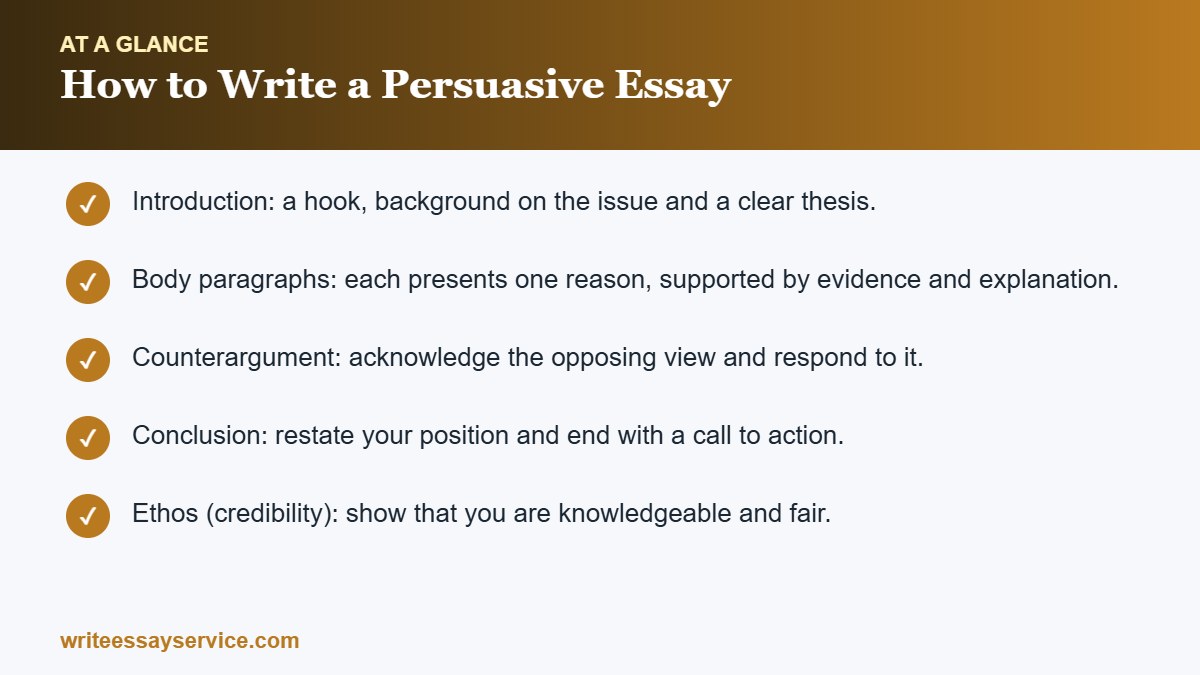
- Introduction: a hook, background on the issue and a clear thesis.
- Body paragraphs: each presents one reason, supported by evidence and explanation.
- Counterargument: acknowledge the opposing view and respond to it.
- Conclusion: restate your position and end with a call to action.
Step-by-Step Guide
1. Choose a Debatable Topic
Pick an issue on which reasonable people disagree. “Schools should start later in the morning” is debatable. “Sleep is important” is not. For ideas, see our list of persuasive topics, which also work for essays.
2. Know Your Audience
Think about who will read the essay and what they already believe. Choose arguments that matter to them.
3. Write a Strong Thesis
Your thesis should state your position clearly, for example: “Schools should start after 8:30 a.m. because later start times improve student health and academic performance.” Read how to write a thesis statement for formulas.
4. Gather Evidence
Use facts, statistics, expert opinions and examples. Choose reliable sources and keep track of them, so you can cite properly.
5. Use the Three Appeals
- Ethos (credibility): show that you are knowledgeable and fair.
- Logos (logic): present clear reasoning and evidence.
- Pathos (emotion): connect with the reader’s feelings and values through stories and vivid examples.
6. Outline Your Essay
Put your strongest argument first or last, because readers remember the beginning and the end best. Use an outline to organise your points.
7. Address the Opposing View
Mention the strongest counterargument and explain why your position is still stronger. This builds trust and makes your essay harder to dismiss.
8. Write a Powerful Conclusion
Summarise your key points and tell the reader what to think or do next. See how to write a conclusion for an essay.
9. Revise and Proofread
Check that each paragraph supports your thesis, remove weak arguments and fix errors using this proofreading checklist.

Persuasive Language Tips
- Use strong, confident verbs and avoid “I think” or “maybe”.
- Use rhetorical questions sparingly.
- Use the rule of three for rhythm.
- Use transition words to link ideas. Our sentence starters for essays can help.
Example Thesis Statements
- Plastic bags should be banned because they harm wildlife and cost more to clean up than to replace.
- Students should be allowed to use calculators in all maths exams because the exams should test understanding, not arithmetic.
- Public libraries deserve more funding because they provide equal access to education.
Common Mistakes
- Choosing a topic that is too broad or not debatable.
- Relying only on emotion without evidence.
- Ignoring the opposing side.
- Using unreliable sources or unsupported claims.
To see the full writing process, visit our Essay Writing Guide or start with How to Write an Essay.

