




Qualitative vs Quantitative Research: The Short Answer
Qualitative research explores meanings, experiences, and reasons through non-numerical data, such as interviews, observations, and open-ended responses. Quantitative research measures variables and tests relationships through numerical data from surveys, experiments, and existing datasets.
Put simply, qualitative research asks “why” and “how.” Quantitative research asks “how many,” “how much,” and “how often.” Your research question should decide which one you use, not which method feels easier.
Definitions
What Is Qualitative Research?
Qualitative research collects words, images, and behaviors to understand a topic in depth. Researchers look for patterns, themes, and context rather than counts. It is common in sociology, education, nursing, psychology, and marketing whenever the goal is to understand how people think or feel.
Because the focus is depth, qualitative studies usually involve smaller groups of participants chosen on purpose.
What Is Quantitative Research?
Quantitative research turns observations into numbers that can be counted, compared, and analyzed statistically. Researchers use it to test hypotheses, identify trends, and measure how strongly variables are related.
Quantitative studies typically need larger samples, ideally selected at random, so the results can be generalized to a wider population.
Key Differences at a Glance
This table compares the two approaches on the features that matter most when you plan a study.
Data Collection Methods
Qualitative Methods
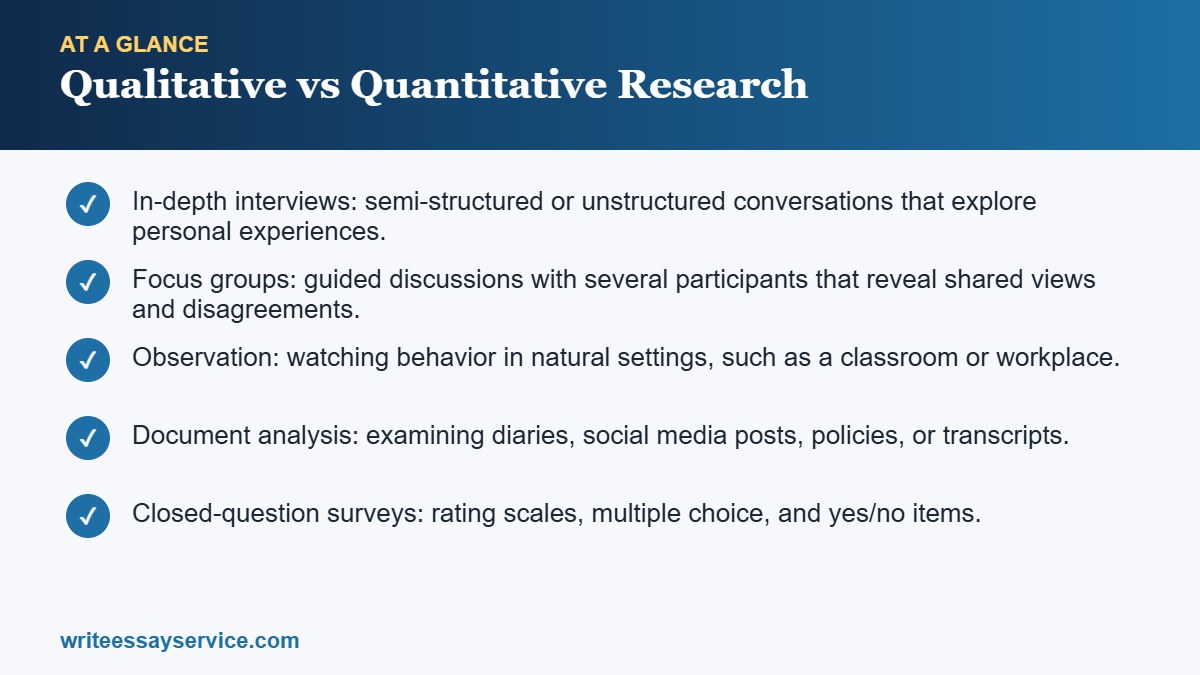
- In-depth interviews: semi-structured or unstructured conversations that explore personal experiences.
- Focus groups: guided discussions with several participants that reveal shared views and disagreements.
- Observation: watching behavior in natural settings, such as a classroom or workplace.
- Document analysis: examining diaries, social media posts, policies, or transcripts.
Quantitative Methods
- Closed-question surveys: rating scales, multiple choice, and yes/no items.
- Experiments: changing one variable to measure its effect on another.
- Structured observation: counting specific behaviors with a fixed checklist.
- Secondary data analysis: working with existing datasets, such as government records.
Strengths and Limitations
Qualitative Strengths
It captures depth, context, and unexpected insights. Its flexibility lets you follow new ideas as they emerge.
Qualitative Limitations
Findings are hard to generalize, and analysis takes time. The researcher’s interpretation can also shape results.
Quantitative Strengths
It produces measurable, comparable results. Larger samples and statistical tests support generalization and replication.
Quantitative Limitations
It may miss the reasons behind the numbers. Poorly designed questions can produce precise but misleading data.
Short Examples
Here is how researchers could study the same topic, student stress, with each approach:
- Qualitative: Interview a small group of first-year students about how they experience exam stress and which coping strategies they use. Then analyze the transcripts for recurring themes.
- Quantitative: Survey a large group of students with a standardized stress scale. Then test whether stress scores differ by year of study or by hours of paid work.
For help framing open-ended questions, browse these example qualitative research questions to see how wording shapes a study.
What About Mixed Methods?
Mixed methods research combines both approaches in one study. It helps when numbers alone, or stories alone, would leave your question only half-answered. There are three common designs:
- Explanatory sequential: Run a survey first, then interview selected participants to explain surprising results.
- Exploratory sequential: Start with interviews to identify themes, then build a survey to test them on a larger group.
- Convergent: Collect both types of data at the same time and compare the findings.
Mixed methods are powerful but demanding. In a short undergraduate paper, one approach done well usually beats two rushed ones.
How to Choose for Your Thesis or Research Paper
Start with your research question. Your thesis statement and research question should point clearly toward the kind of evidence you need. Then work through this checklist:
- ✅ Choose qualitative if you want to explore experiences, meanings, or a topic with little existing research.
- ✅ Choose quantitative if you want to measure something, compare groups, or test a specific hypothesis.
- ✅ Check access: If you can’t reach enough participants for a meaningful statistical sample, qualitative may be more realistic.
- ✅ Check your skills: Consider whether you are more comfortable with statistical software or with coding and interpreting text.
- ✅ Check your time: Interviews and transcription often take longer than students expect.
- ✅ Check expectations: Follow your field’s norms and your supervisor’s guidance.
Once you’ve chosen, map your methodology section in an essay outline before you collect any data. Then follow a clear guide on how to write a research paper to present your findings.
FAQ
Is one approach better than the other?
No. Each approach answers different kinds of questions. A study’s quality depends on how well its method fits the question and how carefully the method is carried out.
Can a survey be qualitative?
Yes. Surveys with open-ended questions generate qualitative data, which you analyze for themes rather than numbers.
How many participants do I need?
Qualitative studies often continue until new interviews stop producing new themes, a point known as data saturation. In quantitative studies, the right sample size depends on your planned analysis and is often estimated with a power analysis. Ask your supervisor for guidance specific to your field.
Is a case study qualitative or quantitative?
Most case studies are qualitative, but they can also include quantitative data, such as performance figures.
Summary
Qualitative research explains experiences and meanings through words. Quantitative research measures and tests through numbers. Let your research question guide the choice, and check your time, access, and skills. Consider mixed methods only when your question truly needs both perspectives.
Need Help With Your Research Paper?
Get support choosing a method, structuring your paper, and polishing your final draft.
Keep learning: see our full Essay Writing Guide for every step of the essay process and sample essays.