



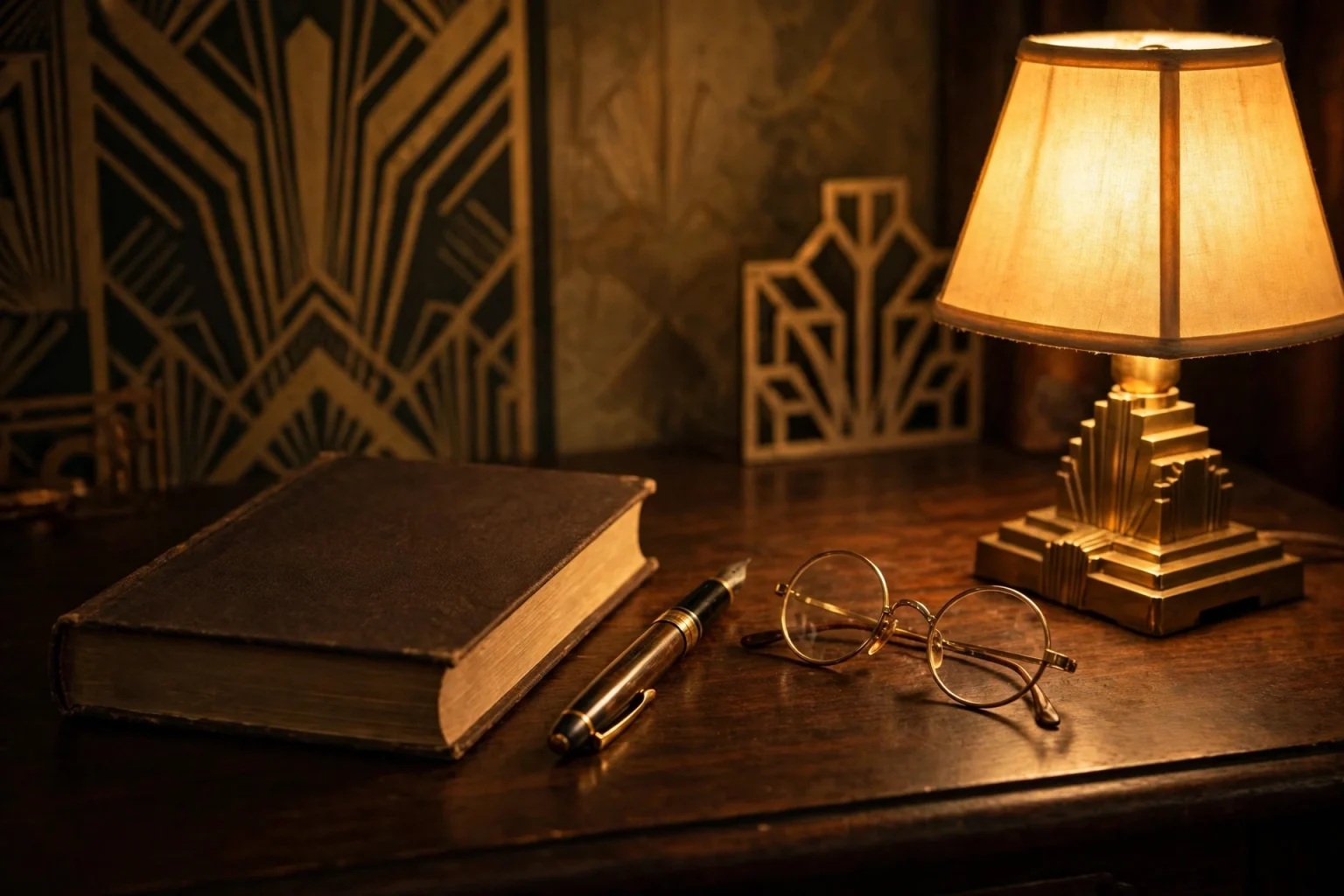
Few novels appear on set-text lists as often as The Great Gatsby. Fitzgerald’s short, glittering novel packs wealth, class, desire, moral decay and narrative trickery into fewer than two hundred pages, which makes it an ideal exam and coursework text: there is always more to say than space allows. That density is also the challenge. Students often know the plot well but struggle to turn that knowledge into a focused argument, so a good gatsby essay topics list is only half the job — the other half is knowing how to plan each question before writing a word.
This guide gives you fifteen essay questions on The Great Gatsby, grouped by theme, with a planning note for each one. Each note suggests a thesis direction, the scenes and evidence worth discussing, and a counter-reading to consider. Use them as a starting point for your own analysis, not as finished answers.

Wealth and Class
1. How does Fitzgerald use the contrast between East Egg and West Egg to explore class in The Great Gatsby?
Plan around the idea that geography is class in the novel: old money versus new money, inherited status versus performed wealth. Discuss the Buchanan house and Gatsby’s mansion, the parties, and the "careless people" motif. Weigh the counter-reading that the eggs are less opposites than mirror images — both worlds are corrupt, and Gatsby’s wealth changes nothing about how he is judged.
2. To what extent does Gatsby’s wealth liberate him, and to what extent does it trap him?
A strong thesis might argue that money buys Gatsby access but never acceptance, so wealth functions as both ladder and cage. Use the shirts scene, the parties, and the moment Tom exposes Gatsby’s bootlegging. Consider the counter-argument that Gatsby is trapped less by class than by his own fixation: he chooses the dream over every real opportunity to escape it.
3. "They were careless people, Tom and Daisy — they smashed up things and creatures and then retreated back into their money." How far do you agree?
This question invites a judgement on the novel’s moral centre. Plan evidence around Myrtle’s death, the hit-and-run, and the Buchanans’ departure, then test whether "careless" is fair — Daisy, for instance, shows moments of awareness. The counter-reading is that Nick’s verdict is itself partial: he forgives Gatsby’s recklessness while condemning the Buchanans’.
4. How does Fitzgerald present the valley of ashes, and what does it reveal about the world of the novel?
Treat the valley as the novel’s moral geography: the dumping ground on which the eggs’ glamour depends. Discuss Wilson’s garage, the eyes of T.J. Eckleburg, and the ash-grey imagery. A counter-reading worth weighing is whether the valley’s inhabitants are given any real interior life, or whether Fitzgerald uses working-class characters mainly as scenery for the rich.
The American Dream
5. What does Gatsby’s dream reveal about the American Dream in the novel?
Frame the thesis around the gap between the dream’s promise (self-invention, upward mobility) and its reality (a dream fixed on a married woman and a past that cannot be repeated). Use the green light, Gatsby’s invented biography, and the final pages. Consider the counter-reading that Gatsby’s dream is not the American Dream at all, but a private obsession dressed in its language.
6. How does Fitzgerald use the green light as a symbol in The Great Gatsby?
Plan a symbol-focused answer: the light moves from a concrete dock light to an image of longing, then to a universal emblem of aspiration. Track its appearances from chapter one to the novel’s closing lines. The counter-reading to test is whether the symbol collapses under its own weight — by the end, the light means so much that it risks meaning nothing in particular.
7. Is Gatsby a hero, a victim, or a fool? Discuss with reference to the novel’s treatment of the American Dream.
This question rewards a balanced judgement rather than a single label. Organise the plan around three strands: Gatsby’s imagination and loyalty (heroic), the forces that exploit him (victim), and his wilful self-deception (foolish). A good counter-reading is that the categories overlap by design — Fitzgerald’s point may be that the Dream makes its believers all three at once.
8. "So we beat on, boats against the current, borne back ceaselessly into the past." How does Fitzgerald use the past throughout the novel?
Plan around the novel’s backward pull: Gatsby’s five-year fixation on Daisy, Nick’s retrospective narration, and the repeated imagery of boats, clocks and repeated time. Discuss the scene where Gatsby knocks the clock off the mantel. Weigh the counter-reading that the novel is not nostalgic at all — its past is always shown as corrupted, and characters who idealise it are punished for it.
Narration and Unreliability
9. How reliable is Nick Carraway as a narrator?
This is a central question for any The Great Gatsby literary analysis, so plan carefully. A thesis might argue that Nick is honest about his biases yet unreliable in his judgements — he admits to reserving judgement while constantly judging. Use his opening claims, his selective omissions (his own past, Jordan’s dishonesty), and his shifting attitude to Gatsby. Consider the counter-reading that his unreliability is the point: we are meant to notice it.
10. How does Fitzgerald use Nick’s position as an outsider to shape the reader’s understanding of the novel’s world?
Plan around Nick’s double role: insider by invitation, outsider by background and temperament. Discuss his Midwestern origins, his rented cottage between the mansions, and his access to both Gatsby’s and Tom’s worlds. The counter-reading is that Nick is less an outsider than he claims — he benefits from the same privilege he criticises, and his narration protects him from scrutiny.
11. To what extent does the novel’s first-person narration limit what the reader can know?
Focus on what Nick cannot see: Gatsby’s criminal dealings, Daisy’s private thoughts, the moments he reconstructs second-hand. A strong thesis argues that these gaps are deliberate, forcing the reader to judge characters on partial evidence. Weigh the counter-argument that Fitzgerald compensates through dialogue, reported speech and symbolism, so the limits are narrower than they first appear.
Symbols and Imagery
12. How does Fitzgerald use colour imagery to develop the novel’s themes?
Plan a structured answer around three or four colours: gold and yellow (wealth and decay), green (hope and money), white (purity and emptiness), and grey (the valley of ashes). Gather one or two key moments per colour rather than listing every instance. The counter-reading to consider is whether colour symbolism is sometimes inconsistent — white, for example, attaches to both Daisy and to corruption — and whether that inconsistency is meaningful.
13. What is the significance of the eyes of Dr T.J. Eckleburg?
This question suits a thesis about godlessness and moral judgement in a world without a watching authority. Discuss the billboard’s placement over the valley, Wilson’s reading of it as the eyes of God, and its silent witness to the novel’s deaths. Consider the counter-reading that the eyes mean nothing at all — they are a decaying advertisement, and the novel’s irony is that characters project meaning onto an empty sign.
Character
14. How does Fitzgerald present Daisy Buchanan, and how far is she responsible for the novel’s tragedy?
Plan around the tension between Daisy’s charm and her evasions: her voice "full of money", her choices at the Plaza Hotel and after Myrtle’s death, and her retreat into wealth. A careful thesis will resist simply blaming Daisy and instead ask what choices were genuinely available to her. The counter-reading is that Nick’s narration softens her culpability — or, alternatively, that it exaggerates it by filtering her through male perspectives.
15. How does Fitzgerald use minor characters — such as Myrtle Wilson, Jordan Baker and Meyer Wolfsheim — to develop the novel’s themes?
Plan by assigning each minor character a thematic function: Myrtle embodies aspiration and its costs, Jordan represents the era’s moral flexibility, and Wolfsheim connects Gatsby’s wealth to organised crime. Discuss two or three scenes per character. The counter-reading worth weighing is whether these figures are fully realised people or thematic devices — and whether that distinction matters for your judgement of the novel.
Structuring a Literary Analysis Paragraph for Your Gatsby Essay Topics
Once your plan is set, the paragraph is where the argument lives. A reliable structure for a Gatsby essay plan is: point, evidence, analysis, link. Start with a clear topic sentence that makes one claim — not a plot summary. Follow it with a brief, well-chosen piece of evidence: a short quotation of a few words, a described scene, or a pattern of imagery. Then spend most of the paragraph on analysis: explain how the evidence works and why it supports your claim, bringing in the counter-reading where it sharpens your point. Close by linking back to the question. If you want a fuller walkthrough of this structure, see our guide on how to write an analytical essay, and make sure your central claim is precise by reading our advice on writing a strong thesis statement.
A common mistake is to write paragraphs that describe rather than argue. If a paragraph could appear in an essay on a different question without changing a word, it probably is not answering this one. Keep returning to the key terms of the question, and let each paragraph do one job well.
Frequently Asked Questions
What are the main themes of The Great Gatsby? The most commonly discussed The Great Gatsby themes are wealth and class, the American Dream, love and obsession, moral decay, and the unreliability of memory and narration. Most strong essays focus on two or three themes and show how they connect, rather than listing all of them.
How many essay questions should I prepare for a Gatsby exam? Prepare around five or six thoroughly, covering different themes — wealth, the American Dream, narration, symbolism and character. Depth beats breadth: a well-planned answer on one question is worth more than a shallow attempt at many.
How do I write a thesis statement for a Gatsby essay? A good thesis makes a specific, arguable claim — for example, that Gatsby’s wealth buys access but never acceptance — rather than stating a fact about the plot. It should be narrow enough to prove in the space you have and open enough to allow a counter-reading.
Should I quote the novel in my essay? Yes, but briefly. Short quotations of a few words, woven into your own sentences, are more effective than long blocks. Always follow a quotation with analysis of what it shows and why it matters to your argument.
Is Nick Carraway an unreliable narrator? Most critics argue that he is partially unreliable: honest about his feelings but biased in his judgements, selective in what he reports, and inconsistent in applying his own standards. A good essay acknowledges both his candour and his blind spots.
How long should a Gatsby essay be? That depends on the assignment, but a typical school or university essay of 1,000–1,500 words needs a clear thesis, three or four well-developed paragraphs, and a conclusion that answers the question directly. Planning time is part of the writing time — a strong plan usually makes a shorter essay stronger, not weaker.

