
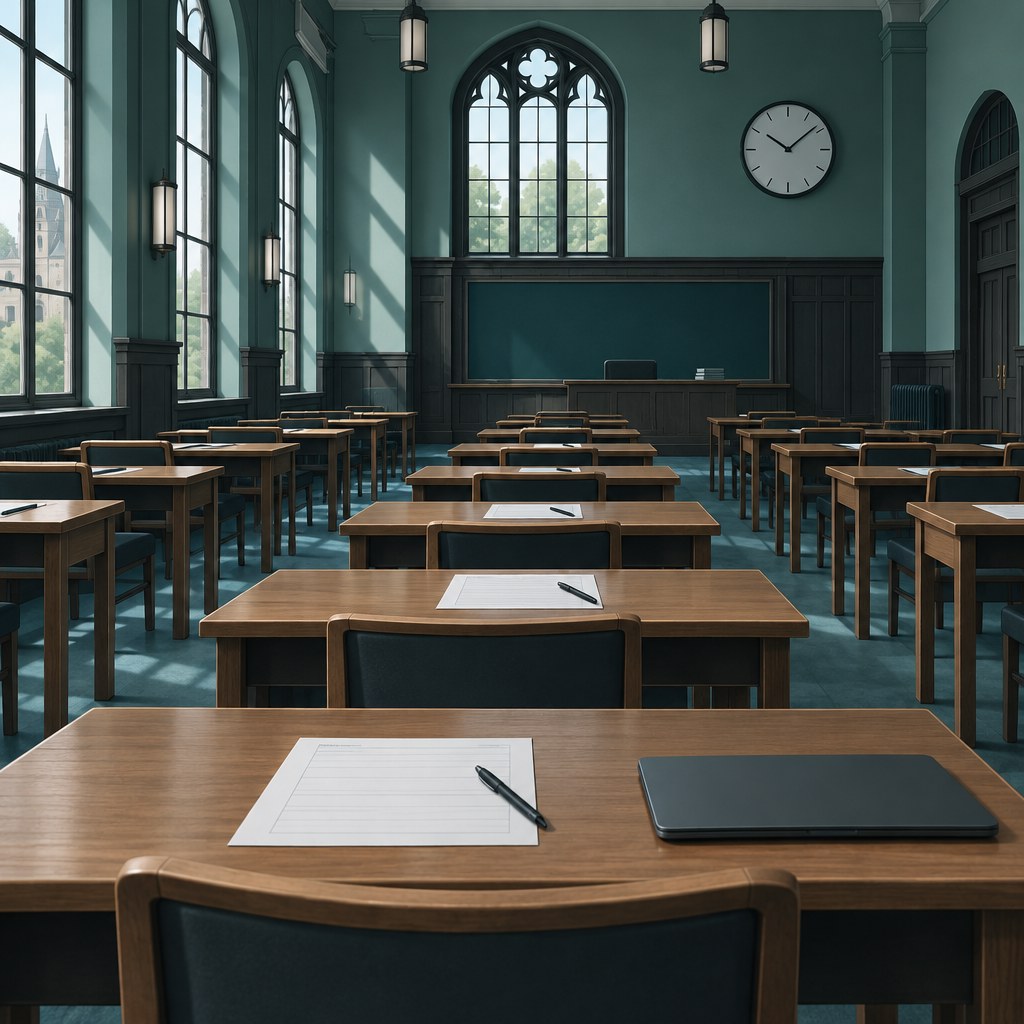
A growing number of UK universities are moving some assessments back into the exam hall. According to a Times Higher Education report published in summer 2026, universities are worried that take-home essays no longer show what students can do without AI, and they are bringing back supervised, in-person exams. The same concern is behind the AI smart glasses cheating cases in South Korea and the rising AI misconduct figures at Irish universities.
The numbers behind the shift
Figures cited in the report show how quickly student AI use has grown:
- Up to 95% of students say they use AI in their studies, up from 66% in 2024.
- The share of students including AI-generated text in assessed work rose to 12%, from 3% in 2024.
At Swansea, law lecturer Michael Draper said grades were “getting bunched” in the high 2:2 to low 2:1 range, with fewer high-class marks. At Birkbeck’s law school, more than 45% of students received firsts under invigilated exams, compared with 13% for take-home essays the previous year.
Which universities are changing
- Bath: From 2026-27, a “Two-Lane” model. “Closed” assessments are time-limited, invigilated and in-person.
- Cardiff: Plans to adopt the two-lane approach. It does not expect a large-scale return to paper-based exams, but expects more supervised, in-person formats where appropriate.
- LSE: Reports more in-class and invigilated exams, plus oral and process-based assessment.
- Swansea (law): Returning to in-person exams for some assessments next year, with students allowed to bring some notes.
- Birkbeck (law): Reintroduced invigilated exams this academic year after academics faced many suspected AI-written essays.
- Durham: Not a policy change, but Professor Andy Hamilton stepped down as chair of the philosophy board of examiners over AI cheating and has argued for sit-down exams.
Not everyone agrees
The University of Surrey is taking the opposite approach and is embedding AI across all of its courses. Its representative criticised traffic-light systems that label AI use as allowed or banned, calling them “prohibitive and punitive and just outdated.”
Online exams are still common
A freedom of information study by Draper and Philip Newton found that 78% of UK universities still use online exams. Of those, 65% use no proctoring, and 10% use remote invigilation for all online exams. About 70% of institutions have no plans to phase out online exams, 19% plan to scale back, and 3% (two institutions) plan to eliminate them. Draper suggests that “at least” 50% of assessments should be supervised.
The Higher Education Policy Institute (HEPI) found that 96 of 163 UK universities (59%) have public AI policies. Of those, 83 use education-focused language, 9 are mixed, and 4 are detection-focused.
What it means for students
Expect more exams, oral questions and in-class writing, and fewer assessments that rely only on a polished take-home essay. Building real writing skills matters more than ever. If you face a timed, exam-style essay, practise with our guide to the DBQ essay format, keep your argument moving with sentence starters for essays, and finish strongly with conclusion sentence starters. For longer assignments, see how to write a research paper. Our writing services can support your own original work.
Related coverage
- AI Smart Glasses Cheating Hits South Korean University Exams
- Irish Universities Report Hundreds of AI Cheating Cases
- DBQ Essay Format: Structure, Examples and Writing Tips
Source
- Are universities returning to in-person exams to combat AI cheating?, Times Higher Education, published 29 June 2026 and updated 26 August 2026