




Introduction: why 1984 keeps appearing on essay lists
George Orwell’s 1984 (1949) is one of the most-set novels in English literature courses, and the reason is simple: it gives essay writers three enormous ideas to work with — surveillance, truth and power — and it connects them so tightly that almost any question about one of them pulls in the other two. A good essay on 1984 does not retell the plot. It takes one of those ideas, argues a position about it, and proves that position with carefully chosen evidence from the novel.
This guide gives you 15 essay questions on 1984, grouped under the three themes markers ask about most, and shows you how to plan each one: a thesis angle, the evidence to use, and a paragraph plan. Use them as planning practice. The planning is the work that earns marks; a memorised essay that does not answer the exact question asked will not.
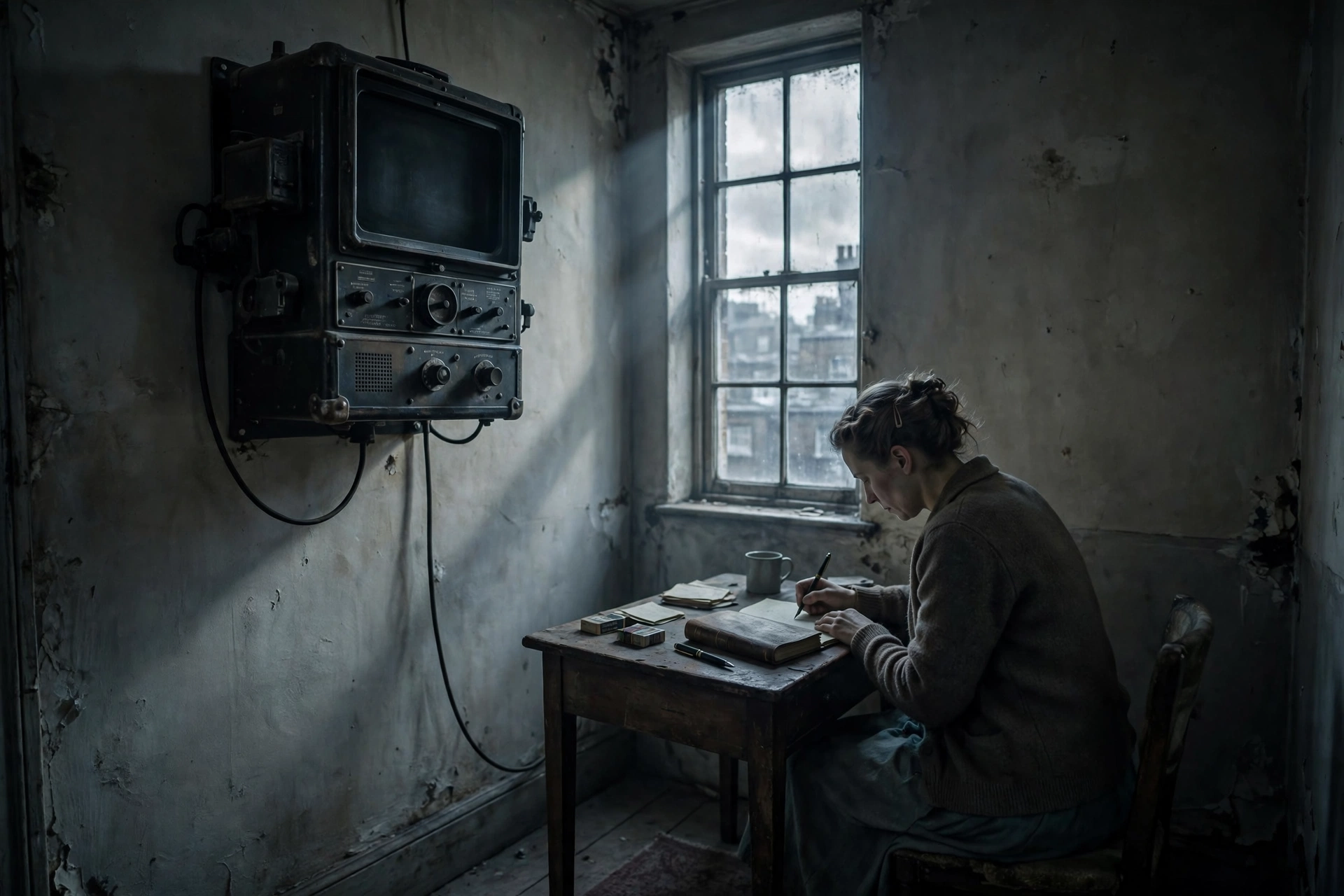
How to use these questions
Pick one question. Before you write a word, do three things:
- Turn the question into an argument. A question such as “How does Orwell present surveillance?” is not yet an argument. “Orwell presents surveillance as a tool that makes citizens police themselves, so the Party needs less open force” is. Your introduction should state that argument clearly.
- Choose three or four pieces of evidence — and no more. One strong, analysed quotation beats five listed ones. For each piece of evidence, note the technique (imagery, irony, repetition) and what it proves.
- Plan paragraph jobs. Each body paragraph should do one job: one idea, one set of evidence, one step in your argument. If a paragraph does two jobs, split it.
If you are unsure how to frame a thesis, read Thesis Statement vs Topic Sentence: The Difference, With Examples and a Quick Test first — it shows the difference between a topic and an arguable claim.
Surveillance and control (Questions 1–5)
1. How does Orwell present surveillance in 1984, and what is its purpose?
Angle: Argue that surveillance in Oceania is not mainly about catching criminals — it is about making citizens behave as if they are always watched, so that control becomes self-imposed. The telescreens, the Thought Police and the posters of Big Brother all serve this purpose.
Evidence: The opening image of Big Brother’s eyes following Winston; the telescreen that both receives and transmits; Winston’s care in keeping his back to the screen while writing; the Two Minutes Hate as public, watched performance.
Plan: Paragraph 1 — the telescreens and the impossibility of privacy. Paragraph 2 — Big Brother’s gaze and the poster (“BIG BROTHER IS WATCHING YOU”) as psychological pressure. Paragraph 3 — how citizens internalise the watch: Winston’s self-censorship, the Parsons children denouncing their father. Conclude: surveillance works best when the watched do the watching themselves.
2. “The telescreen received and transmitted simultaneously.” Explore the significance of the telescreen as a symbol of Party power.
Angle: The telescreen’s double function — it watches and it speaks — makes it the novel’s perfect symbol: the Party does not only observe its citizens, it tells them what to think while it watches them think it.
Evidence: Winston’s flat and the telescreen’s “dim” setting that never truly switches off; the morning exercises and instructions; the telescreen’s role in the Two Minutes Hate; the moment O’Brien’s voice comes through it in the Ministry of Love.
Plan: Paragraph 1 — the telescreen as watcher (no privacy). Paragraph 2 — the telescreen as voice (propaganda, orders, Newspeak). Paragraph 3 — the telescreen as trap (Winston and Julia caught in the room above the shop). Conclude: a symbol that is also a weapon.
3. To what extent is Winston’s rebellion a response to surveillance?
Angle: Winston’s diary, his affair with Julia and his visit to the prole districts are all attempts to find a space the Party cannot see. Argue that the rebellion is real but limited: it is private and secret, which is exactly why it cannot succeed.
Evidence: The diary’s first entry (“DOWN WITH BIG BROTHER”) written with his back to the telescreen; the room above Mr Charrington’s shop as a supposed blind spot; the paperweight as a symbol of a private past; the telescreen hidden behind the picture.
Plan: Paragraph 1 — the diary as a first act of thoughtcrime. Paragraph 2 — the affair and the room as a private world. Paragraph 3 — why secrecy dooms the rebellion: it can never become public or collective. Conclude: Orwell shows that private rebellion under total surveillance is a form of defeat, not a path to freedom.
4. How does Orwell use the Thought Police and the figure of Big Brother to create fear?
Angle: Neither is shown directly for most of the novel, and that absence is the point: fear works best when the threat is everywhere and nowhere. Big Brother may not even exist as a person; the Thought Police strike without warning.
Evidence: The knock on the door that Winston dreads; the vaporisation of people who become “unpersons”; the Parsons children as junior spies; O’Brien’s revelation about how the Party really operates.
Plan: Paragraph 1 — Big Brother as an image, not a man: the face on posters, coins and telescreens. Paragraph 2 — the Thought Police as an invisible, unpredictable force. Paragraph 3 — fear’s effect on ordinary behaviour: the Two Minutes Hate, the self-censorship of the Party members, Winston’s nightmares. Conclude: the most effective fear is the one you cannot see coming.
5. “Freedom is the freedom to say that two plus two make four.” Discuss the relationship between surveillance and independent thought in the novel.
Angle: The Party watches bodies in order to control minds. Argue that Orwell’s chain is: control what people can say, control what they can think, and surveillance is the enforcement mechanism at every step.
Evidence: Thoughtcrime as an offence with no defined act; the diary as the crime of private thought; Newspeak as the narrowing of sayable thought; Winston’s final acceptance that “two plus two make five” is not a mistake but a surrender.
Plan: Paragraph 1 — surveillance of action (telescreens, patrols). Paragraph 2 — surveillance of speech and the criminalisation of thought. Paragraph 3 — the end point: Winston loves Big Brother because his mind has been remade, not merely his behaviour. Conclude: in Oceania, to be unwatched is to be free, and nobody is unwatched.
Truth and language (Questions 6–10)
6. How does the Party control the truth in 1984?
Angle: The Party controls the truth by controlling the record: it rewrites newspapers, photographs and statistics, so that the past always matches the present. Argue that this is more powerful than lying — it removes the evidence that a lie ever happened.
Evidence: Winston’s job in the Records Department; the chocolate ration “raised” from 30 to 20 grams; the photograph of Jones, Aaronson and Rutherford that Winston destroys; the mutability of the past as stated in the Party slogan.
Plan: Paragraph 1 — the Ministry of Truth and the daily rewriting of records. Paragraph 2 — the destruction of evidence (the photograph, the memory hole). Paragraph 3 — the result: a population that cannot check the Party’s claims, and a Winston who begins to doubt his own memory. Conclude: whoever controls the record controls reality.
7. Explore the significance of Newspeak in the novel.
Angle: Newspeak is the Party’s long-term project: if words disappear, the thoughts they carry become impossible. Argue that it is the most chilling idea in the novel because it attacks dissent before it can be thought.
Evidence: Syme’s enthusiasm for destroying words; the reduction of vocabulary and the elimination of synonyms; “doublethink” as a word that names the mental habit the Party needs; the appendix on the principles of Newspeak.
Plan: Paragraph 1 — what Newspeak is and why Syme loves it. Paragraph 2 — how shrinking language shrinks thought (the example of “free” surviving only in phrases like “free from”). Paragraph 3 — why the project is slow, and what that implies: the Party plans for a future in which rebellion is literally unthinkable. Conclude: Newspeak shows that power over language is power over the mind.
8. “Who controls the past controls the future. Who controls the present controls the past.” What does Orwell suggest about history in 1984?
Angle: Orwell argues that history is not a fixed record but a resource that power can edit. The Party’s slogan is a method, not a boast: control the present’s records, and you control what the future believes the past was.
Evidence: Winston’s memory of the photograph and his inability to prove it; the changing enemy (Oceania has “always been at war with Eastasia”); the Party’s claim to have invented the aeroplane; Goldstein’s book on the three super-states.
Plan: Paragraph 1 — the slogan and Winston’s work. Paragraph 2 — the practical methods: rewriting, destroying, inventing. Paragraph 3 — the human cost: Winston cannot trust his own memories, including his mother’s fate. Conclude: when history is editable, citizens lose the ground on which to stand against power.
9. How does Orwell present the concept of doublethink, and why is it essential to the Party?
Angle: Doublethink — holding two contradictory beliefs at once — is the mental skill that lets the Party’s rule work. Argue that it is essential because the Party’s claims contradict each other constantly, and a population that cannot notice contradiction cannot resist.
Evidence: The slogans (“War is Peace”, “Freedom is Slavery”, “Ignorance is Strength”); the switch from Eastasia to Eurasia as the enemy mid-sentence; Winston’s training in crimestop; O’Brien’s explanation in the Ministry of Love.
Plan: Paragraph 1 — what doublethink is, with the slogan examples. Paragraph 2 — how it is taught and practised (crimestop, the Two Minutes Hate). Paragraph 3 — why the Party needs it: a population that can hold contradictions will accept anything. Conclude: doublethink is the Party’s greatest invention — a way to make people lie to themselves.
10. To what extent does Winston succeed in holding on to the truth?
Angle: Winston’s struggle is the novel’s emotional centre, and his failure is its tragedy. Argue that he succeeds briefly — the diary, the photograph, his memory of his mother — but that the Party’s system is designed so that private truth cannot survive public power.
Evidence: The diary as a record for the future; the photograph that proves the Party lied, and Winston’s destruction of it; the coral paperweight and the room; the final scene in the Chestnut Tree Café.
Plan: Paragraph 1 — Winston’s early acts of truth-keeping. Paragraph 2 — the pressure that erodes them: fear, loneliness, torture. Paragraph 3 — the ending: Winston accepts the Party’s truth, and Orwell’s bleak point is that the system wins. Conclude: the novel suggests truth needs a shared, public world to survive — and Oceania has destroyed that world.
Power and resistance (Questions 11–15)
11. “Power is not a means; it is an end.” Discuss O’Brien’s explanation of the Party’s motives.
Angle: O’Brien’s speech in the Ministry of Love is the novel’s thesis: the Party does not seek power for wealth, security or ideology, but for power itself. Argue that this makes 1984 different from earlier dystopias — there is no secret good intention to discover.
Evidence: O’Brien’s rejection of the idea that the Party seeks the good of the people; the boot stamping on a human face “for ever”; the contrast with the Brotherhood’s hopes; Winston’s realisation that O’Brien is not a fellow rebel.
Plan: Paragraph 1 — what Winston expected the Party’s motive to be. Paragraph 2 — O’Brien’s answer and the “boot” image. Paragraph 3 — why this matters for the whole novel: if power is the end, there is nothing to appeal to, and no reform to hope for. Conclude: Orwell’s bleakest claim is that power can be an end in itself.
12. How does Orwell present the relationship between Winston and Julia?
Angle: Their affair is political before it is romantic: it is a rebellion against a Party that controls the body. Argue that Orwell makes the relationship honest rather than sentimental — it is driven by hatred of the Party as much as by love.
Evidence: Julia’s note (“I love you”) and her practical rebellion (make-up, real coffee, black-market goods); the room above the shop as a world of their own; Julia’s indifference to the Brotherhood and to ideas; their betrayal of each other under torture.
Plan: Paragraph 1 — the affair as thoughtcrime and bodily rebellion. Paragraph 2 — Julia’s pragmatic rebellion versus Winston’s intellectual one. Paragraph 3 — the betrayal and what it proves: under the Party, even love is a private act the state can break. Conclude: the relationship shows both the human need for private life and its fragility under total power.
13. What role do the proles play in the novel, and why does Winston hope in them?
Angle: Winston believes “if there is hope, it lies in the proles” because they are the only group the Party does not watch closely. Argue that Orwell presents this hope as understandable but misplaced: the proles are free from surveillance but not free from ignorance, and they never organise.
Evidence: The prole woman singing while hanging washing; the pub and the market; the proles’ loyalty to the Party through the lottery and the songs; the old man’s inability to remember life before the Party.
Plan: Paragraph 1 — why Winston hopes: the proles are 85 per cent of the population and are left alone. Paragraph 2 — why the hope fails: they lack education, organisation and memory. Paragraph 3 — the song of the prole woman as a symbol of life continuing without freedom. Conclude: Orwell’s point is that numbers alone are not power — without awareness and organisation, the many remain ruled by the few.
14. How does Orwell use the ending of the novel to make his argument about power?
Angle: The ending — Winston broken, loving Big Brother — is deliberately without hope. Argue that Orwell refuses a comforting resolution because his argument is a warning: a system like the Party’s, once complete, does not fall from within.
Evidence: Room 101 and the rats; Winston’s betrayal of Julia; the Chestnut Tree Café scene; the final sentence about loving Big Brother; the appendix on Newspeak as a note of (very distant) hope.
Plan: Paragraph 1 — what happens to Winston and why it is not a defeat in a fair fight. Paragraph 2 — the deliberate bleakness: no rescue, no revolution, no secret resistance. Paragraph 3 — the appendix as a small counterweight: Newspeak is written about in the past tense, suggesting it eventually failed. Conclude: the ending is the warning; the appendix is the reminder that warnings can work.
15. “1984 is a warning, not a prediction.” To what extent do you agree?
Angle: This is the classic synoptic question, and it rewards a balanced answer: agree that Orwell wrote to warn against tendencies he saw in his own time (totalitarianism, propaganda, the manipulation of language), but acknowledge that some of his warnings — mass surveillance, the rewriting of records, the control of language — have become real in ways he did not predict.
Evidence: The historical context: Stalin’s Soviet Union, Nazi Germany, wartime propaganda; the novel’s own technology (telescreens) versus modern surveillance; the persistence of “Orwellian” as a word for state control.
Plan: Paragraph 1 — the warning: Orwell’s 1949 context and what he was warning against. Paragraph 2 — the prediction that came true in part: surveillance technology and the control of information. Paragraph 3 — what he got wrong or left out: the Party’s total success, the absence of the internet, the resilience of ordinary life. Conclude: the novel’s power is that it is both — a warning rooted in 1949 that still describes real dangers.
Common mistakes to avoid
- Retelling the plot. Markers do not reward summaries. Every paragraph should argue something, with plot used only as evidence for that argument.
- Listing techniques without analysis. Naming “imagery” or “irony” earns nothing on its own. Say what the technique does in this moment, and what it proves about your argument.
- Treating Big Brother as a character. Big Brother is an image and an idea. Writing about him as if he were a person with motives weakens an essay.
- Forgetting the question. “Discuss” wants a balanced judgement; “to what extent” wants a measured answer with a clear position; “how does Orwell present” wants methods and effects, not just themes.
- Quoting at length. Short, well-chosen phrases (“BIG BROTHER IS WATCHING YOU”, “two plus two make four”) analysed closely beat long block quotations every time.
For a companion guide to another Orwell text, see Writing About Animal Farm: 15 Essay Questions on Power, Language and Control — and How to Plan Each One — the same planning method applied to Orwell’s other great political novel.
Frequently asked questions
What is the best essay topic on 1984 for a first essay?
Start with surveillance (Question 1) or the Party’s control of truth (Question 6). Both have clear, concrete evidence — the telescreens, the Records Department — and both let you build a simple, strong argument before you tackle the more abstract questions about doublethink or power.
How many quotations should I use in a 1984 essay?
Three or four strong, short quotations in a typical school essay are enough. Choose ones you can analyse for technique and meaning, not ones you can merely repeat. A quotation you cannot explain is worse than no quotation.
Is 1984 about surveillance or about power?
Both — and the connection is the essay. Surveillance is the Party’s method; power is its purpose. The strongest essays show how the method serves the purpose, rather than treating the two themes as separate lists.
Can I compare 1984 with Animal Farm in an essay?
Yes, if the question invites comparison. Both novels are about power, but they work differently: Animal Farm is an allegory of a revolution that betrays itself, while 1984 is a portrait of power already complete. Compare the methods of control, not just the plots.
How do I write a thesis statement for a 1984 essay?
State your argument in one sentence that someone could disagree with. “Orwell presents surveillance as a tool that makes citizens police themselves” is a thesis; “1984 is about surveillance” is a topic. The difference matters — see the thesis statement versus topic sentence guide for the full method.