



Few set texts reward careful planning as richly as Shakespeare's Hamlet. In a single long tragedy, a prince is ordered to avenge his father's murder, doubts the command, feigns madness, and watches almost everyone around him die. That density is exactly why the play appears so often in school and university assessments — and why a strong plan matters more than a memorised paragraph. This guide to hamlet essay topics is designed to help you think, not to hand you an answer. Use it to practise forming a position and selecting precise evidence.
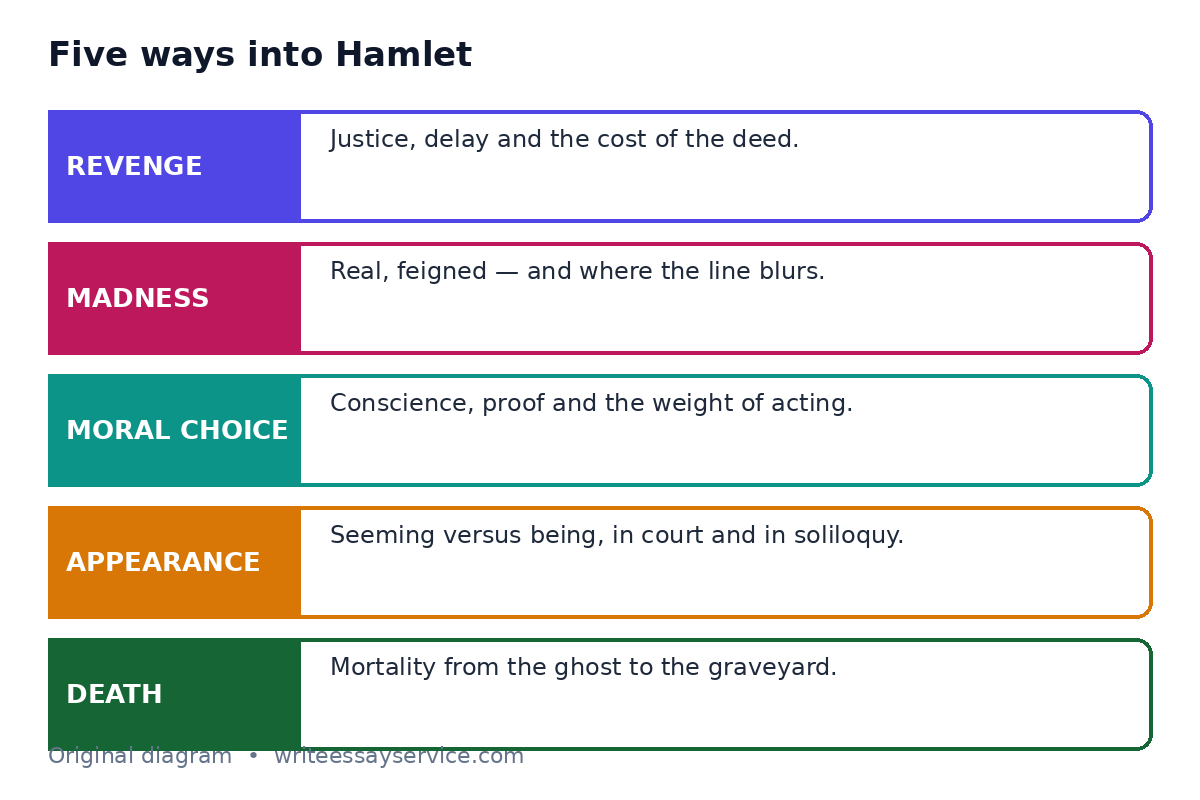
The fifteen questions below are grouped by theme, so you can revise one cluster at a time or compare ideas across clusters. Each one comes with a short planning note: a suggested line of argument, the scenes and quotations most useful for testing it, and a reminder of what the question is really asking. Work through a question by deciding your own position first, then gathering three or four well-chosen moments that support it, and finally thinking about a counter-reading that complicates it. A good essay on Hamlet does not simply list examples of revenge or madness; it shows how Shakespeare makes those ideas interact.
Before you begin, read each question twice. Underline its command words — explore, discuss, to what extent, how far — because they tell you whether you need to evaluate, compare, or trace a development. Learning how to plan a hamlet essay in this way will serve you for any question the play throws at you, because the same habits — position, evidence, counter-reading — apply every time.
Revenge: Hamlet Essay Questions
Revenge drives the plot of Hamlet, yet Shakespeare never treats it as a simple duty. Hamlet is commanded to avenge his father, but he hesitates, questions the Ghost, and watches other revengers — Laertes and Fortinbras — act far more quickly than he does. These hamlet revenge essay questions invite you to trace that tension.
- Explore how Shakespeare presents revenge in Hamlet.
Planning angle: Argue that revenge is presented as a duty that corrupts everyone who pursues it, beginning with the Ghost's command and ending with a stage littered with bodies. Use Hamlet's delay, Laertes' impulsive return, and Fortinbras' cold march to show three different responses to the same demand, and consider whether any of them achieves justice. - “Hamlet is a play about revenge that delays revenge.” To what extent do you agree?
Planning angle: Take a qualified position: the play's structure is built around delay, yet revenge is never far from the surface. Weigh Hamlet's soliloquies against the swift revenges of Laertes and Fortinbras, and use the prayer scene, where Hamlet spares Claudius, as evidence that his hesitation is moral reasoning rather than simple cowardice. - How does Shakespeare use Laertes and Fortinbras to comment on Hamlet's revenge?
Planning angle: Treat the two men as foils who expose what Hamlet is not. Laertes acts instantly and regrets it; Fortinbras acts without feeling and prospers. Compare their arrivals in Denmark with Hamlet's soliloquies, and argue that Shakespeare uses them to ask whether speed, thought, or indifference is the right response to a call for revenge.
Madness, Real and Feigned: Hamlet Essay Questions
The question of Hamlet's madness is one of the play's great puzzles. He announces that he will “put an antic disposition on”, yet his behaviour grows increasingly erratic, and Ophelia's genuine madness provides a disturbing contrast. These hamlet madness analysis questions ask you to examine the line between performance and breakdown.
- Is Hamlet really mad, or is he only pretending? Discuss.
Planning angle: Argue that the play deliberately refuses a single answer, and that your job is to weigh the evidence on both sides. Use his lucid soliloquies and his calculated cruelty to Polonius against his erratic outbursts and his treatment of Ophelia, and consider whether the two states can coexist. - Explore the significance of Ophelia's madness in Hamlet.
Planning angle: Argue that Ophelia's madness is the play's only unambiguous case of a broken mind, and that it exposes the cost of the court's corruption on someone with no power. Use her fragmented songs and flowers in Act 4, Scene 5, and contrast them with Hamlet's controlled wordplay, to show how Shakespeare distinguishes genuine suffering from performance. - How does Shakespeare use the theme of madness to explore truth in Hamlet?
Planning angle: Focus on the paradox that Hamlet speaks most honestly when he appears least sane, telling Claudius truths disguised as riddles and using the play within the play to “catch the conscience of the king”. Use the “To be, or not to be” soliloquy and the graveyard scene to show how madness becomes a way of speaking truths the court cannot bear to hear.
Moral Choice and Delay: Hamlet Essay Questions
Hamlet's famous delay is often treated as a character flaw, but the play gives him genuine moral reasons to hesitate: he cannot be sure the Ghost is honest, and murder, even of a murderer, carries a terrible weight. These hamlet essay questions about moral choice ask you to examine how Shakespeare presents conscience, duty, and the difficulty of acting rightly.
- Explore how Shakespeare presents Hamlet's delay.
Planning angle: Argue that the delay is presented as a moral problem, not a weakness, beginning with Hamlet's doubt about the Ghost and continuing through his fear of damnation.
“The spirit that I have seen / May be the devil”
Use the prayer scene and the “To be, or not to be” soliloquy as key moments, and consider whether delay protects Hamlet's conscience or destroys it.
- “Hamlet's conscience prevents him from acting.” To what extent do you agree?
Planning angle: Take a balanced position that separates conscience from fear, acknowledging that Hamlet thinks deeply about the morality of killing while also shrinking from the act itself. Weigh his philosophical soliloquies against his impulsive killing of Polonius, and ask whether conscience is his guide or his excuse. - How does Shakespeare present the conflict between thought and action in Hamlet?
Planning angle: Argue that the play stages thought and action as rivals, with Hamlet's reflective language constantly interrupting the plot's demand for violence. Use the contrast between his long soliloquies and the sudden deaths — Polonius behind the arras, Ophelia's drowning, the final duel — to show how action, when it comes, is often unplanned and catastrophic.
Appearance Versus Reality: Hamlet Essay Questions
Denmark is a court of spies, masks, and performances, where almost everyone is watching someone else and pretending to be something they are not. Hamlet's feigned madness, Claudius's smooth kingship, and Polonius's spying all raise the same question: how can anyone know what is true? These hamlet themes questions turn to the play's most persistent idea.
- Explore how Shakespeare presents appearance and reality in Hamlet.
Planning angle: Argue that the gap between seeming and being is the play's central pattern, from Hamlet's
“I know not ‘seems’”
in Act 1 to Claudius's confession that
“words fly up, my thoughts remain below”
. Use the play within the play, the spying scenes, and the graveyard's equalising skulls to show how Shakespeare strips away appearances one by one.
- How does Shakespeare use the play within the play to develop the theme of appearance and reality?
Planning angle: Focus on The Mousetrap as a test: Hamlet stages a murder to watch Claudius's reaction, turning theatre into a tool for discovering truth. Use Claudius's rising and calling for light, and Hamlet's triumphant
“O good Horatio, I'll take the ghost's word for a thousand pound”
, to show how performance reveals what polite court language conceals.
Gertrude and Ophelia: Hamlet Essay Questions
The women of Hamlet are often discussed as victims of the men around them, yet both Gertrude and Ophelia make choices that matter to the plot. These questions invite a hamlet character analysis that looks beyond a simple reading of either woman.
- Explore how Shakespeare presents Gertrude in Hamlet.
Planning angle: Argue that Gertrude is best understood as a study in ambiguity — loyal to Claudius, loving towards Hamlet, and yet apparently blind to the murder at the heart of her marriage. Use the closet scene, where Hamlet confronts her, and her death drinking the poisoned cup, to trace her arc, and decide whether her final act is an accident, a sacrifice, or a moment of choice. - How does Shakespeare present Ophelia's relationship with Hamlet?
Planning angle: Trace the relationship from affection to cruelty, using Hamlet's early letters, his denial — “I loved you not” — and his grief at her grave. Consider how both characters are used by the men around them, and what their ruined relationship reveals about a court where love is always watched.
Death and Mortality: Hamlet Essay Questions
Death is everywhere in Hamlet: a murdered king, a graveyard, a skull in Hamlet's hands, and a final scene in which nearly the whole court dies. Yet the play treats death as a question as much as an event, asking what comes after it and whether it can ever be faced calmly.
- Explore how Shakespeare presents death in Hamlet.
Planning angle: Argue that death is presented as both a fact and a fear, beginning with the Ghost's return from the grave and deepening through Hamlet's meditation on suicide. Use the graveyard scene and Yorick's skull to show how Shakespeare moves from terror to a strange acceptance, and consider whether the play offers any consolation at all. - How does the graveyard scene (Act 5, Scene 1) develop the play's ideas about mortality?
Planning angle: Focus on the scene's levelling effect: kings, lawyers, and jesters all become dust, and Hamlet's reflection on Alexander the Great shows how ambition looks from the grave. Use the humour of the gravediggers to show how Shakespeare lightens the scene without weakening it, and connect the moment to Hamlet's new calm in the final act.
How to Structure Your Answer
A strong plan turns a broad question into a manageable argument. Start by writing your position in a single sentence — for example, “Shakespeare presents revenge as a duty that destroys everyone who pursues it, including the avenger.” Then choose three or four key moments that test that position, ideally spread across the play so you can show development. For each moment, note the quotation or stage detail you will use, what it shows, and how it connects to your next point. Keep quotations short: a single vivid line, embedded in your own sentence, is more persuasive than a long block of verse.
Next, build in a counter-reading. If your argument is that Hamlet delays because of conscience, ask what evidence might suggest otherwise — his fear, his disgust, the pressure of a court that rewards action — and decide how you will answer it. Finally, plan your conclusion as a return to the question, not a repetition of your introduction: restate your position in light of the evidence you have examined, and say what the play ultimately suggests about revenge, madness, or moral choice.
For more practice with the same approach, see our guide to Macbeth essay questions and our guide to The Great Gatsby essay questions, which use the same question-and-planning-angle format for other set texts.
Frequently Asked Questions
What are the best hamlet essay topics for a first essay?
Start with a theme you can trace clearly across the play, such as revenge or madness, and choose a question with a built-in development — for example, how Hamlet's attitude changes over time.
How many quotations should I use in a Hamlet essay?
Aim for one short, well-chosen quotation per main point, embedded in your own sentence and followed by analysis of its language. Four or five precise quotations, each genuinely analysed, will serve you better than ten quotations listed without comment. Always explain why the words matter, not just what they say.
How do I write about Hamlet's madness without simply saying he is mad?
Treat madness as a question, not an answer. Discuss what Hamlet says and does, how his language changes, and how other characters respond to him, then weigh the evidence for performance against the evidence for breakdown. A good essay keeps both possibilities in view — feigned and real — and argues for a position rather than settling for one or the other.
Can I compare Hamlet with Laertes or Fortinbras in one essay?
Yes, and comparison often produces the strongest arguments, especially on revenge and delay. Plan by pairing moments: Laertes' instant fury against Hamlet's reflection, Fortinbras' cool efficiency against Hamlet's moral doubt. Make sure the comparison serves a single argument, rather than becoming two or three separate character sketches placed side by side.