



Few set texts reward careful planning as richly as Shakespeare's Macbeth. In a single short tragedy, ambition curdles into murder, guilt corrodes the mind, and the supernatural blurs the line between fate and free will. That density is exactly why the play appears so often in school and university assessments — and why a strong plan matters more than a memorised paragraph. This guide to macbeth essay topics is designed to help you think, not to hand you an answer. Use it to practise forming a position, selecting precise evidence, and building an argument that develops from scene to scene.
The fifteen questions below are grouped by theme, so you can revise one cluster at a time or compare ideas across clusters. Each one comes with a short planning angle: a suggested line of argument, the scenes and quotations most useful for testing it, and a reminder of what the question is really asking. Work through a question by deciding your own position first, then gathering three or four well-chosen moments that support it, and finally thinking about a counter-reading that complicates it. A good essay on Macbeth does not simply list examples of ambition or guilt; it shows how Shakespeare makes those ideas interact, and how a character's language changes as the consequences unfold.
Before you begin, read each question twice. Underline its command words — explore, discuss, to what extent, how far — because they tell you whether you need to evaluate, compare, or trace a development. Note, too, whether the question focuses on a character, a theme, or Shakespeare's methods. The planning angles here point you towards that focus, but the final argument should always be yours.
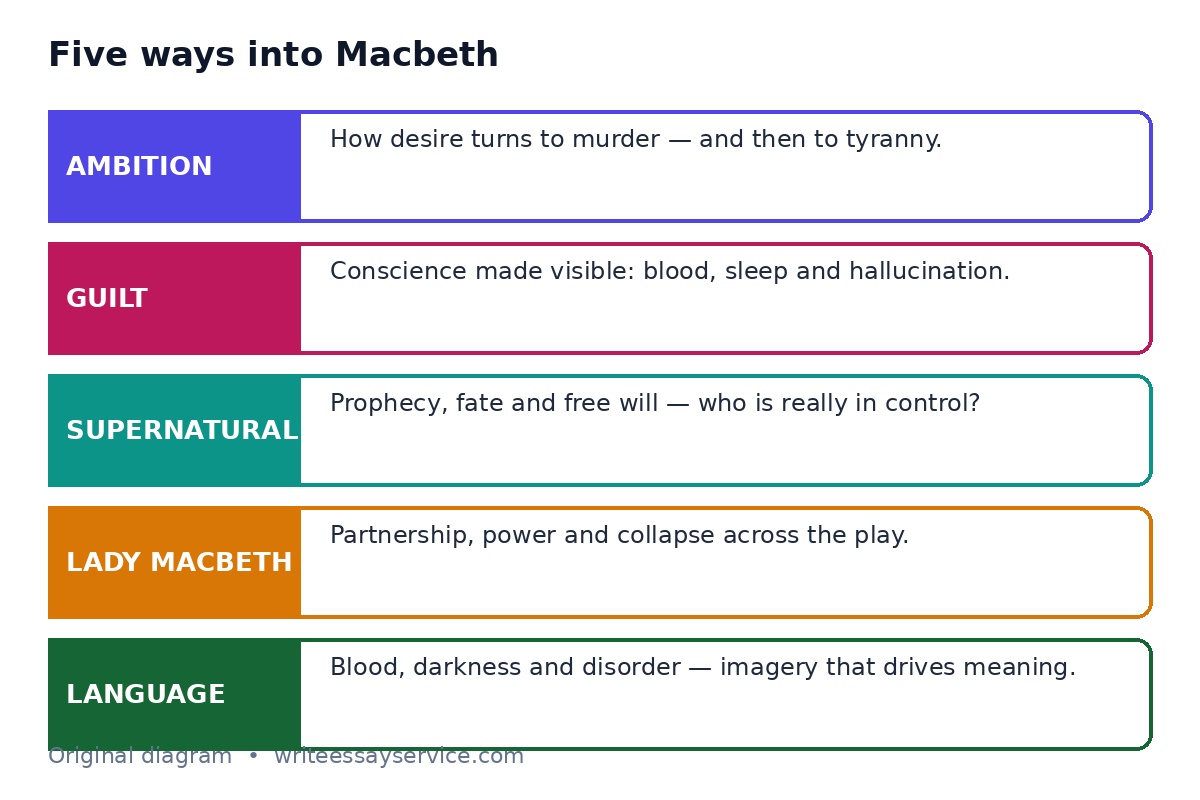
Ambition and Power: Macbeth Essay Questions
Ambition is the engine of the play, but Shakespeare never treats it as a single, simple motive. Macbeth's ambition is entangled with loyalty, imagination, fear, and the encouragement of others, and the play keeps asking where responsibility lies. These macbeth ambition essay questions invite you to trace that entanglement, from the first prophecy to the final battle, and to consider how power changes the man who seizes it.
- Explore how Shakespeare presents ambition in Macbeth.
Planning angle: Argue that ambition is presented as both a spur and a poison, beginning with the witches' prophecy and Macbeth's “vaulting ambition” soliloquy in Act 1, Scene 7. Use the contrast between Macbeth's early loyalty and his later tyranny to show ambition intensifying, and consider whether Lady Macbeth or the witches share responsibility for its growth. - “Macbeth is a victim of his own ambition.” To what extent do you agree?
Planning angle: Take a qualified position: Macbeth chooses to act, yet his imagination makes the choice feel inevitable to him. Weigh his soliloquies against the external pressures of the witches and Lady Macbeth, and use Act 3, when he orders Banquo's murder without prompting, as evidence that ambition has become self-sustaining. - How does Macbeth change after he becomes king?
Planning angle: Trace a shift from hesitation and guilt to ruthless decisiveness, using the murder of Duncan, the murder of Banquo, and the massacre at Macduff's castle as turning points. Note how his language becomes more violent and less reflective, and ask whether kingship corrupts him or simply reveals what was already there.
Guilt and Conscience: Macbeth Essay Questions
Guilt in Macbeth is not an abstract idea; it is heard, seen, and felt. A voice cries that Macbeth has murdered sleep, a dagger appears before his eyes, and blood will not wash from Lady Macbeth's hands. These macbeth guilt essay questions ask you to examine how Shakespeare makes conscience visible on stage, and why guilt destroys one character while another seems, for a time, to outrun it.
- Explore how Shakespeare presents guilt in Macbeth.
Planning angle: Argue that guilt is presented through hallucinations, disturbed sleep, and obsessive imagery of blood and darkness. Compare Macbeth's immediate horror after Duncan's murder with Lady Macbeth's delayed breakdown in the sleepwalking scene, and consider whether guilt functions as punishment, conscience, or both. - How does Lady Macbeth's attitude towards guilt change over the course of the play?
Planning angle: Follow her from the early dismissal of guilt — “a little water clears us of this deed” — to the compulsive hand-washing of Act 5, Scene 1. Use that reversal to argue that her earlier confidence was a performance, and examine what the change suggests about repression and the return of conscience. - “Macbeth is more haunted by his conscience than by the supernatural.” Discuss.
Planning angle: Weigh the witches and Banquo's ghost against Macbeth's soliloquies and his fear of discovery. Argue that supernatural figures often externalise an inner state, using the dagger in Act 2, Scene 1 and the ghost at the banquet as evidence, while acknowledging that the witches remain genuinely ambiguous.
The Supernatural and Fate: Macbeth Essay Questions
The witches open the play in thunder and lightning, and their equivocal prophecies shape everything that follows. Yet Shakespeare leaves their power deliberately unclear: do they cause Macbeth's crimes, or merely give voice to desires he already holds? These macbeth supernatural essay questions help you plan an argument about fate, free will, and the dramatic function of the strange and the uncanny.
- Explore the role of the supernatural in Macbeth.
Planning angle: Argue that the supernatural creates atmosphere, drives the plot, and raises questions about agency all at once. Use the opening scene, the apparitions in Act 4, and the ambiguous fulfilment of the prophecies to show how Shakespeare keeps the audience uncertain about whether Macbeth is fated or free. - How far is Macbeth responsible for his own downfall?
Planning angle: Take a balanced position that separates influence from decision, acknowledging the witches' provocations and Lady Macbeth's persuasion while insisting that Macbeth's choices — especially after Duncan's murder — are his own. Use his soliloquies to show moments when he recognises the wrongness of his course and proceeds anyway. - Explore how Shakespeare uses the witches to create tension and uncertainty.
Planning angle: Focus on their language: riddles, paradoxes such as “fair is foul, and foul is fair”, and prophecies that are true in letter but misleading in spirit. Show how their equivocation keeps both Macbeth and the audience guessing, and connect that uncertainty to the play's wider concern with appearance and reality.
Lady Macbeth and Gender: Macbeth Essay Questions
Lady Macbeth is one of Shakespeare's most debated characters: ambitious, commanding, and ultimately broken. Her famous appeal to be “unsexed” raises questions about gender, power, and the roles available to women in the play's world. These lady macbeth essay questions invite you to look beyond a simple villain-heroine reading and to consider how Shakespeare uses her to test the limits of ambition.
- Explore the character of Lady Macbeth.
Planning angle: Argue that she is best understood as a study in contradiction — resolute in planning Duncan's murder yet unable to commit it herself, dominant in Act 1 yet diminished by Act 5. Use her soliloquies and the sleepwalking scene to trace that arc, and decide whether her collapse is presented as punishment, tragedy, or both. - How does Shakespeare present the relationship between Macbeth and Lady Macbeth?
Planning angle: Trace the relationship from partnership to isolation, using their early letters and shared planning, the growing distance after the murder, and Macbeth's flat response to her death. Consider how their language towards each other changes, and what that change reveals about the corrosive effect of shared guilt. - “Lady Macbeth is the driving force behind the tragedy.” To what extent do you agree?
Planning angle: Acknowledge her decisive role in Act 1, especially her challenge to Macbeth's manhood, but argue that her influence fades once the murder is done. Use Macbeth's independent decisions in Act 3 to show that the tragedy outgrows its first catalyst, and weigh her agency against the witches' and Macbeth's own ambition.
Language, Imagery and Structure: Macbeth Essay Questions
Macbeth is a play of unforgettable images — blood, darkness, sleeplessness, and unnatural nature — and of a structure that moves with unusual speed from temptation to tyranny. These macbeth themes essay questions turn attention to how Shakespeare achieves his effects, asking you to connect imagery and dramatic structure to meaning rather than treating them as decoration.
- Explore how Shakespeare uses imagery of blood in Macbeth.
Planning angle: Argue that blood imagery develops from a symbol of honour in battle to a mark of guilt that cannot be washed away. Follow its appearances from the captain's report in Act 1 through Macbeth's “Will all great Neptune's ocean wash this blood clean from my hand?” to Lady Macbeth's “Out, damned spot!”, and link each stage to the moral state of the characters. - How does Shakespeare create a sense of darkness and disorder in Macbeth?
Planning angle: Examine the play's repeated images of night, storm, and unnatural events — the owl's shriek, Duncan's horses turning wild — alongside the breakdown of natural order in the kingdom. Connect this imagery to the moral disorder of regicide, and consider how it shapes the audience's emotional response. - Explore the significance of the sleepwalking scene (Act 5, Scene 1).
Planning angle: Argue that the scene functions as a delayed confession, revealing in Lady Macbeth's fragmented speech what she refused to admit while awake. Use the doctor's and gentlewoman's reactions to show how Shakespeare lets the audience judge her, and consider why the scene is placed so close to the play's end.
How to Plan Your Answer
A strong plan turns a broad question into a manageable argument. Start by writing your position in a single sentence — for example, “Shakespeare presents ambition as a force that begins as imagination and ends as compulsion.” Then choose three or four key moments that test that position, ideally spread across the play so you can show development. For each moment, note the quotation or stage detail you will use, what it shows, and how it connects to your next point. Keep quotations short: a single vivid line, embedded in your own sentence, is more persuasive than a long block of verse.
Next, build in a counter-reading. If your argument is that Macbeth is responsible for his downfall, ask what evidence might suggest otherwise — the witches' influence, Lady Macbeth's pressure, the pressure of a warrior culture — and decide how you will answer it. Examiners reward essays that acknowledge complexity and then resolve it, rather than essays that ignore it. Finally, plan your conclusion as a return to the question, not a repetition of your introduction: restate your position in light of the evidence you have examined, and say what the play ultimately suggests about ambition, guilt, or fate.
For more practice with the same approach, see our guide to Frankenstein essay questions and our guide to The Great Gatsby essay questions, which use the same question-and-planning-angle format for other set texts. Comparing how different writers handle ambition and guilt will sharpen your sense of what makes Shakespeare's treatment distinctive.
Frequently Asked Questions
What are the best macbeth essay topics for a first essay?
Start with a theme you can trace clearly across the play, such as ambition or guilt, and choose a question with a built-in development — for example, how a character changes over time. A focused question with three clear turning points is easier to plan, and easier to argue well, than a very broad question about the whole play.
How many quotations should I use in a Macbeth essay?
Aim for one short, well-chosen quotation per main point, embedded in your own sentence and followed by analysis of its language. Four or five precise quotations, each genuinely analysed, will serve you better than ten quotations listed without comment. Always explain why the words matter, not just what they say.
How do I write about the supernatural without saying the witches “made” Macbeth do it?
Treat the witches as a question, not an answer. Discuss what they say, how equivocal their prophecies are, and what Macbeth does with them, then weigh their influence against his own decisions. A good essay keeps both possibilities in view — fate and free will — and argues for a position rather than settling for one or the other.
Can I compare Macbeth with Lady Macbeth in one essay?
Yes, and comparison often produces the strongest arguments, especially on guilt and ambition. Plan by pairing moments: her early confidence against his hesitation, his later ruthlessness against her collapse. Make sure the comparison serves a single argument, rather than becoming two separate character sketches placed side by side.