



Mary Shelley’s Frankenstein remains one of the most frequently set novels for school and university essays, and for good reason. Published in 1818, it combines a gripping gothic story with questions that still feel urgent: what do we owe the things we create, what makes someone human, and where does ambition become dangerous? A strong essay does not simply retell Victor’s experiments or the creature’s journey. It selects a focused argument, supports it with carefully chosen scenes, and explains what those scenes reveal about Shelley’s wider ideas.
This guide collects 15 frankenstein essay topics — presented as essay questions — and shows how to plan each one. Every question is grouped under a major theme, with a short planning note suggesting an angle to argue and the evidence most likely to support it. Use the questions as starting points, not as ready-made answers: your task is to develop your own thesis, choose your own evidence, and explain your reasoning in your own words.
Frankenstein Essay Topics: Creation and Responsibility
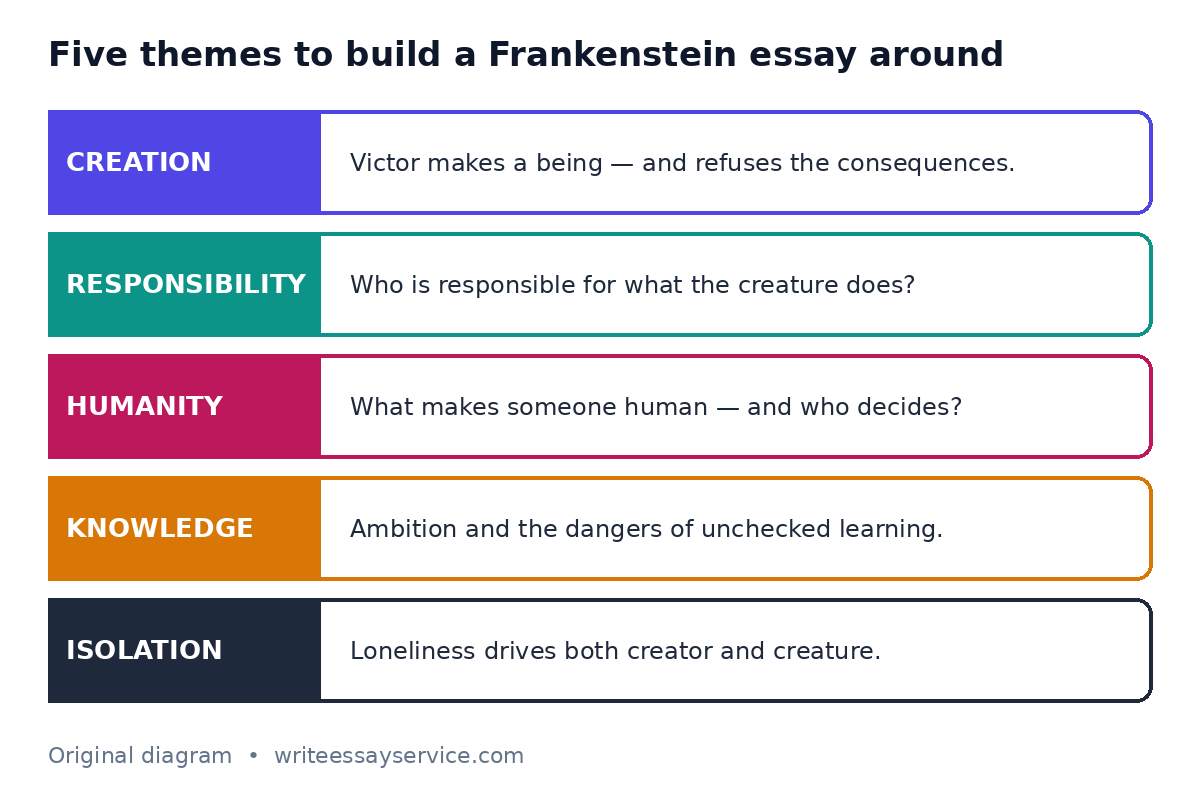
Creation is at the centre of the novel, but Shelley is less interested in the science of Victor’s experiment than in what happens afterwards. These frankenstein essay questions ask who is responsible when a creation is abandoned, and whether responsibility can be shared, avoided, or passed on.
-
To what extent is Victor Frankenstein responsible for the creature’s actions?
Planning angle: Argue a position on a scale rather than a simple yes or no. Use Victor’s decision to leave the creature immediately after its animation, his refusal to create a companion, and his later pursuit of revenge as evidence for different stages of responsibility.
-
Does Shelley present creation as an act of power, an act of care, or both?
Planning angle: Compare Victor’s language of mastery and ambition with the care the creature longs for and briefly receives from the De Lacey family. Consider whether the novel separates the act of making something from the duty of looking after it.
-
Who bears the greater moral blame: Victor, the creature, or the society that rejects him?
Planning angle: Weigh the three candidates in turn. Victor abandons his creation; the creature chooses violence; yet villagers, Felix, and even Victor’s family react with fear before they understand him. Decide which cause Shelley treats as most decisive, and explain why.
Frankenstein Essay Topics: Humanity and Monstrosity
Shelley repeatedly blurs the line between human and monster. Victor looks respectable, while the creature looks frightening, yet their behaviour often reverses that expectation. A frankenstein themes essay on this topic works best when it examines actions and language, not appearance alone.
-
What makes a character human in Frankenstein?
Planning angle: Build a working definition from the novel — language, feeling, moral choice, or the desire for companionship — then test Victor, the creature, and Walton against it. The creature’s capacity for speech and sympathy is especially useful evidence.
-
Is the creature a monster by nature, or is he made monstrous by others?
Planning angle: Trace the creature’s development from curiosity and kindness towards the De Laceys to anger and revenge. Ask whether each act of violence follows a rejection, and whether Shelley leaves room for a different outcome.
-
How does Shelley use the word “monster” to challenge the reader’s judgement?
Planning angle: Track who uses the word, and when. Victor applies it freely to his creation, while the creature sometimes applies it to himself. Consider how the novel invites readers to question first impressions formed by appearance.
Frankenstein Essay Questions on Knowledge and Ambition
Victor’s pursuit of knowledge drives the plot, but Shelley also gives us Walton and Clerval as contrasting figures. These questions invite a frankenstein analysis essay that compares different kinds of ambition and asks what knowledge is for.
-
Does Shelley condemn the pursuit of knowledge, or only the way Victor pursues it?
Planning angle: Distinguish between curiosity itself and Victor’s secrecy, obsession, and disregard for consequences. Walton’s letters and Clerval’s interest in language and culture provide useful contrasts.
-
How is ambition presented as both creative and destructive in the novel?
Planning angle: Pair Victor’s early achievements — his studies at Ingolstadt and his scientific breakthrough — with the losses that follow: William, Justine, Clerval, and Elizabeth. Show how the same drive produces both outcomes.
-
What warning, if any, does Frankenstein offer about scientific progress?
Planning angle: Avoid treating the novel as a simple warning against science. Instead, argue that Shelley questions unchecked ambition, secrecy, and the refusal to consider consequences. Use Victor’s own reflections in the final chapters to test this reading.
Frankenstein Essay Topics: Nature vs Nurture
The creature begins life without a name, a family, or a teacher. His story raises a classic question: are we shaped by what we are born with, or by how we are treated? This cluster suits a focused frankenstein character analysis that follows one figure closely through the novel.
-
Is the creature’s violence the result of his nature or his treatment by others?
Planning angle: Follow a clear sequence: the creature’s early gentleness, his rejection by Victor, the villagers, and the De Laceys, and his later decision to seek revenge. Decide whether Shelley presents violence as inevitable or as learned.
-
How do Victor’s upbringing and education shape the choices he makes?
Planning angle: Consider Victor’s loving childhood, his father’s guidance, and his education at Ingolstadt. Ask whether a supportive background prevents poor judgement, or whether Shelley shows that privilege and learning can still lead to irresponsibility.
-
What does the creature learn from observing the De Lacey family?
Planning angle: Focus on the creature’s secret education: language, kindness, family affection, and the pain of exclusion. Use this episode to argue that he learns both human goodness and the social rules that will later shut him out.
Frankenstein Essay Questions on Isolation and Companionship
Almost every major character in the novel is, at some point, alone. Victor isolates himself through secrecy; the creature is isolated by rejection; Walton is isolated by his voyage. These questions explore why companionship matters so much in the novel.
-
How does isolation affect Victor and the creature differently?
Planning angle: Contrast Victor’s chosen isolation in his workshop and later travels with the creature’s enforced isolation. One withdraws from people he could turn to; the other longs for connection and is denied it. Use that contrast to sharpen your argument.
-
Why is the creature’s request for a companion so important to the novel’s meaning?
Planning angle: Treat the request as a test of Victor’s responsibility. The creature does not ask for wealth or revenge at first; he asks for understanding. Consider what Victor’s refusal reveals about fear, power, and the limits of his sympathy.
-
Does Shelley suggest that companionship can prevent tragedy, or only delay it?
Planning angle: Look at the relationships that briefly sustain characters — Victor and Clerval, the creature and the De Laceys, Walton and Victor — and ask what breaks them. Decide whether Shelley offers companionship as a genuine remedy or as something fragile and easily lost.
Building a Thesis for a Frankenstein Essay
A good thesis for a Frankenstein essay makes one clear, arguable claim and signals how you will prove it. Avoid a thesis that merely announces a theme, such as “This essay will discuss responsibility in Frankenstein.” Instead, take a position: “Shelley presents responsibility not as a single act of creation, but as an ongoing duty that Victor repeatedly fails, and that failure — rather than the creature’s nature — drives the novel’s tragedy.”
Once you have a thesis, plan your paragraphs around it. Each paragraph should make one point, introduce a scene or short quotation, and explain what that evidence shows. Keep quotations very brief — a phrase such as “wretched” or “the spark of being” is enough to anchor a point — and spend most of your paragraph on your own analysis. A clear structure helps here: if you need a refresher, revisit the five-paragraph essay structure and adapt it to the length your assignment requires, adding body paragraphs where a longer essay needs more evidence.
Choose evidence from across the novel, not from one chapter alone. A strong essay on creation might move from Victor’s workshop to the creature’s first days, then to the De Lacey episode and the final pursuit in the Arctic. That range shows that your argument holds across the whole text. For comparison, the planning approach used for another frequently set text — The Great Gatsby essay questions — follows the same method: a focused question, a clear thesis, and evidence chosen to test it.
Finally, leave time to revise. Check that every paragraph connects back to your thesis, that your quotations are introduced and explained, and that your conclusion answers the question rather than simply repeating your introduction. A short, focused essay with a clear argument will always be stronger than a long summary of the plot.
FAQ: Frankenstein Essay Topics
What are the best frankenstein essay topics for a first essay on the novel?
Start with a theme you can argue clearly, such as responsibility, humanity, or isolation. The questions in this guide on Victor’s responsibility and the creature’s treatment by others are good first choices because the evidence is spread clearly across the novel and the argument can be stated in one sentence.
How do I choose between frankenstein essay questions?
Choose the question that lets you make a specific claim rather than summarise the story. If you can turn the question into a thesis — “Shelley shows that…” — and name two or three scenes that would support it, you have a workable question. Avoid questions that invite only a yes-or-no answer with no room for discussion.
How many quotations should a frankenstein analysis essay include?
Use a small number of short quotations, well chosen and fully explained. One brief phrase per paragraph is usually enough. The marker is looking for your analysis of the quotation, not for a collection of lines from the novel, so explain why each phrase matters to your argument.
Can I write a frankenstein character analysis of Victor and the creature together?
Yes, and a paired analysis often works well. Comparing Victor and the creature can reveal the novel’s central irony: the creator behaves less responsibly than his creation. Keep the comparison balanced, giving both characters similar attention and linking each point back to your thesis.
What makes a strong thesis for a frankenstein themes essay?
A strong thesis takes a position on how Shelley presents a theme, rather than merely naming it. For example, instead of writing that the novel is “about ambition,” argue that Shelley presents ambition as dangerous only when it is secretive and unchecked. That claim gives your essay a direction and a test.
How long should my Frankenstein essay plan be?
A plan does not need to be long, but it should be complete. Aim for a one-sentence thesis, three or four paragraph headings with a scene or quotation noted under each, and a one-line conclusion. If you cannot fill in the evidence for a paragraph, that is a sign to narrow your thesis or choose a different question.