




Muhammad Ali Jinnah, known as Quaid-e-Azam (“the Great Leader”), is the founder of Pakistan and one of the most written-about figures in South Asian history. Students are asked to write about him from school through university. This guide gives you key facts, three sample essays of different lengths and tips for writing a strong essay in your own words.
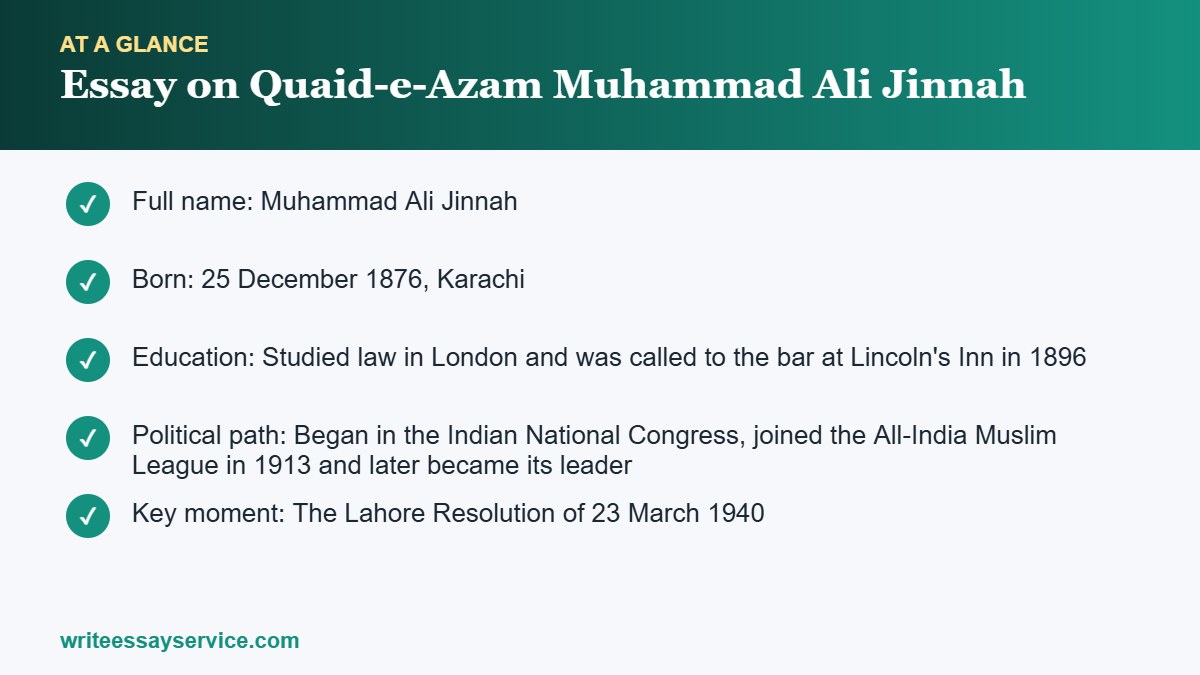
Key Facts About Quaid-e-Azam
- Full name: Muhammad Ali Jinnah
- Born: 25 December 1876, Karachi
- Education: Studied law in London and was called to the bar at Lincoln’s Inn in 1896
- Political path: Began in the Indian National Congress, joined the All-India Muslim League in 1913 and later became its leader
- Key moment: The Lahore Resolution of 23 March 1940
- Achievement: Pakistan came into being on 14 August 1947, with Jinnah as its first Governor-General
- Died: 11 September 1948, Karachi
Short Essay on Quaid-e-Azam (150 words)
Quaid-e-Azam Muhammad Ali Jinnah was the founder of Pakistan. He was born in Karachi on 25 December 1876. After studying law in England, he returned to the subcontinent and became a successful lawyer. He later led the All-India Muslim League and worked tirelessly for a separate homeland for the Muslims of the subcontinent. His leadership, honesty and determination earned him the title Quaid-e-Azam. Pakistan was created on 14 August 1947, and he became its first Governor-General. He died on 11 September 1948, but his message of unity, faith and discipline still guides the nation. His mausoleum in Karachi is visited every year by people from across the country.
Medium Essay on Quaid-e-Azam (300 words)
Muhammad Ali Jinnah is remembered as the leader who turned the dream of a separate Muslim homeland into reality. Born in Karachi in 1876, he showed an early love for learning. He travelled to London, qualified as a barrister and returned to practise law, earning a reputation for sharp reasoning and integrity.
At first, Jinnah worked for Hindu-Muslim unity within the Indian National Congress. Over time, he came to believe that the political rights of Muslims could not be safeguarded without a separate state. He joined the Muslim League in 1913 and became its guiding voice. In 1940, the Lahore Resolution set out the demand for independent Muslim-majority states, and the movement gained strength under his leadership.
Jinnah’s methods were constitutional and peaceful. He argued his case through speeches, negotiations and legal reasoning rather than force. This approach made his cause respected at home and abroad.
After independence on 14 August 1947, he became Governor-General and faced enormous challenges, including the settlement of refugees and the building of new institutions. He urged citizens to work with faith, unity and discipline. He passed away on 11 September 1948, only a year after independence. Today, his portrait appears on the country’s currency, and his principles remain a source of inspiration.
Long Essay Outline on Quaid-e-Azam
For a longer essay of 800 words or more, organise your ideas under clear headings:
- Introduction: a hook about his role in history, plus your thesis
- Early life and education: family background, schooling and legal training
- Political career: from Congress to the Muslim League, including the Lahore Resolution
- Leadership qualities: integrity, discipline, legal skill and constitutional approach
- Founding of Pakistan: the events of 1947 and his role as Governor-General
- Legacy: why his principles matter today
- Conclusion: return to your thesis and end on a thoughtful note
Our guide on how to write an essay outline has a template you can adapt for this structure.
Useful Quotations and How to Use Them
Quotations can strengthen an essay, but only if they are accurate and relevant. Check any quote against a reliable source, such as an official biography or published collection of speeches, before including it. Introduce it with a sentence and then explain what it shows about his character. If you are unsure how to blend a source into your own words, see how to paraphrase without plagiarizing.

Tips for Writing Your Own Essay
- Start with a clear thesis, for example: “Jinnah’s legal training, integrity and constitutional approach made him the ideal leader for Pakistan’s freedom movement.” See how to write a thesis statement.
- Use specific dates and events instead of general praise.
- Write an engaging opening. Our essay introduction guide has six hook ideas.
- Finish strongly. A good ending ties your points together. See how to write a conclusion.
- Proofread. Check names, dates and spellings with our proofreading checklist.
Common Mistakes to Avoid
- Copying a sample essay word for word, which teachers and plagiarism checkers can spot
- Mixing up dates, such as the Lahore Resolution (1940) and independence (1947)
- Writing only praise without any specific examples
- Skipping the conclusion
Need Help With Your Essay?
If you want a custom, original essay written to your word count and academic level, our writers can help. Contact us with your requirements.
Keep learning: see our full Essay Writing Guide for every step of the essay process and sample essays.
Read next: Essay on Pakistan Day
Further Reading
More Pakistan essays: Essay on Fatima Jinnah | Essay on Abdul Sattar Edhi