




Fatima Jinnah, known as Madar-e-Millat (Mother of the Nation), stood beside her brother Quaid-e-Azam during the struggle for Pakistan. Her life is a popular essay topic. Below are key facts, a short essay, a long essay and tips.
Key Facts About Fatima Jinnah
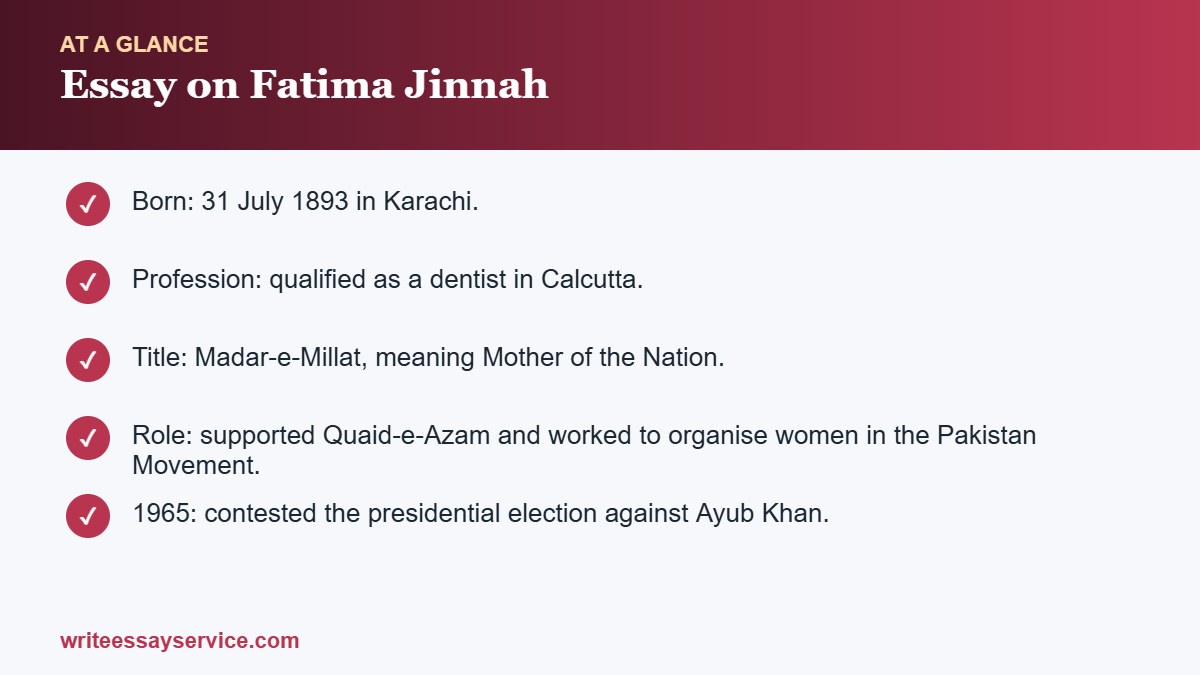
- Born: 31 July 1893 in Karachi.
- Profession: qualified as a dentist in Calcutta.
- Title: Madar-e-Millat, meaning Mother of the Nation.
- Role: supported Quaid-e-Azam and worked to organise women in the Pakistan Movement.
- 1965: contested the presidential election against Ayub Khan.
- Died: 9 July 1967 in Karachi. She is buried near the Mazar-e-Quaid.
Short Essay on Fatima Jinnah (150 Words)
Fatima Jinnah was the younger sister of Quaid-e-Azam Muhammad Ali Jinnah. She was born in Karachi in 1893 and became a dentist at a time when very few Muslim women went to college.
During the Pakistan Movement, she stood beside her brother as a caring companion and a strong supporter. She encouraged Muslim women to take part in politics and public life. After independence, she worked for the welfare of refugees and women.
People gave her the title Madar-e-Millat. In 1965, she contested the presidential election against Ayub Khan, showing great courage. She died in 1967. Her life inspires women to be confident, educated and active in nation-building.
Long Essay on Fatima Jinnah
Introduction
Behind every great leader there is often a strong supporter. For Quaid-e-Azam, that person was his sister Fatima Jinnah, a brave woman who gave her life to the cause of Pakistan.
Early Life and Education
Fatima Jinnah was born in Karachi in 1893. She studied dentistry in Calcutta and opened her own clinic in Bombay. This was a bold step for a woman of her time.
Role in the Pakistan Movement
After the death of her sister-in-law, Fatima stayed with her brother and became his closest companion. She travelled with him, managed his household and advised him during difficult years. She also encouraged Muslim women to join the movement and worked to make them politically aware.
After Independence
After 1947 she helped with the settlement of refugees and supported women’s organisations, hospitals and schools. She also remained a symbol of the values that Quaid-e-Azam stood for.
The 1965 Election
In 1965, she agreed to contest the presidential election against Ayub Khan with the support of opposition parties. Although she lost in a disputed election, her campaign showed that women could lead a national political struggle.
Legacy
She died in 1967 and was laid to rest near her brother. Many schools, roads and institutions in Pakistan carry her name.
Conclusion
Fatima Jinnah’s life is a lesson in loyalty, courage and public service. For girls and boys alike, she remains a role model for the nation.
Tips for Writing Your Own Essay
- Plan your points with an essay outline before you start.
- Open with a hook and a clear thesis. See how to write an essay introduction.
- Check every date, name and number. Examiners notice factual mistakes.
- Finish with a strong ending. Read how to write a conclusion for an essay.
- Proofread using this 10-step checklist.
Related Pakistan Essays
- Essay on Quaid-e-Azam
- Essay on Women’s Rights in Pakistan
- Essay on Pakistan Day
- Essay on Abdul Sattar Edhi
For the full writing process, read our Essay Writing Guide.