



Women’s rights is a common essay topic in exams and competitions in Pakistan. A good essay explains what rights women have by law, the challenges they still face and what can be done to improve their situation. This guide gives a short essay, a long essay and tips for writing your own. It also links to other useful essay resources on our site.
Key Points to Remember
- The Constitution of Pakistan guarantees equality before the law. Article 25 states that all citizens are equal and prohibits discrimination on the basis of sex.
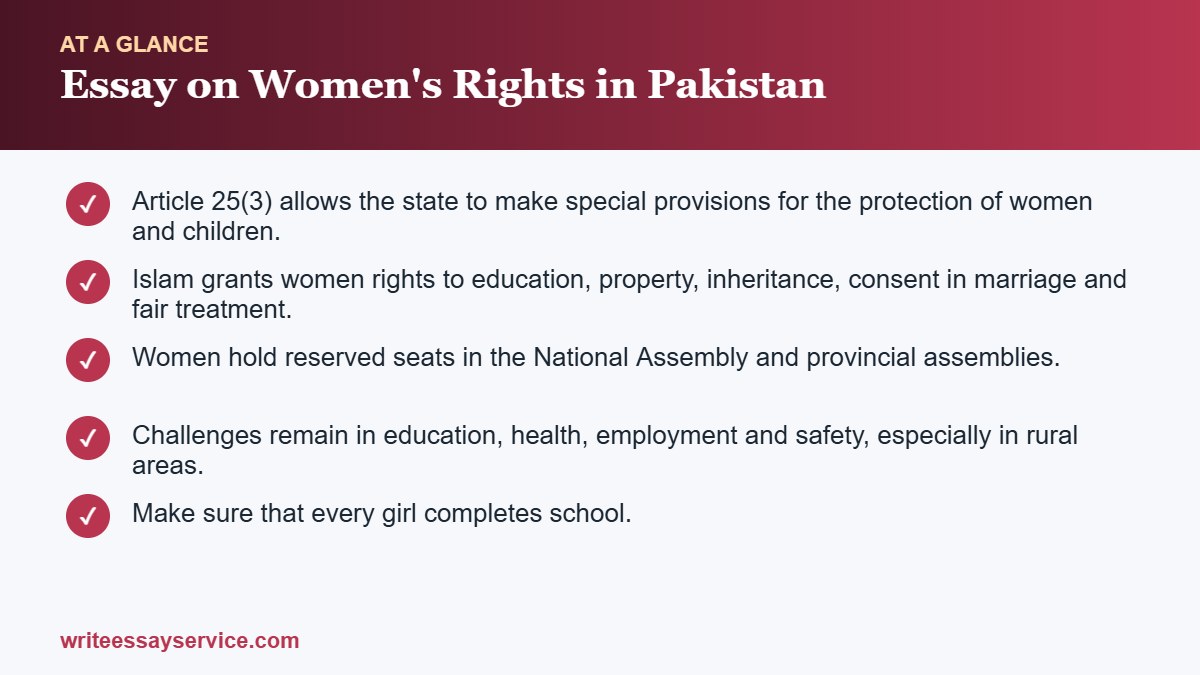
- Article 25(3) allows the state to make special provisions for the protection of women and children.
- Islam grants women rights to education, property, inheritance, consent in marriage and fair treatment.
- Important laws include the Protection of Women (Criminal Laws Amendment) Act 2006, the Protection against Harassment of Women at the Workplace Act 2010 and the Criminal Law (Amendment) Act 2016 against so-called honour killings.
- Women hold reserved seats in the National Assembly and provincial assemblies.
- Challenges remain in education, health, employment and safety, especially in rural areas.
Short Essay on Women’s Rights in Pakistan (150 Words)
Women make up about half of Pakistan’s population, and no nation can progress without their full participation. Islam gave women the rights to education, property and respect more than fourteen centuries ago. The Constitution of Pakistan also guarantees equality and prohibits discrimination based on sex.
Despite these guarantees, many women still face problems such as limited access to education, early marriage, violence and unequal opportunities at work. In many rural areas, traditions are used to deny women their legal rights.
To improve the situation, the government must enforce existing laws, and society must change its attitude. Girls’ education, safe workplaces and fair wages are essential steps. When women are educated and empowered, families and the whole country benefit. Respecting women’s rights is both a religious duty and a national need.
Long Essay on Women’s Rights in Pakistan
Introduction
The status of women is a measure of a society’s progress. Pakistan has produced remarkable women, from Fatima Jinnah, who stood beside the Quaid during the struggle for independence, to Benazir Bhutto, the first woman to lead a Muslim-majority country as Prime Minister, and Malala Yousafzai, the youngest Nobel Peace Prize winner. Yet millions of ordinary women still struggle to enjoy basic rights.
Women’s Rights in Islam
Islam gave women the right to seek knowledge, own and inherit property, choose a spouse, earn and keep income, and be treated with dignity. These teachings form a strong foundation for modern legislation and social reform.
Legal Protection in Pakistan
The Constitution of 1973 guarantees equal rights to all citizens and allows special measures to protect women. Over the years, Parliament has passed laws to deal with specific problems. These include laws against workplace harassment, acid crimes, forced marriages and honour killings, as well as provincial laws on domestic violence. Reserved seats ensure that women are represented in legislatures.
Major Challenges
Education: Millions of girls are out of school, especially in rural areas, because of poverty, distance and social restrictions.
Employment: Women’s participation in the labour force is low compared with men, and many work in the informal sector without legal protection.
Violence and safety: Domestic violence, harassment and honour-related crimes remain serious concerns, and cases are often under-reported.
Health: Limited access to healthcare affects maternal and child health, particularly in remote areas.
International indexes, such as the World Economic Forum’s Global Gender Gap Report, have consistently placed Pakistan among the countries with the widest gender gaps.
The Way Forward
- Make sure that every girl completes school.
- Enforce existing laws strictly and speed up court cases.
- Create safe workplaces and transport.
- Support women entrepreneurs through training and credit.
- Use media and religious scholars to challenge harmful customs.
Conclusion
Women’s rights are human rights. Pakistan has laws and a strong religious and constitutional foundation to protect women, but real change depends on implementation and on a change in attitudes. When women are educated, safe and free to contribute, the whole nation moves forward.
How to Write Your Own Essay on This Topic
- Pick a clear position and support it with facts. A strong thesis statement keeps your essay focused.
- Organise your ideas with an outline.
- If you are asked to argue a viewpoint, see how to write an argumentative essay.
- Use your own words and cite sources. Read how to paraphrase without plagiarising.
Related Essays
Explore every step of the writing process in our Essay Writing Guide.
Further Reading
More Pakistan essays: Essay on Fatima Jinnah | Essay on Pakistan

