



A strong essay can lose marks in its final paragraph. The argument is built and the evidence is in place — and then the ending rushes, repeats the introduction, or trails off with “In conclusion, this essay has shown…”. Markers notice: a conclusion is the last impression your essay leaves.
Learning how to write a conclusion for an essay is not about finding a magic phrase, but about knowing the job the final paragraph has to do and choosing an essay ending that fits your argument. This guide explains what markers look for, the three jobs every concluding paragraph must do, and five distinct closers, each with a short worked example.
What Markers Look for in a Conclusion
Judgement. A good conclusion shows you have weighed the argument and reached a considered position. If your essay explored two sides, the ending is where you say which side is stronger and why — sitting on the fence after arguing firmly looks like the writer ran out of confidence.
Coherence. The ending should connect clearly to the question asked and to the argument you actually made. If it introduces a claim your essay never supported, the marker will notice. Reread the question and your introduction before you write the ending, so the conclusion closes the loop between them. Our guide to how essays are marked, including command words and mark schemes explains how examiners use the question wording to judge every part of an essay, including the final paragraph.
Control of expression. Short, clear sentences read as confidence; long, tangled ones read as panic. The best conclusions are often the shortest paragraphs in the essay — typically 80 to 150 words.
A sense of completion. The reader should feel the essay has arrived somewhere, not simply stopped — that comes from a final sentence that lands.
The Job of a Conclusion: Three Things It Must Do
1. Restate the thesis in fresh words. Your thesis is the main claim your essay argued. To restate the thesis well, rewrite it rather than copying it. If your introduction said “School uniforms reduce visible inequality but limit self-expression,” your conclusion might say “Uniforms narrow the gap between rich and poor pupils, yet that gain comes at the cost of individual choice.”
2. Sum up the argument. Bring the two or three strongest points from the body together in one or two sentences. Do not list every point, and do not add new evidence.
3. Leave a final thought. The last sentence should give the reader something to take away — a judgement, an implication, or a wider reflection. This is the part students most often skip, and the part that separates a competent ending from a memorable one.
Five Closers That Earn Marks
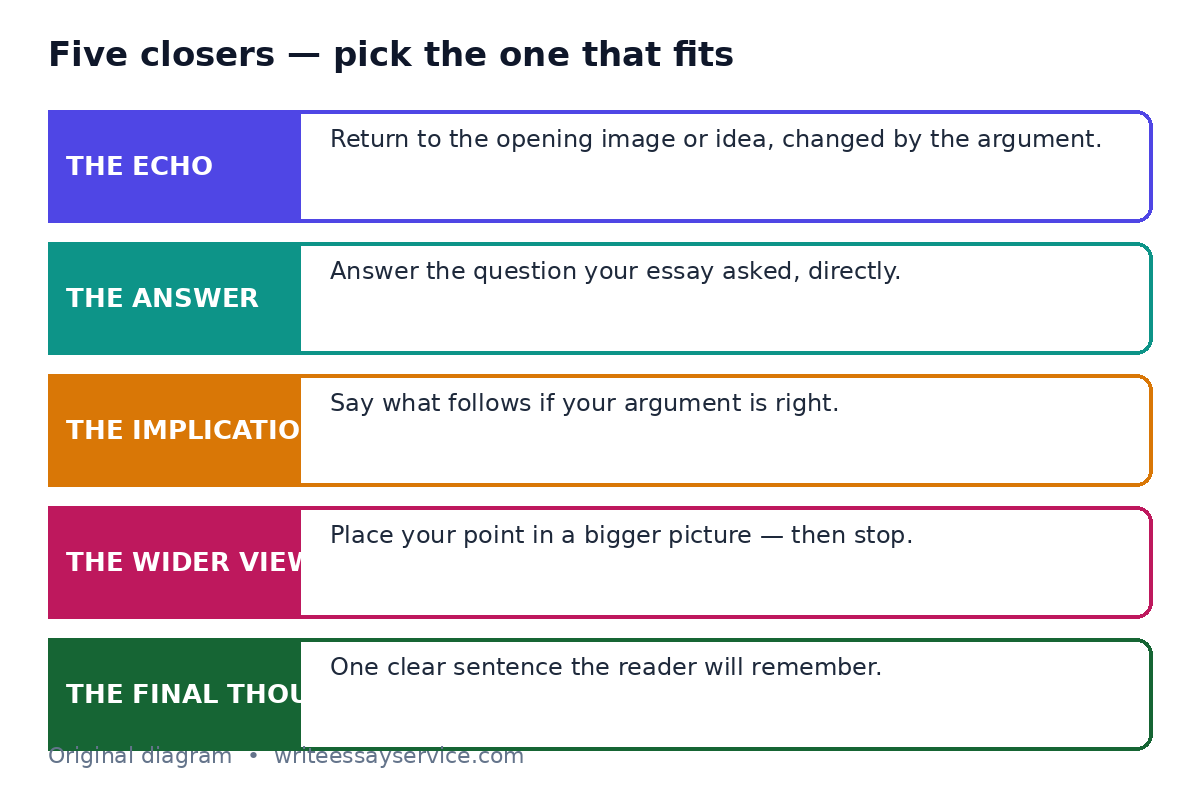
Each closer suits a different kind of essay. Choose the one that fits your argument. Every example is a short model ending for a practice question — study the pattern, then apply it to your own topic.
1. The Echo
The echo returns to an image, phrase or idea from your introduction and repeats it with new meaning. Essay conclusion examples that use it often feel the most satisfying to read, because the ending answers the opening.
Worked example:
An essay that opened with a student staring at a blank page might end: “The blank page that began this essay is no longer empty. It holds a plan, a first draft and a writer who knows what to say next — which is, after all, the point of learning to write at all.”
When it works best: When your introduction opened with a concrete image, a question, or a striking detail you can return to. It suits reflective and discursive essays well. When it fails: When the introduction has nothing worth echoing, or when the echo is exact repetition rather than a return with new meaning.
2. The Answer
The answer gives a direct, confident response to the essay question. It suits essays that asked a clear question — “Should…?”, “To what extent…?”, “Is…?” — and it is the safest closer under exam pressure.
Worked example:
“Should homework be abolished? The evidence in this essay says no — not abolished, but reformed. Short, purposeful tasks that reinforce the day’s learning help pupils; long, repetitive worksheets do not. The answer is not less homework, but better homework.”
When it works best: In argumentative and evaluative essays where the question demands a judgement, and when you are short on time, because it is direct and hard to get wrong. When it fails: When the answer does not match the argument, or when it hedges so much that it stops being an answer.
3. The Implication
The implication looks forward: it states what follows from your argument. It shows a marker that you can think beyond the essay itself, which is exactly the kind of thinking higher mark bands reward.
Worked example:
“If social media does shape how teenagers see themselves, then schools cannot treat it as a private matter. Digital literacy belongs in the curriculum alongside reading and writing — not as an optional extra, but as a skill every pupil needs before they leave school.”
When it works best: In essays about social issues, policy, technology or the environment, where the argument naturally points to a consequence or a change. When it fails: When the implication is too big for the essay to support — a 500-word essay on school lunches cannot credibly conclude that the whole food industry must be reformed.
4. The Call to Think
The call to think ends with a question or a challenge that invites the reader to keep thinking after the essay ends. It asks for reflection, not action.
Worked example:
“We have seen that free school meals improve attendance, concentration and results. The question is no longer whether they work, but whether we are willing to pay for what we know works — and what it says about us if we are not.”
When it works best: In discursive and persuasive essays where the topic is genuinely open and the question grows naturally from the argument. When it fails: When the question replaces the conclusion instead of adding to it — ending on a question without first restating your thesis and summing up the argument leaves the essay feeling unfinished.
5. The Wider View
The wider view steps back and places your argument in a larger context — a historical pattern, a principle, or a comparison. It signals to the marker that you understand your topic is part of something bigger.
Worked example:
“The debate over school uniforms is, in the end, a debate about what schools are for. Every generation has argued about the line between belonging and individuality — uniforms are simply where this generation draws it. That line will keep moving, but the question behind it will not.”
When it works best: In essays on themes with history behind them — education, freedom, technology, tradition — where the wider context genuinely illuminates the argument. When it fails: In short essays or narrow questions, where a wider view feels like padding — zooming out to “the whole of human history” after an essay about one novel will look disconnected.
How to Choose Between the Five Closers
If the question asked for a judgement, choose the answer. If your introduction opened with an image, choose the echo. If your argument points to a change, choose the implication. If the topic is open, choose the call to think; if it sits inside a bigger theme, choose the wider view.
Decide your closer when you write your outline — our guide to planning a 500-word essay in 10 minutes shows how to leave room for a proper conclusion. Whichever closer you choose, write it in your own words and make sure it matches the argument you actually made: a closer is a technique, not a template to copy.
Good conclusion starters can help you begin — “In the end”, “Taken together”, “What this shows is” and “Ultimately” all work when the sentence that follows them has something real to say. If you are learning how to end an essay under time pressure, start with the three jobs above — restate thesis, summary, final thought.
What to Avoid in an Essay Conclusion
Introducing new evidence. The conclusion is not the place for a fresh statistic, a new quotation, or an argument you forgot to make earlier. If you find a strong point while writing the ending, move it into the body — or leave it out.
“In conclusion” and other empty openers. Phrases like “In conclusion”, “To conclude” and “In summary” add nothing; the reader already knows the essay is ending. Start with the restated thesis instead.
Apologising for your argument. “Although this essay may not have covered everything…” and “I am not an expert, but…” undermine everything that came before them. Markers do not expect a perfect essay; they expect a confident one.
Repeating the introduction word for word. Restating the thesis is essential; copying it is not. Change the wording and the sentence structure, and let the restated claim carry the evidence gathered since.
Stopping without an ending at all. The most common mistake in timed essays is running out of time and stopping mid-argument. Leave five minutes at the end of any essay to write your conclusion: three sentences — restated thesis, summary, final thought — earn more marks than a brilliant body with no ending.
Frequently Asked Questions
How long should an essay conclusion be?
For a typical school or college essay, aim for 80 to 150 words — roughly one paragraph of four to six sentences. It should be long enough to restate the thesis, sum up the argument and leave a final thought, and short enough that it does not repeat the body.
Can I use “in conclusion” in my essay?
You can, but it is better not to — the phrase is a cliché that adds no meaning, and starting with your restated thesis instead sounds more confident.
How do I restate my thesis without repeating myself?
Change both the words and the structure. If your introduction said “Social media harms teenagers’ self-esteem by encouraging constant comparison,” your conclusion might say “Constant comparison on social media leaves teenagers measuring themselves against images no one can live up to.” The claim is the same, but the vocabulary and sentence shape have changed — and the version in the conclusion now carries the evidence your essay provided.
What is the difference between a conclusion and a summary?
A summary repeats what has been said; a conclusion completes it. A good concluding paragraph does contain a brief summary, but it adds two things a summary does not: a restated thesis in fresh words and a final thought that shows judgement.
How do I end an essay when I have run out of time?
Write three sentences, in this order: restate the thesis, name your strongest point, and give a one-sentence final thought. For example: “Uniforms reduce visible inequality, and that is their strongest defence. Yet the loss of self-expression matters too, and on balance the cost is too high. Schools should find other ways to close the gap.” It is not your best ending, but a complete ending earns far more marks than a strong essay that simply stops.