




What Is a Thesis Proposal?
A thesis proposal is a short document that explains what you plan to research, why it matters, and how you will do it. Its job is to convince your supervisor or committee that your project is focused, feasible, and worth approving before you start the full thesis.
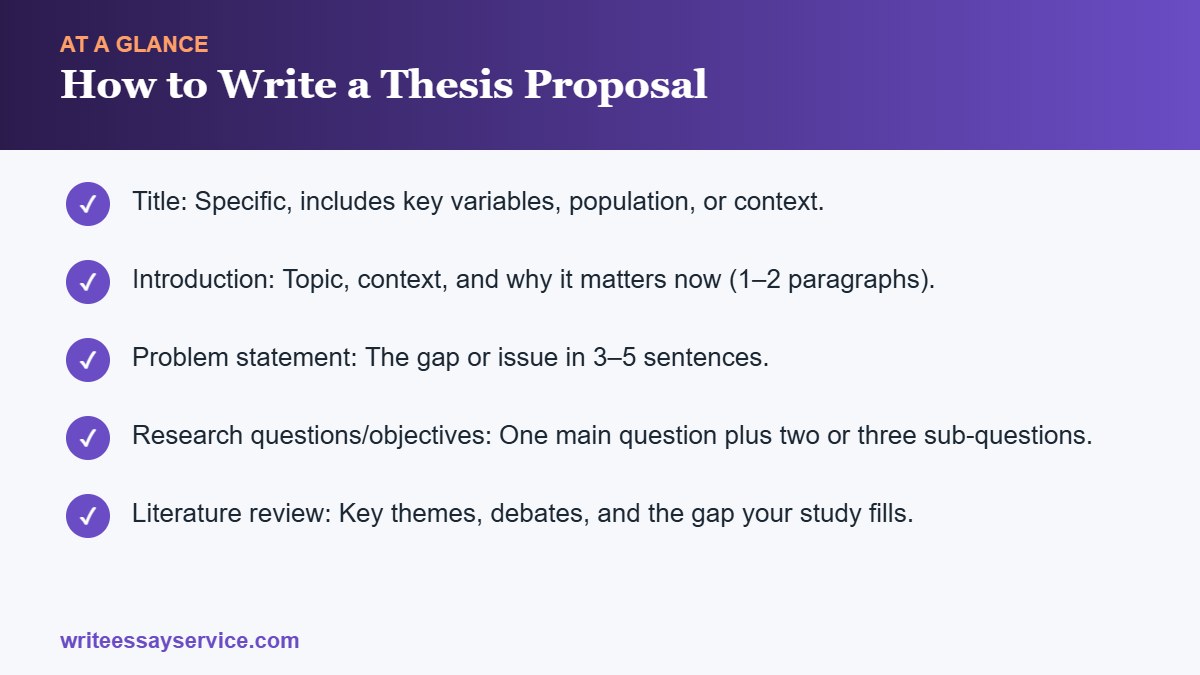
Most proposals include a title, introduction and background, problem statement, research questions or objectives, literature review, methodology, timeline, expected outcomes, and references. Length and format vary widely between universities and degree levels, so always check your department’s guidelines first. Treat this guide as a general framework, not a replacement for those rules.
Thesis Proposal Structure: The Core Sections
Here is what each section typically does and the question it answers for your reader.
How to Write a Thesis Proposal: Step by Step
1. Narrow Your Topic
Start broad, then cut. “Social media and mental health” is a field, not a project. “How university students describe the effect of Instagram use on exam-period stress” is researchable. A narrow topic makes every later section easier.
2. Read Before You Write
Skim recent journal articles and review papers in your area. Note recurring debates, methods, and open questions. This reading becomes your literature review and helps you spot a genuine gap.
3. Draft the Problem Statement and Questions
Write these early, even if roughly. Every other section should connect back to them. If you are planning interview- or observation-based work, browsing example qualitative research questions can help you phrase yours clearly.
4. Choose Your Methodology
Explain your research design, participants or data sources, collection methods, and analysis approach. Justify each choice. If you are unsure which approach fits, compare qualitative vs quantitative research before committing. Mention ethics approval if you work with people.
5. Build a Realistic Timeline
Break the project into stages: literature review, ethics, data collection, analysis, writing, and revision. Add buffer time, because recruitment and feedback often take longer than expected.
6. Write, Cite, and Revise
Write in plain, precise language. Summarize sources in your own words; our guide to paraphrasing without plagiarizing covers this. Use the citation style your department requires, and if it uses notes, review how to format footnotes correctly. Many skills overlap with learning how to write a research paper.
Simple Thesis Proposal Template
Adapt this outline to your department’s required headings and length.
- Title: Specific, includes key variables, population, or context.
- Introduction: Topic, context, and why it matters now (1–2 paragraphs).
- Problem statement: The gap or issue in 3–5 sentences.
- Research questions/objectives: One main question plus two or three sub-questions.
- Literature review: Key themes, debates, and the gap your study fills.
- Methodology: Design, sample, data collection, analysis, ethics, limitations.
- Timeline: Stages with target dates, often as a table.
- Expected outcomes: Possible contributions to theory, practice, or policy.
- References: Every cited source in the required style.
Example: Problem Statement and Research Question
Below is an illustrative example, not drawn from a real study.
Problem statement: Many universities have moved first-year tutorials online, yet little is known about how first-generation students experience this format. Without this understanding, institutions may design online support that overlooks these students’ specific needs.
Research question: How do first-generation undergraduate students describe their experience of online tutorials during their first year?
Notice that the problem names a specific group, a specific gap, and a consequence. The question is open-ended, focused, and answerable with interviews.

Common Mistakes to Avoid
- Too broad a scope: trying to answer everything in one project.
- Vague questions: wording that cannot be answered with your chosen method.
- Descriptive literature review: listing sources instead of identifying a gap.
- Unjustified methods: naming a method without explaining why it fits.
- Unrealistic timeline: no time for ethics, recruitment, or revisions.
- Ignoring guidelines: wrong length, headings, or citation style.
Final Thesis Proposal Checklist
- ✅ Title is specific and matches the research question.
- ✅ Problem statement clearly names a gap.
- ✅ Questions or objectives are focused and answerable.
- ✅ Literature review leads logically to your study.
- ✅ Methodology is justified, ethical, and feasible.
- ✅ Timeline includes buffer time.
- ✅ Citations are complete and consistently formatted.
- ✅ Format follows your department’s guidelines.
- ✅ Proofread for clarity, grammar, and typos.
FAQ
How long should a thesis proposal be?
It depends entirely on your program. Undergraduate proposals are often a few pages, while doctoral proposals can be much longer. Your department or supervisor will specify the expected length.
Can I change my research question after approval?
Usually yes, within reason. Refining questions is normal as research develops, but discuss significant changes with your supervisor, especially if ethics approval is involved.
What tense should I use?
Use the future tense for what you will do (“This study will examine…”) and the present or past tense when discussing existing literature.
Summary and Next Step
A strong thesis proposal is focused, well-justified, and realistic. Narrow your topic, define a clear problem and question, ground it in the literature, explain your methods, and plan your time. Then check every requirement against your department’s guidelines before submitting.
Need Help With Your Thesis Proposal?
Get guidance on structure, editing, and clarity from experienced academic writers.
Keep learning: see our full Essay Writing Guide for every step of the essay process and sample essays.