



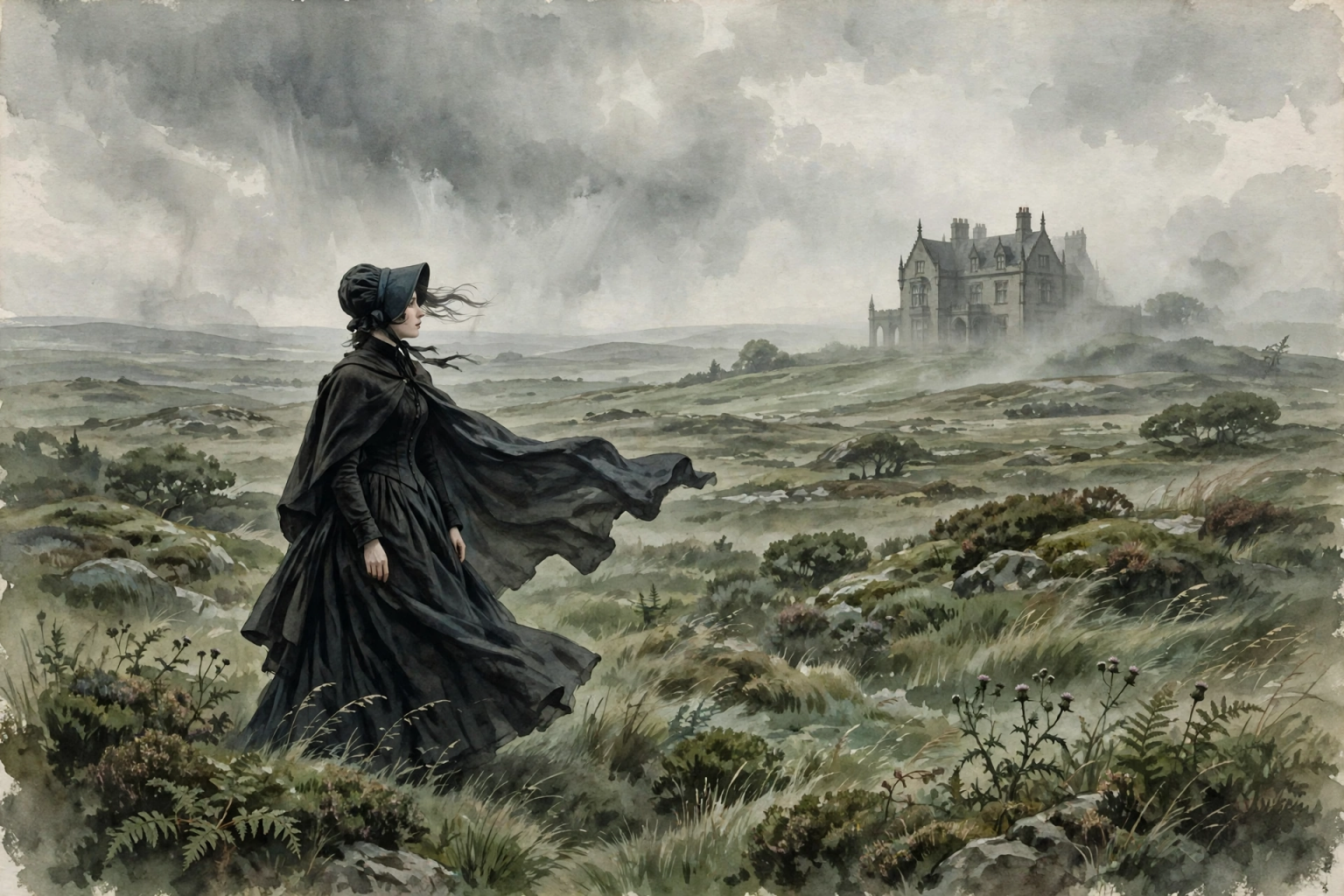
Few novels repay an essay writer as generously as Charlotte Brontë’s Jane Eyre (1847). It is a love story, a Gothic mystery, a coming-of-age novel, a religious debate and a social protest, all told in a first-person voice so forceful that readers still argue about Jane more than 175 years later. For students, that richness is both the opportunity and the trap. There is so much to say that essays drift into retelling the plot — Gateshead, Lowood, Thornfield, Moor House, Ferndean — without ever answering the question that was actually set.
This guide takes a different route. It offers fifteen Jane Eyre essay topics, grouped under the novel’s three great themes — independence, class and morality — and plans each one for you. Every question comes with a thesis angle, the scenes and quotations to build your argument on, and a pitfall to avoid. You will not find a model essay here: the point is to give you a plan strong enough that your own essay writes itself.
The Trap: Plot Summary Disguised as Analysis
The single most common weakness in essays on this novel is summary. It is tempting, because the story is so memorable, to walk through it chapter by chapter. But a marker does not need to know what happened; they need to know what it means. A good rule of thumb: every paragraph should contain at least one piece of evidence (a scene, a quotation, a detail of language) and at least one sentence explaining what that evidence proves about the question. If a paragraph only tells the story, cut it or rewrite it.
How to Approach Jane Eyre Essay Questions
Before you write a word, spend ten minutes on three steps.
- Underline the command words. “Discuss”, “To what extent”, “How far do you agree” and “Analyse” ask for different things. A “to what extent” question demands a balanced judgement, not a one-sided celebration of Jane.
- Decide your thesis in one sentence. If you cannot state your argument in a single sentence, you do not yet have one. “Jane achieves independence only when she has money, equality and a voice of her own” is a thesis. “Jane is independent” is a topic, not an argument.
- Choose three points, not ten. A short essay that proves three points well beats a long essay that gestures at ten. Pick the three scenes that best support your thesis and plan one paragraph around each.
Planning Method: Thesis First, Three Points, One Scene per Point
This is the method behind every planning note below. For each question, start with a one-sentence thesis (with a qualification such as “to a large extent” or “only in part”), choose three supporting points — your strongest evidence, a contrasting or complicating piece, and the resolution — and anchor each point in one specific scene with a quotation or detail. If you cannot name the scene, the point is not ready.

Independence: Five Essay Questions
1. “I am no bird; and no net ensnares me.” To what extent is Jane’s declaration of independence at Thornfield borne out by the rest of the novel?
Planning note: Argue that the speech is a statement of intent rather than an accomplished fact — Jane claims spiritual equality with Rochester, but she still lacks money, status and legal power, and she proves her independence only later by leaving him. Use the proposal scene itself (“I am a free human being with an independent will”), the interrupted wedding and her flight from Thornfield as your three points, and the inheritance and her return to Ferndean as the resolution. Pitfall to avoid: quoting the speech as if it settled the question; the essay should test the claim against what happens next, including the fact that Jane returns to a blinded, dependent Rochester.
2. How does Brontë present Jane’s journey from dependence to independence?
Planning note: Structure this as a journey through the novel’s five settings, and choose three: Gateshead (dependence enforced by cruelty), Lowood (dependence endured through friendship and education) and Thornfield/Moor House (independence chosen and then earned). For each stage, show what Jane gains — a voice at Gateshead, learning at Lowood, money and self-knowledge at Moor House — and what still limits her. Pitfall to avoid: treating independence as a straight line; Jane is most dependent, emotionally, at the moment she is most in love, and her flight from Thornfield is both a loss and a liberation.
3. Discuss the significance of the red room episode in establishing Jane’s character.
Planning note: Treat the red room as the novel’s origin scene: it is where Jane first articulates injustice (“Unjust! — unjust!”) and first experiences terror, vision and confinement. Build your three points around what the episode reveals — her sense of justice, her passionate nature, and her isolation — and connect it forward to the attic at Thornfield and her imprisonment in other people’s houses. Use the mirror scene, in which Jane sees herself as a strange, small figure, as evidence of how others make her feel like an outsider. Pitfall to avoid: describing the episode at length without linking it to the rest of the novel; every detail you mention should earn its place by explaining something about the adult Jane.
4. “Reader, I married him.” How far does the ending of Jane Eyre confirm Jane as an independent heroine?
Planning note: This is a judgement question, so weigh both sides honestly. On one side, Jane returns by choice, with her own fortune, and marries on equal terms; on the other, she marries a man who is now blind and maimed, and the famous closing line can be read as triumph or as a narrowing of her world to marriage. Plan your points around her inheritance, her refusal of St John, and the Ferndean reunion, and reach a qualified conclusion. Pitfall to avoid: assuming the ending is either a feminist triumph or a conservative retreat; the strongest essays show that it is both, and explain why that ambiguity is the point.
5. To what extent is Jane a feminist heroine?
Planning note: Define your terms first — what would count as feminist in 1847, and what would count now? Then test Jane against that definition in three areas: her demand for equality (“women feel just as men feel”), her refusal to be a mistress or a missionary’s wife, and her insistence on economic independence. Balance this with the limits: she still marries, she still values Rochester’s approval, and Brontë herself was writing within Victorian expectations. Pitfall to avoid: judging a Victorian novel by twenty-first-century standards without acknowledging the historical context, or praising Jane without examining the moments when she conforms.
Class: Five Essay Questions
6. How does Brontë present the position of the governess in Jane Eyre?
Planning note: Use Jane’s governess years at Thornfield as a case study in being caught between classes — too educated to be a servant, too poor and too employed to be a lady. Your three points could be her arrival and the housekeeper’s welcome, her awkward position at the Ingram visit (when Blanche treats her as invisible), and Rochester’s insistence that she is his equal. Bring in the historical context of the governess as a figure of Victorian anxiety, and compare Jane briefly with Adèle’s future. Pitfall to avoid: writing a general history essay about governesses; keep the focus on how Brontë dramatises the position through specific scenes and dialogue.
7. “Do you think I am an automaton? — a machine without feelings?” Analyse Brontë’s presentation of class and equality in the novel.
Planning note: Centre this on Jane’s great speeches to Rochester, but spread the evidence: the Reeds’ treatment of a poor relation at Gateshead, the charity-school regime at Lowood, and the Thornfield drawing room where rank is performed through dress, music and manners. Argue that Brontë attacks the manners of class while keeping its economic realities — Jane needs the inheritance before she can marry as an equal. Pitfall to avoid: quoting the automaton speech and stopping there; the question asks about class and equality across the novel, so your evidence must range beyond Thornfield.
8. How far does Jane’s inheritance change her social position — and does it change her?
Planning note: Argue that the inheritance changes Jane’s circumstances more than her character, and that this is Brontë’s point: money gives Jane choices, but the values she holds — honesty, self-respect, refusal to be bought — were formed in poverty. Plan around the discovery of the Rivers siblings and the legacy, her decision to share the money, and her return to Rochester as a woman who can choose rather than a woman who must. Pitfall to avoid: treating the inheritance as a fairy-tale windfall; it is also a plot device that lets Brontë test whether Jane’s principles survive prosperity.
9. Discuss the presentation of the upper classes in Jane Eyre through the Reeds, the Ingrams and the Rivers family.
Planning note: This is a character-group question, so give each group a paragraph and a distinct function: the Reeds embody cruel, complacent wealth; the Ingrams embody fashionable, mercenary society; the Rivers family embodies respectable but cold middle-class duty. Show how Jane’s encounters with each group teach her something different, and how Brontë uses houses — Gateshead, Thornfield’s drawing room, Moor House — as symbols of each class world. Pitfall to avoid: listing characters without comparing them; the essay should argue something about how Brontë uses the upper classes, not merely describe them.
10. How does Brontë use houses and settings to explore class in the novel?
Planning note: Treat setting as argument: Gateshead’s red room and the nursery show a child excluded from wealth; Lowood’s bare dormitories show institutional poverty; Thornfield’s grand rooms and hidden attic show wealth built on secrets; Moor House and Ferndean show modest independence. Choose three houses and, for each, connect one architectural detail to one class idea — the locked attic to hidden shame, the drawing room to performance, the small parlour at Ferndean to equality. Pitfall to avoid: turning the essay into a tour of the houses; each setting must be tied to a claim about class, and you should prioritise the houses that best prove your thesis.
Morality: Five Essay Questions
11. “Laws and principles are not for the times when there is no temptation.” How does Brontë explore morality through Jane’s choices?
Planning note: Use Jane’s own moral language as your framework, and test it against three temptations: staying with Rochester as his mistress, marrying St John without love, and keeping the whole inheritance for herself. For each, show the principle Jane invokes, the cost of following it, and what the choice reveals about her moral code — that it is personal and reasoned rather than simply inherited from religion or society. Pitfall to avoid: reducing Jane’s morality to “she does the right thing”; the interest lies in the moments when two rights conflict, such as love against duty, and in how she reasons her way through them.
12. Compare and contrast Helen Burns and St John Rivers as models of religious morality.
Planning note: This is a comparison question, so keep the two figures in balance throughout rather than treating them in separate halves. Both offer Jane a model of endurance and self-denial, but Helen’s is loving and forgiving while St John’s is cold and demanding; Helen accepts suffering, St John inflicts it on himself and others. Use Helen’s deathbed scene and St John’s proposal scene as your paired evidence, and conclude by showing which model Jane ultimately follows — and which she rejects. Pitfall to avoid: presenting Helen as simply good and St John as simply bad; both are presented with sympathy, and St John’s missionary zeal is shown as genuinely principled, which is what makes Jane’s refusal of him difficult.
13. How does Brontë present Bertha Mason, and what is her function in the novel?
Planning note: Handle this question with care and nuance: Bertha is both a Gothic device and a human being, and modern criticism reads her very differently from Victorian readers. Plan three points around her roles — as the secret that blocks Jane’s marriage, as a dark double for Jane’s own passion and anger, and as a victim of colonial and patriarchal power (she is a Creole heiress from Jamaica, imprisoned by her husband). Quote the first sightings of Bertha sparingly and focus on what she means for Jane’s choices. Pitfall to avoid: describing Bertha only as a monster or only as a symbol; the strongest essays acknowledge both readings and show how Brontë’s presentation invites both.
14. Is Jane’s decision to leave Rochester after the interrupted wedding morally justified?
Planning note: Answer as a moral argument, not a plot summary: lay out the case for staying (love, Rochester’s suffering, the argument that the marriage was already broken) and the case for leaving (the law, Jane’s principles, her refusal to live as a mistress), then judge between them. Use the wedding scene itself, Jane’s night of prayer and decision, and her destitute journey across the moors as your evidence, and connect her choice to the novel’s wider claim that principles matter most when they cost something. Pitfall to avoid: answering with your own twenty-first-century opinion alone; ground the judgement in the novel’s own moral terms and in what the decision costs Jane.
15. How does the first-person narration shape the reader’s moral judgement of Jane and Rochester?
Planning note: This is a technique question, so make narration your subject: because Jane tells her own story, the reader experiences events through her judgements, her passions and her blind spots. Show how this works in three places — her account of the Reeds (where the child’s anger colours the telling), her account of Rochester (where love softens her judgement), and her account of Bertha (where she repeats Rochester’s version of events). Ask whether the reader is invited to trust Jane entirely or to notice the gap between Jane’s telling and what might have happened. Pitfall to avoid: asserting that first-person narration is automatically unreliable or automatically trustworthy; the interesting answer is that Brontë uses it to make the reader complicit in Jane’s judgements, and then quietly invites us to question them.
What Markers Reward
Across all fifteen of these Jane Eyre essay questions, the essays that score highest share four qualities. First, a clear thesis that answers the question rather than restating it. Second, evidence spread across the novel, not clustered in a single scene. Third, attention to how Brontë writes — her first-person voice, her imagery of fire and ice, imprisonment and flight — and not just what happens. Fourth, a willingness to hold two ideas at once: that Jane is both rebellious and conventional, that the ending is both a triumph and a compromise.
If you want a quick self-check before you submit, read your introduction and your conclusion back to back. They should agree with each other, and the conclusion should be more specific than the introduction — it should say what you have proved, not merely repeat what you set out to prove. For a model of how to close an essay well, see our guide on how to write a conclusion that earns marks, and for the same planning method applied to another classic novel, see our Pride and Prejudice essay questions planning guide.
FAQ
What are the main Jane Eyre essay topics?
The most productive Jane Eyre essay topics cluster around three themes: independence (Jane’s journey from Gateshead to Ferndean), class (the governess position and the gap between Jane and Rochester), and morality (religion, duty and Jane’s choices). Within those themes, strong essays focus on a single question and test it against evidence from across the novel.
What is the best Jane Eyre essay plan for a timed exam?
Start with a one-sentence thesis, choose three points, and anchor each point in one scene with a quotation. Plan for roughly five minutes, write for the rest of the time, and leave five minutes to check that every paragraph answers the question.
Which scenes should I use in a Jane Eyre independence essay?
The strongest evidence for a Jane Eyre independence essay comes from the red room at Gateshead, the “I am no bird” speech at Thornfield, Jane’s flight after the interrupted wedding, and her return to Ferndean with her inheritance. Together these scenes show independence claimed, tested, lost and finally earned — a much richer argument than any single quotation.
How does Charlotte Brontë present class in Jane Eyre?
Brontë presents class through Jane’s position as a governess — educated but poor, living in a wealthy house but not belonging to it — and through contrasting households such as Gateshead, Thornfield and Moor House. This Charlotte Brontë analysis of class shows that manners and money divide people, but that Jane’s moral equality with Rochester is asserted long before her inheritance makes it socially possible.
Is Jane Eyre a feminist novel?
That depends on the definition you use, and examiners reward essays that say so. Jane demands equality of soul and feeling, refuses to become a mistress or a loveless wife, and insists on economic independence — all strikingly bold claims for 1847. But she also marries, values domestic life and works within Victorian expectations. A strong Jane Eyre essay plan on this question weighs both sides and reaches a qualified judgement rather than a simple yes or no.