


Few novels appear on school essay lists as often as Harper Lee's To Kill a Mockingbird. Published in 1960 and set in Maycomb, Alabama, during the 1930s, it follows Scout Finch, her brother Jem and their father Atticus through a trial that exposes the fault lines of their community. Its lasting appeal is not only the story, but the way it invites careful argument: about fairness, about how children learn what adults really believe, and about the gap between what a town says it values and what it actually does.
That is why to kill a mockingbird essay topics work so well as a planning exercise. The novel gives you a clear narrative, memorable characters and symbols that reward close reading, yet none of the big questions has a single obvious answer. A strong essay does not simply retell the plot or praise Atticus; it takes a position, selects the most telling scenes as evidence, and explains how Lee's choices — point of view, structure, imagery — support that reading. The questions below are designed to help you do exactly that, with a planning note for each one suggesting an angle and the evidence most likely to carry it.
Before you begin, read the question twice and underline its key terms. Is it asking you to evaluate a character, compare two ideas, or explain how a theme develops? Your answer should match that instruction: a question about justice needs a judgement about fairness, not only a summary of the trial, while a question about growing up needs to show change over time.
To Kill a Mockingbird Essay Topics and Questions on Justice and the Trial
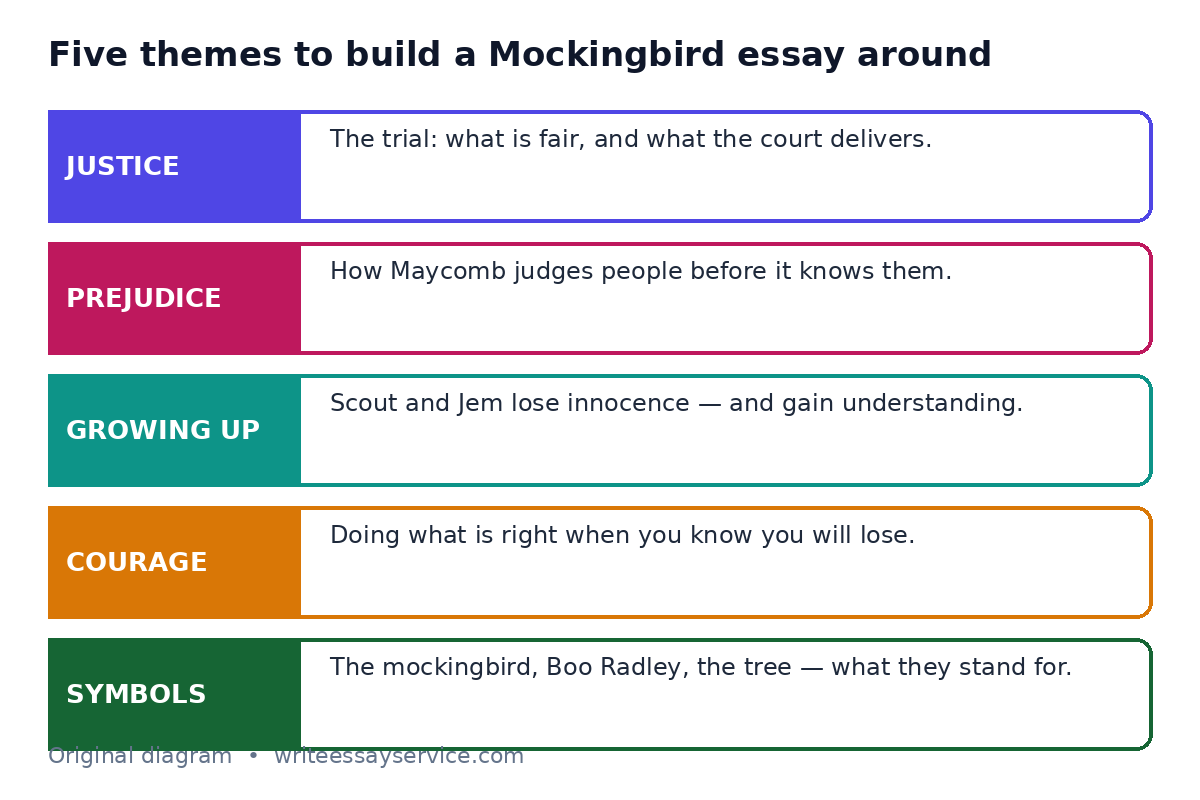
The trial of Tom Robinson is the novel's centre of gravity, and to kill a mockingbird essay questions on justice are among the most frequently set. These questions ask you to weigh law against morality, and to consider whether a fair process can exist inside an unfair society.
- Is the trial of Tom Robinson fair? Discuss with reference to the evidence, the jury and Atticus's closing argument.
Planning angle: Argue that the proceedings look orderly but the outcome is decided by prejudice before the trial begins; use Atticus's cross-examination of the Ewells and the evidence about Tom's injured arm to show how procedure and justice come apart. - "The law is not always just." How far does To Kill a Mockingbird support this view?
Planning angle: Take a measured position: the law gives Atticus a platform to speak for equality, yet it cannot protect Tom; contrast its formal language with the verdict and Tom's death to test the limits of legal justice. - How does Lee use the courtroom scenes to reveal the values of Maycomb?
Planning angle: Focus on who sits where, who speaks and who is believed; use the segregated balcony, the jury's composition, Scout's viewpoint from above, and the townspeople's reactions to show a community performing respectability while upholding inequality.
Mockingbird Essay Analysis: Prejudice and Racism
Prejudice in the novel is not confined to one villain. It runs through gossip, schoolyard talk, church life and the courtroom. A good mockingbird essay analysis of this theme traces how prejudice is learned, repeated and occasionally challenged, rather than treating it as a single character's flaw.
- How does Lee present racism in Maycomb, and how do different characters respond to it?
Planning angle: Compare responses across the town — Atticus's principled defence, Miss Maudie's quiet dissent, Alexandra's social codes, and the children's confusion — to argue that racism is shown as a shared system, not only as individual cruelty. - To what extent is Bob Ewell presented as a product of his society rather than simply as a villain?
Planning angle: Avoid excusing Ewell, but examine how poverty, status and the Ewells' place in Maycomb shape his actions; use his testimony, his threats after the trial and his attack on the children to weigh personal responsibility against social conditioning. - What is the significance of Calpurnia's double life between the Finch household and her own community?
Planning angle: Argue that Calpurnia reveals the boundaries Maycomb draws around race and class; use the visit to First Purchase Church, her code-switching, and Scout's surprise to show how the novel exposes the limits of the children's understanding.
To Kill a Mockingbird Themes Essay: Growing Up and Innocence
Scout narrates as an adult looking back, which lets Lee show childhood and hindsight at once. Questions in this group suit a to kill a mockingbird themes essay that tracks how innocence is lost gradually, through small disillusionments as well as one large injustice.
- How do Scout and Jem change over the course of the novel?
Planning angle: Chart change in stages — Scout's lessons at school and with Calpurnia, Jem's disillusionment after the verdict, and their final understanding of Boo Radley — to argue that growing up means learning to see other perspectives. - What does Scout learn from the women in her life, including Calpurnia, Miss Maudie and Aunt Alexandra?
Planning angle: Treat each woman as a different model of femininity and moral life; contrast Alexandra's emphasis on breeding and propriety with Maudie's independence and Calpurnia's authority, and show Scout testing each model before forming her own judgement. - Is childhood innocence presented as something valuable to protect, or as something that must be lost?
Planning angle: Take a nuanced line: Lee values children's moral clarity but shows that innocence without understanding cannot survive Maycomb; use the children's games about Boo, the trial, and the final scene on the Radley porch to argue that maturity replaces innocence with empathy.
Courage and Empathy in a Mockingbird Character Analysis Essay
Atticus's definition of courage — knowing you are beaten before you begin but beginning anyway — runs through the novel. These questions work well for a mockingbird character analysis essay because they ask you to test a character against an idea, rather than simply describing what that character does.
- "Real courage is when you know you're licked before you begin, but you begin anyway and you see it through no matter what." How is this idea explored through Atticus and Mrs Dubose?
Planning angle: Compare two very different kinds of courage: Atticus's public, principled stand in the trial and Mrs Dubose's private struggle to die free of morphine; use both to argue that Lee widens courage beyond physical bravery to include moral endurance. - How does Atticus teach his children empathy, and how successful is he?
Planning angle: Focus on his repeated advice to climb into another person's skin and walk around in it; test it against Scout's encounters with Miss Caroline, Boo Radley and Mayella Ewell, and judge where the children apply the lesson and where they still fail. - Is Atticus Finch a heroic figure, or does Lee present him with limitations?
Planning angle: Give a balanced evaluation: acknowledge his integrity, patience and defence of Tom, then consider criticisms — his faith in gradual change, his distance from the Black community's experience, and his protection of Boo at the end — to argue that Lee presents a principled man, not a flawless one.
Symbols in To Kill a Mockingbird: The Mockingbird and Boo Radley
Lee's symbols do analytical work: the mockingbird and Boo Radley focus the novel's questions about harm, protection and judgement. Link each symbol to a character and a theme, and explain how its meaning changes by the end.
- What is the significance of the mockingbird as a symbol in the novel?
Planning angle: Argue that the mockingbird stands for innocence that does no harm and therefore should not be harmed; connect Tom Robinson and Boo Radley through Miss Maudie's and Atticus's explanations, and show how the symbol turns a moral idea into a test for the reader. - How does Lee present Boo Radley, and how does the reader's understanding of him change?
Planning angle: Trace the shift from gothic rumour to human reality: the children's games and the town's stories, the gifts in the tree, the blanket during the fire, and the rescue and final walk home; argue that Boo's arc mirrors Scout's growth in empathy. - Why is the novel's ending — Scout standing on the Radley porch — important to its meaning?
Planning angle: Read the final scene as a summary of the novel's moral education: Scout finally sees the neighbourhood from Boo's point of view, literally and figuratively; use her reflection on the events from his perspective to argue that understanding, not punishment, is Lee's resolution.
If you are comparing set texts, the planning habits here transfer well. The same approach — question first, thesis second, evidence third — applies to The Great Gatsby essay questions, where symbols and social judgement also reward a focused, arguable reading.
Building a Thesis for a Mockingbird Essay
A thesis is a single, arguable sentence that answers the question and gives your essay direction. It is not a statement of fact, such as "the novel is set in the 1930s," and it should not simply repeat the question; it needs a claim you can defend with evidence.
Start by narrowing the question. "How does Lee present prejudice?" is too broad for one essay, so choose one mechanism — for example, the way children absorb prejudice from adults — and make that your focus. Then add your judgement: Lee shows prejudice as learned behaviour, passed on through language, gossip and social rules, rather than as a natural instinct.
Next, test your thesis against the evidence you plan to use. Can you support it with at least three well-chosen scenes, each analysed rather than summarised? If your thesis is about empathy, the scenes might be Scout's first day at school, the visit to First Purchase Church, and the final scene with Boo Radley. If one scene does not fit, refine the thesis rather than forcing the evidence.
Finally, organise your paragraphs around ideas, not events. Each paragraph should make one point that develops your thesis, introduce evidence, explain how that evidence supports the point, and link back to the question. A clear five-paragraph essay structure can help you keep that discipline when you are starting out, but longer essays should let the argument, not a fixed number of paragraphs, decide the shape.
FAQ
What are good to kill a mockingbird essay topics for a first essay on the novel?
Good to kill a mockingbird essay topics for a first essay are focused and arguable: how Scout and Jem change, what the mockingbird symbolises, or whether the trial is fair. Choose a question where you can name three scenes as evidence and take a clear position, rather than a broad topic such as "racism in the novel" with no angle.
How do I choose between to kill a mockingbird essay questions on justice and ones on growing up?
Match the question to the evidence you know best. Justice questions suit you if you can analyse the courtroom scenes closely, including Atticus's arguments and the jury's verdict. Growing-up questions suit you if you can trace change across the novel, from the children's games to the final scene.
How many quotations should I use in a Mockingbird essay?
Use a small number of short quotations, chosen for analysis rather than decoration. A phrase such as "climb into his skin" or "it's a sin to kill a mockingbird" is enough to anchor a paragraph, provided you explain what the wording reveals about character, theme or Lee's technique. Long quotations that repeat the plot weaken an essay; your own analysis should do most of the work.
How can I write a strong thesis for a to kill a mockingbird themes essay?
State a claim, a mechanism and a scope in one sentence — for example, that Lee presents growing up as innocence gradually replaced by empathy, shown through Scout's changing understanding of Boo Radley and her neighbours. Then check that each paragraph develops one part of that claim.
What is the best way to plan a mockingbird character analysis essay?
Begin with a judgement about the character, not a biography. Decide what you want to argue — for instance, that Atticus is principled but limited — then select scenes that test that judgement from different angles. Analyse what each scene shows about the character's values, choices and blind spots, and compare the character with another figure where the contrast sharpens your point.
Do I need to discuss the historical context of the 1930s in my essay?
Context helps when it explains a choice in the novel, but it should not replace analysis of the text. Mention the Depression-era South, segregation and the Scottsboro Trials only where they illuminate Lee's presentation — for example, why the jury's verdict would have been expected by Maycomb — and always return to how Lee uses that context in character, scene and language.