



Few novels appear on school essay lists as often as Jane Austen’s Pride and Prejudice. Published in 1813 and set among the landed families of Hertfordshire, it follows Elizabeth Bennet, her four sisters, and the two men whose pride and prejudice nearly keep them apart. Its lasting appeal is not only the romance, but the way it invites careful argument: about money, about how people judge each other, and about what a good marriage is actually for.
That density is also the challenge. Students often know the plot well but struggle to turn that knowledge into a focused argument, so a good pride and prejudice essay topics list is only half the job — the other half is knowing how to plan each question before writing a word. This guide gives you fifteen questions, each with an angle and a plan.
How to Plan a Pride and Prejudice Essay
Before you pick a question, learn the planning method that works for every set text.
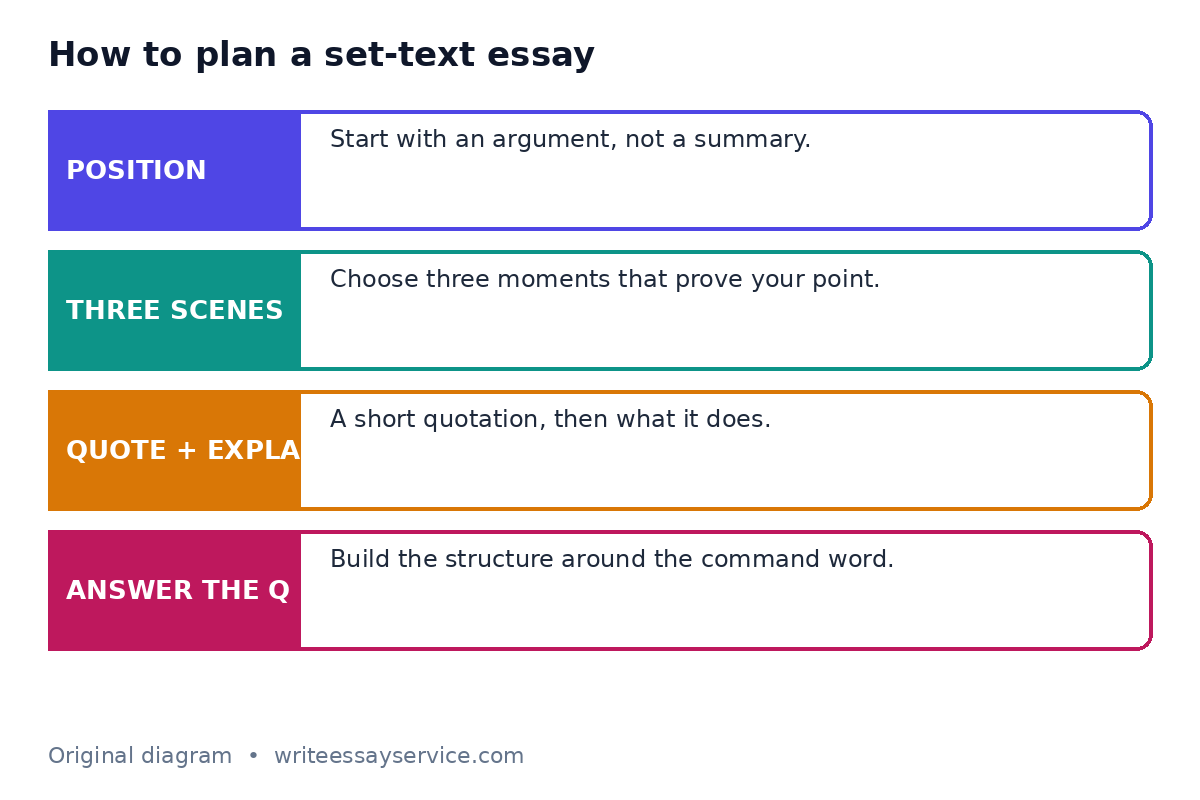
Start with a position, not a summary. A strong essay argues something: that Elizabeth’s prejudice is worse than Darcy’s pride, or that the novel’s marriages are really about money. If your plan is a list of plot points, you do not yet have an argument.
Choose three scenes, not ten. A good plan rests on three well-chosen moments, each proving one part of your argument. The proposal at Hunsford, the letter that follows, and the second proposal at Longbourn can carry an entire essay on pride — if you analyse them instead of retelling them.
Quote briefly, then explain. A short quotation — “It is a truth universally acknowledged” — earns marks only when you explain what it does: how Austen’s irony undercuts the sentence even as it states it. Quotation without analysis is decoration.
Answer the question asked. Every question below names its key word: “explore”, “to what extent”, “how far”. Plan your structure around that word, not around the novel in general. Our guide to how essays are marked, including command words and mark schemes explains what each command word asks you to do.
For the same planning method applied to other set texts, see our guides to The Great Gatsby and Macbeth.
Love and Marriage
1. “It is a truth universally acknowledged, that a single man in possession of a good fortune, must be in want of a wife.” Explore how Austen presents marriage in the novel.
The angle: The famous opening line is ironic — it is not a truth at all, but the neighbourhood’s assumption. Your essay should show how the novel tests that assumption through five very different marriages.
Plan: Open with the irony of the first sentence and what it reveals about the society. Then compare the marriages: Charlotte and Collins (prudence), Lydia and Wickham (passion without sense), Jane and Bingley (affection, easily shaken), and Elizabeth and Darcy (affection tested and earned). Conclude that Austen does not reject marriage for money — she rejects marriage for money alone.
2. To what extent is Elizabeth and Darcy’s marriage presented as ideal?
The angle: The novel ends with a happy marriage, but Austen shows us what it cost. The question asks you to weigh the ideal against the obstacles.
Plan: First, establish what makes the match work: mutual respect, honest self-knowledge, and Darcy’s changed behaviour. Then weigh the counter-evidence: Elizabeth’s fortune is small, Darcy’s pride is real, and the match depends on a great deal of luck. Conclude that the marriage is ideal not because it is perfect, but because both partners have earned it by changing.
3. Compare the marriages of Charlotte Lucas and Elizabeth Bennet. What does the comparison reveal about Austen’s views on marriage?
The angle: Charlotte marries for security; Elizabeth refuses to. The comparison is the novel’s central debate, not a side issue.
Plan: Present Charlotte’s case fairly — at twenty-seven, with no fortune, marriage to Collins is rational, and Austen lets her be content. Then present Elizabeth’s refusal of the same logic, and the risks she takes. Conclude that Austen respects Charlotte’s choice while admiring Elizabeth’s: the novel defends the right to choose, not one particular choice.
4. How does Austen use the character of Mr Collins to explore attitudes to marriage and social status?
The angle: Collins is comic, but he is also the novel’s clearest picture of how the marriage market works — a man who proposes as if offering a favour.
Plan: Analyse the proposal scene: Collins lists his reasons (Lady Catherine’s advice, his duty, his income) and never once mentions love. Then show how his marriage to Charlotte works precisely because both parties are honest about the bargain. Conclude that Collins is funny because he says aloud what the society quietly believes.
Pride and Prejudice
5. “Vanity and pride are different things.” Explore the difference between pride and prejudice in the novel.
The angle: Mary Bennet states the distinction early, and the novel spends the rest of its pages proving her right. Pride is about self-worth; prejudice is about judging without evidence.
Plan: Define both terms using Mary’s speech and Darcy’s own admission that he is “proud” but not vain. Show Darcy’s pride — in his family, his estate, his judgement — and Elizabeth’s prejudice — against Darcy, against Wickham’s story, against first impressions. Then show how the two faults interact: Darcy’s pride feeds Elizabeth’s prejudice, and her prejudice confirms his pride. Conclude that both must be corrected before either can see clearly.
6. How far is Elizabeth Bennet herself prejudiced?
The angle: Elizabeth is the heroine, but she is not the novel’s moral judge — she is its most prejudiced character for much of the book. The question asks you to judge her honestly.
Plan: Gather the evidence: her instant dislike of Darcy at the Meryton assembly, her uncritical belief in Wickham’s story, her refusal to hear evidence about him. Then weigh the correction: Darcy’s letter forces her to re-read everything she thought she knew, and her self-examination — “How despicably I have acted!” — is the novel’s turning point. Conclude that Elizabeth’s prejudice is real but curable, which is exactly why she is worth following.
7. To what extent does Darcy change in the course of the novel?
The angle: Darcy changes more than any other character — but the novel is careful to show that change is earned, not sudden.
Plan: Start with the Darcy of the assembly: rude, silent, contemptuous. Then trace the stages: the first proposal (still proud, and rejected for it), the letter (honesty at last), and his quiet help with Lydia (generosity without display). Conclude that Darcy does not become a different person — he becomes the person his better qualities always promised, once pride stops ruling them.
8. How does Austen present first impressions in the novel?
The angle: The novel’s working title was “First Impressions”, and nearly every judgement in it is wrong at first. The question asks you to show how Austen uses that pattern.
Plan: Collect the false first impressions: Darcy is proud and cold (partly true, mostly manners), Wickham is charming and honest (entirely false), Bingley is easily led (partly true), Caroline Bingley is a friend (false). Then show the novel’s method for correcting them: time, evidence and self-examination. Conclude that Austen’s point is not that first impressions are always wrong, but that they must be tested.
Class, Money and Society
9. Explore the importance of wealth and social class in Pride and Prejudice.
The angle: Money is the novel’s engine: the entail, the fortunes, the incomes. Every plot turn depends on who has how much.
Plan: Explain the entail that threatens the Bennet sisters with homelessness, and the incomes that define the men — Bingley’s £5,000 a year, Darcy’s £10,000. Show how class shapes behaviour: Lady Catherine’s authority, the Bingley sisters’ snobbery, Mrs Bennet’s panic. Then argue that Austen is not attacking wealth itself — she is attacking the way it is used to judge people. Conclude that the novel’s happy ending is also a financial one: Elizabeth marries wealth, but only after love has been proved.
10. How does Austen use the character of Lady Catherine de Bourgh?
The angle: Lady Catherine is the novel’s embodiment of rank — and its proof that rank does not make a person right.
Plan: Show her power: she controls Collins, dominates Rosings, and tries to control Darcy’s marriage. Then show her limits: her visit to Longbourn to forbid the match is the act that brings it about, because Elizabeth’s refusal to obey reveals her own strength. Conclude that Lady Catherine is both comic and serious — a joke about snobbery, and a warning about what happens when rank replaces judgement.
11. “Austen’s novels are about nothing but balls and marriages.” How far do you agree?
The angle: This is a trap question. The balls and marriages are the surface; underneath is a sharp social critique. Your job is to show the depth beneath the manners.
Plan: Concede the surface: the novel is full of balls, visits and proposals. Then show what Austen does with them: the ball is where reputations are made and broken, the proposal is a business negotiation, the visit is a power play. Use the entail, the militia, and Lydia’s elopement to show the real stakes — poverty, disgrace, ruin. Conclude that the manners are the subject, not the decoration: Austen writes about a world where a single social mistake can destroy a family.
Character and Reputation
12. How does Austen present Wickham? Is he simply a villain?
The angle: Wickham is charming, and that is the point. The question asks whether he is a simple villain or something more interesting — a man the novel uses to expose how easily charm replaces judgement.
Plan: Show the charm: his manners, his story, the way the whole neighbourhood believes him. Then show the reality: the debts, the elopement, the attempted seduction of Georgiana. Weigh the “simply a villain” claim: Wickham has no redeeming qualities, but his real function is to reveal Elizabeth’s prejudice and the society’s willingness to believe a handsome face. Conclude that he is a villain, but a useful one — the novel needs him to test its heroine.
13. Explore the relationship between Elizabeth and Jane Bennet.
The angle: Jane is Elizabeth’s opposite — trusting where Elizabeth is sceptical — and the novel uses the sisters to test both attitudes.
Plan: Show Jane’s goodness and its cost: her refusal to think ill of anyone leaves her defenceless against Caroline Bingley’s scheming. Show Elizabeth’s protection of her, and the sisters’ honesty with each other. Conclude that the novel values both sisters but endorses neither attitude alone: Jane must learn to judge, and Elizabeth must learn to trust.
14. How does Austen use irony in the novel?
The angle: Irony is Austen’s chief weapon — saying one thing and meaning another, or letting a character condemn themselves in their own words.
Plan: Start with the opening sentence, which states the opposite of the truth. Then collect examples: Mr Bennet’s dry remarks, Mrs Bennet’s confidence in her own judgement, Collins’s self-praise, Caroline Bingley’s flattery of Darcy. Show that the narrator’s irony and the characters’ self-deception work together — we see what the characters cannot. Conclude that irony is not decoration in Austen: it is how she tells the truth about a society that lies to itself.
15. “Elizabeth Bennet is Austen’s most independent heroine.” How far do you agree?
The angle: Elizabeth refuses two proposals, walks three miles through mud, and answers Lady Catherine to her face. The question asks whether that independence is real — or limited by the world she lives in.
Plan: Gather the evidence of independence: the refusals of Collins and Darcy, the muddy walk to Netherfield, the refusal to be intimidated. Then weigh the limits: her independence depends on a happy marriage in the end, she has no income of her own, and her rebellion stays inside the rules of her society. Conclude that Elizabeth is independent in mind and speech, but not in circumstance — and that this is exactly Austen’s point: intelligence and spirit matter, but in her world they need a little luck too.
Frequently Asked Questions
Which Pride and Prejudice essay question is easiest?
The marriage questions (1–4) are the most forgiving, because the novel gives you clear comparisons to work with — Charlotte against Elizabeth, Lydia against Jane. Start with one of those if you are new to the novel, and build your argument around the comparison.
How many quotations should I use in a Pride and Prejudice essay?
Three to five short quotations, each followed by analysis, will serve you better than ten dropped into the essay without comment. Choose quotations that do work: the opening line, Darcy’s first proposal, Elizabeth’s self-examination after the letter.
Can I write about the film adaptations?
Only if the question asks about them. In a literature essay, the novel is your evidence. Films can help you picture the scenes, but a marker wants your analysis of Austen’s words, not a director’s choices.
How do I avoid retelling the plot?
Plan your essay around an argument, not the story’s order. If a paragraph only tells the reader what happens next, cut it or rewrite it so that the scene proves a point. Ask of every scene: “What does this prove?” If the answer is “that the plot continues”, leave it out.
What is the difference between pride and prejudice in the novel?
Pride is an inflated sense of your own worth — Darcy’s belief that his family and fortune make him better than others. Prejudice is judging someone before you have the evidence — Elizabeth’s instant dislike of Darcy and her uncritical trust in Wickham. The novel shows both faults, and both characters must correct theirs before the story can end happily.